Economic growth in the recent past has been led by increase in labour activity.” Explain this statement. Suggest the growth pattern that will lead to creation of more jobs without compromising labour productivity.
Economic growth in the recent past has been led by increase in labour activity.” Explain this statement. Suggest the growth pattern that will lead to creation of more jobs without compromising labour productivity.
India’s GDP growth in recent decades has been supported more by an increase in labour activity (expansion of workforce and informal employment) rather than by productivity-led job creation. This explains the “job-poor” growth paradox where more people are working, but output per worker remains low.
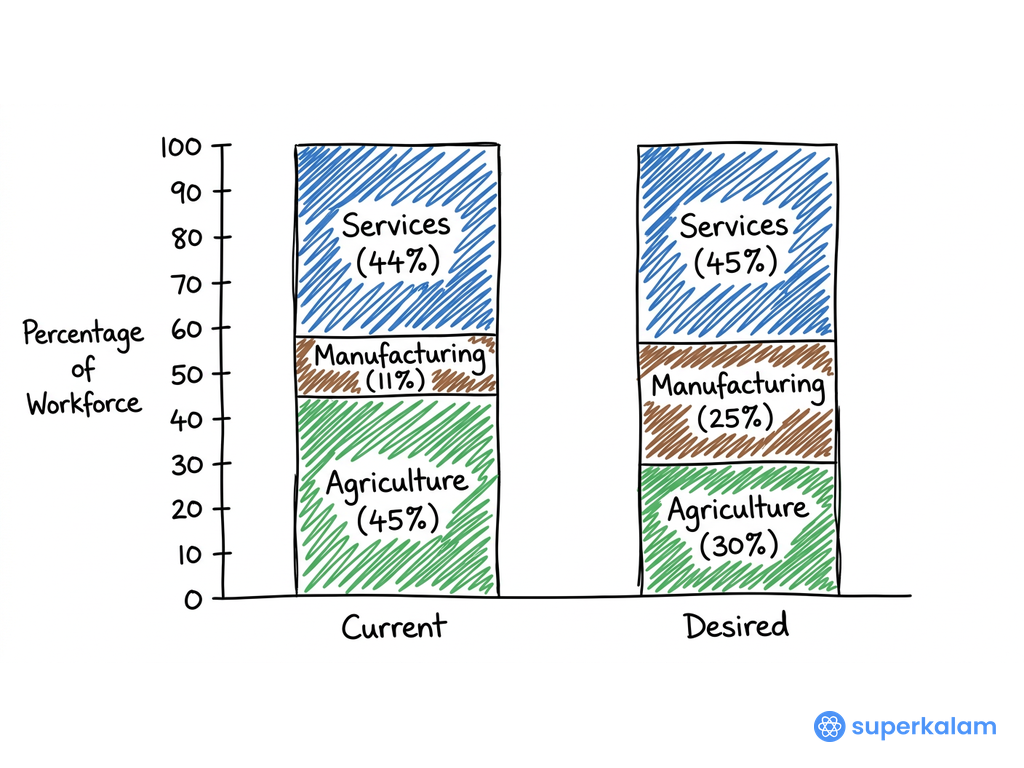
Employment Structure and Desired Growth Comparison
Why Growth is Being Led by Labour Activity
-
Construction Sector Absorption: NSSO data shows construction absorbed ~44% of new jobs (2000–2012), especially low-skilled rural migrants.
-
Services Sector Boom: Growth of retail, hospitality, logistics, IT-enabled services expanded labour demand.
-
Agriculture Dependence: Despite its falling GDP share (18%), agriculture employs ~45% workforce (PLFS 2022–23), showing growth is still “numbers-driven”.
-
Informalisation of Work: Gig economy (Ola, Zomato, Swiggy) added jobs, but mostly low-paying, insecure work.
-
Weak Manufacturing Employment: Manufacturing remains stagnant at 16–17% of GDP, failing to become a mass employer like in East Asia.
-
Labour Force Participation Rise: Urbanisation and migration led to more people working, but without proportionate rise in productivity.
Challenges of This Growth Pattern
-
Low Labour Productivity: According to ILO (2022), India’s labour productivity is less than 20% of OECD average, meaning output per worker is far below global peers.
-
Jobless or Job-poor Growth: Despite 6–7% GDP growth, employment elasticity of growth has declined to ~0.2 (CMIE data).
-
Underemployment and Precarious Work: Large sections of the workforce are engaged in subsistence farming, seasonal construction, and informal gig work, where incomes are low and uncertain.
Example: PLFS (2022–23) shows ~55% workers self-employed, often out of necessity, not entrepreneurship.
-
Income Inequality & Job Polarisation: High-skill service jobs (IT, finance) witness rapid wage growth, while low-skill jobs see stagnation.
Example: The World Inequality Report (2022) shows the top 10% hold 57% of national income, reflecting uneven job quality.
-
Informality Dominance: Over 80% of Indian workers remain in the informal sector with no social security, pensions, or health cover.
-
Female Labour Force Participation Gap: Women’s participation is only ~37% in rural areas and 25% in urban (PLFS 2022–23). Cultural barriers, lack of safety, and care responsibilities limit women’s access to quality work, wasting a massive demographic potential.
-
Regional Imbalances in Employment: Job creation is concentrated in urban hubs like Delhi-NCR, Bengaluru, Pune, while eastern states (Bihar, Jharkhand, Odisha) continue to export labour.
Growth Pattern Needed for Job Creation + Productivity
-
Labour-intensive Manufacturing Push:
-
Boost textiles, leather, toys, food processing – sectors with high employment elasticity.
-
China+1 strategy gives India a window to absorb global supply chain shifts.
-
-
Formalisation of Workforce:
-
Expand EPFO, ESIC coverage, enforce labour codes, and encourage MSME-to-formal transition.
-
Leads to higher productivity through training and better working conditions.
-
-
Skill Development & Human Capital Investment:
-
Leverage Skill India Mission and vocational training for sunrise sectors (EVs, green hydrogen, AI-driven services).
-
Align curricula with industry demand.
-
-
Balanced Regional Development: Promote labour-intensive clusters in Tier-2/3 cities. Example: textile clusters in Surat, Tiruppur.
-
Green Economy Opportunities: Renewable energy, waste management, and sustainable agriculture can create millions of jobs with rising productivity (ILO estimates 24 million green jobs globally by 2030).
-
Boosting Female Labour Force Participation:
-
India’s female LFPR is ~37% (PLFS 2022–23) vs. China’s 61%.
-
Expanding childcare, flexible work, and safety infrastructure will unlock huge labour potential.
-
India’s recent growth has been labour-activity driven but low in productivity gains. The way forward lies in a job-rich growth model that combines labour-intensive manufacturing, formalisation, skill upgrading, women participation, and green economy expansion for sustainable inclusive development.
Answer Length
Model answers may exceed the word limit for better clarity and depth. Use them as a guide, but always frame your final answer within the exam’s prescribed limit.
Evaluate this PYQ now
Write your answer & evaluate in just 60 seconds




500+ students evaluated
Model Answers from
- 2022Economy10 MarksView Answer
The increase in life expectancy in the country has led to newer health challenges in the community. What are those challenges and what steps need to be taken to meet them ?
- 2022Economy10 MarksView Answer
Elaborate the scope and significance of the food processing industry in India
- 2022Economy10 MarksView Answer
What are the major challenges of Public Distribution System (PDS) in India ? How can it be made effective and transparent ?
- 2022Economy10 MarksView Answer
Is inclusive growth possible under market economy ? State the significance of financial inclusion in achieving economic growth in India.
- 2022Economy10 MarksView Answer
Why is Public Private Partnership (PPP) required in infrastructural projects ? Examine the role of PPP model in the redevelopment of Railway Stations in India.
Model Answers by Subject


Crack UPSC with your
Personal AI Mentor
An AI-powered ecosystem to learn, practice, and evaluate with discipline