The increase in life expectancy in the country has led to newer health challenges in the community. What are those challenges and what steps need to be taken to meet them ?
The increase in life expectancy in the country has led to newer health challenges in the community. What are those challenges and what steps need to be taken to meet them ?
India’s life expectancy has increased from 32 years in 1947 to ~70 years in 2023 (World Bank), reflecting improved healthcare and living standards. However, an ageing population brings with it new health challenges, especially the rising burden of chronic diseases, geriatric care needs, and mental health issues.
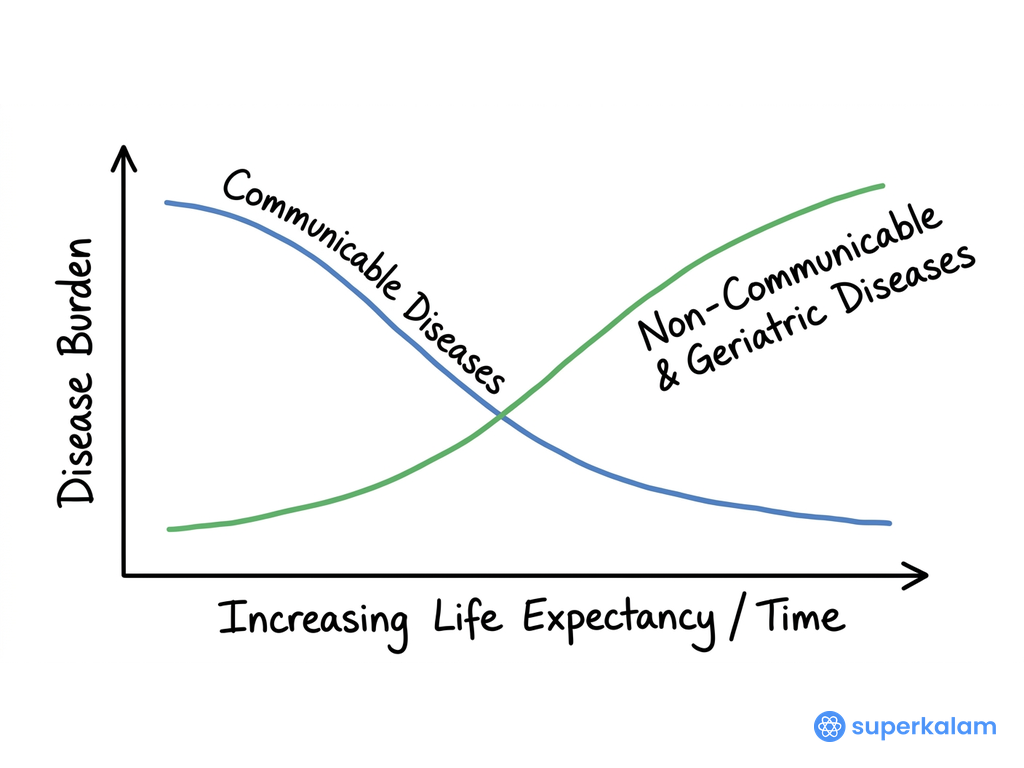
Epidemiological Transition and Increasing Life Expectancy
Challenges Emerging from Increased Life Expectancy
-
Rising Non-Communicable Diseases (NCDs): Elderly are more prone to cardiovascular diseases, diabetes, and cancer. NCDs account for 61% of all deaths in India (WHO).
-
Geriatric Care Burden: There is severe shortage of geriatric specialists (~350 for entire country).
Example: India has 149 million elderly (60+) in 2022, projected to be 19% by 2050 (UNFPA).
-
Mental Health Issues: Loneliness, dementia, and Alzheimer’s rising with urbanisation and nuclear families.
Example: According to National Mental Health Survey 1 in 20 elderly suffers from depression.
-
Health Financing Stress: Long-term care, palliative treatment, and medicines are expensive.
Example: Out-of-Pocket Expenditure (OOPE) = 48% of total health spending (NHA 2023).
-
Weak Social & Family Support Systems:
-
Decline of joint families, rise of migration → social neglect of elderly.
-
Only ₹200–500/month pension (NSAP), inadequate for survival.
-
-
Inadequate Infrastructure: Elderly-friendly infrastructure in hospitals is largely missing.
Example: Only 15% of districts have functional geriatric units (MoHFW 2022).
Steps to Meet the Challenges
-
Strengthen Preventive and Primary Care:
-
Expand Ayushman Bharat – Health & Wellness Centres for routine NCD screening.
-
Annual health check-ups for elderly.
-
Best Practice: Japan’s “Health Japan 21” preventive health model.
-
-
Expand Geriatric Healthcare Services:
-
Implement National Programme for Health Care of the Elderly (NPHCE) fully.
-
Mobile geriatric clinics in rural areas.
-
Best Practice: Sweden’s home-based elderly care system.
-
-
Enhance Mental Health Interventions:
-
Scale up Tele-MANAS and district mental health programmes.
-
Train ASHA workers in elderly counselling.
-
Best Practice: UK’s “Silver Line” helpline for elderly loneliness.
-
-
Health Financing & Insurance Reforms:
-
Expand Ayushman Bharat to cover long-term and outpatient elderly care.
-
Introduce elderly-specific insurance schemes.
-
Best Practice: Germany’s Social Health Insurance for long-term elderly care.
-
-
Develop Human Resources:
-
Introduce geriatrics in MBBS curriculum.
-
Incentivise private hospitals to set up geriatric wards.
-
Best Practice: USA’s Geriatric Workforce Enhancement Programme.
-
-
Leverage Technology:
-
Expand eSanjeevani tele-consultations for elderly.
-
Promote AI-based health wearables for monitoring.
-
-
Strengthen Social Security & Community Support:
-
Enhance pension schemes & expand Integrated Programme for Older Persons (IPOP).
-
Promote public–private partnerships for assisted living homes.
-
Best Practice: China’s Filial Piety Law mandating family responsibility.
-
Increased life expectancy is a demographic achievement, but it must translate into healthy ageing. India needs a shift from curative to preventive and community-based elderly care, supported by technology, insurance reforms, and stronger social security. Drawing from global best practices, India can ensure that longevity becomes a demographic dividend rather than a burden.
Answer Length
Model answers may exceed the word limit for better clarity and depth. Use them as a guide, but always frame your final answer within the exam’s prescribed limit.
Evaluate this PYQ now
Write your answer & evaluate in just 60 seconds




500+ students evaluated
Model Answers from
- 2022Economy15 MarksView Answer
Economic growth in the recent past has been led by increase in labour activity.” Explain this statement. Suggest the growth pattern that will lead to creation of more jobs without compromising labour productivity.
- 2022Economy10 MarksView Answer
Elaborate the scope and significance of the food processing industry in India
- 2022Economy10 MarksView Answer
What are the major challenges of Public Distribution System (PDS) in India ? How can it be made effective and transparent ?
- 2022Economy10 MarksView Answer
Is inclusive growth possible under market economy ? State the significance of financial inclusion in achieving economic growth in India.
- 2022Economy10 MarksView Answer
Why is Public Private Partnership (PPP) required in infrastructural projects ? Examine the role of PPP model in the redevelopment of Railway Stations in India.
Model Answers by Subject


Crack UPSC with your
Personal AI Mentor
An AI-powered ecosystem to learn, practice, and evaluate with discipline