Analyse the multidimensıonal challenges posed by external state and non-state actors, to the internal security of India. Also discuss measures required to be taken to combat these threats.
Analyse the multidimensıonal challenges posed by external state and non-state actors, to the internal security of India. Also discuss measures required to be taken to combat these threats.
India faces unprecedented internal security challenges from sophisticated external actors requiring comprehensive counter-strategies and technological modernization.
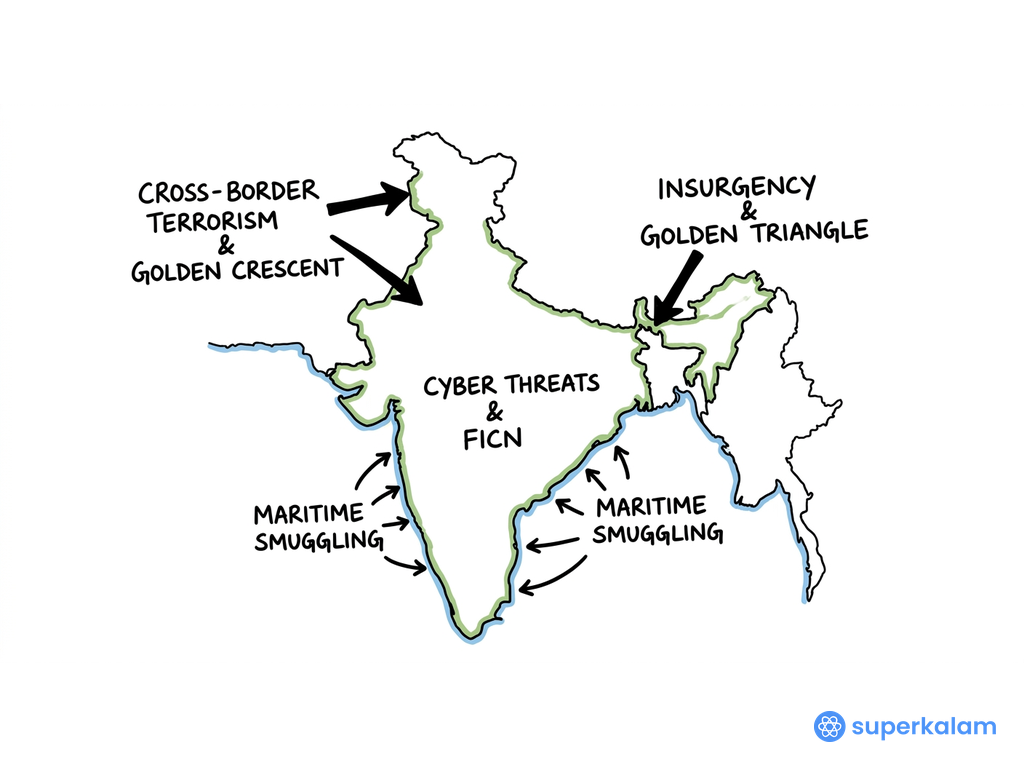
India's External Security Threats Outline Map
Challenges from External State Actors
- Territorial Aggression: China's Galwan Valley confrontations (2020) and ongoing LAC tensions demonstrate direct military threats to India's territorial integrity
- Cyber Warfare: Operation Sindoor (May 2025) witnessed 1.5 million cyberattacks targeting critical infrastructure, with 150 successful breaches of defense and financial systems
- Proxy Support: Pakistan's continued support to terrorist organizations through ISI networks, providing arms, training, and funding to destabilize Kashmir and other regions
- Economic Subversion: State-sponsored counterfeiting operations flooding Indian markets with fake currency notes worth ₹2,500 crore annually
- Information Warfare: Systematic disinformation campaigns targeting India's democratic processes and social cohesion through digital platforms
Challenges from External Non-State Actors
- Cross-Border Terrorism: Recent Pahalgam attack (April 2025) killing 26 civilians showcases persistent threats from Pakistan-based groups like Lashkar-e-Taiba and Jaish-e-Mohammed
- Transnational Crime: Golden Triangle drug trafficking routes through Myanmar-India border bringing narcotics worth ₹30,000 crore annually into Indian markets
- Cyber Criminal Networks: International hacking groups targeting Indian banking systems, with ₹1,200 crore losses reported in 2024
- Arms Smuggling: Sophisticated weapons trafficking through Bangladesh and Myanmar borders supplying insurgent groups in Northeast India
- Human Trafficking: Cross-border trafficking networks exploiting porous borders for forced labor and sexual exploitation
Counter-Measures Required
- Border Security Enhancement: Implementation of Comprehensive Integrated Border Management System (CIBMS) with smart fencing, thermal imaging, and drone surveillance across Pakistan and China borders
- Technological Upgradation: Development of indigenous cybersecurity capabilities through National Cyber Security Strategy 2025 and establishment of Indian Cyber Crime Coordination Centre
- Intelligence Modernization: Strengthening Research and Analysis Wing (RAW) and Intelligence Bureau with AI-powered threat assessment and predictive analytics
- International Cooperation: Enhanced intelligence sharing through Quad Security Partnership and bilateral frameworks with neighboring countries for coordinated counter-terrorism operations
- Institutional Strengthening: ₹1,09,037 crore allocation to Central Armed Police Forces (2024-25) for modernization and specialized training programs
Addressing these multidimensional threats requires India to develop robust defense mechanisms while maintaining democratic values. The National Security Strategy must integrate technological innovation with traditional security approaches to effectively counter evolving threats from both state and non-state actors.
Answer Length
Model answers may exceed the word limit for better clarity and depth. Use them as a guide, but always frame your final answer within the exam’s prescribed limit.
Evaluate this PYQ now
Write your answer & evaluate in just 60 seconds




500+ students evaluated
Model Answers from
- 2021Internal Security15 MarksView Answer
Analyse the complexity and intensity of terrorism, its causes, linkages and obnoxious nexus. Also suggest measures required to be taken to eradicate the menace of terrorism.
- 2021Internal Security10 MarksView Answer
Keeping in view India’s internal security, analyse the impact of cross-border cyber attacks. Also discuss defensive measures against these sophisticated attacks.
- 2021Internal Security10 MarksView Answer
Discuss how emerging technologies and globalisation contribute to money laundering. Elaborate measures to tackle the problem of money laundering both at national and international levels.
- 2021Internal Security10 MarksView Answer
How is the S-400 air defence system technically superior to any other system presently available in the world?
Model Answers by Subject


Crack UPSC with your
Personal AI Mentor
An AI-powered ecosystem to learn, practice, and evaluate with discipline



