Pala period is the most significant phase in the history of Buddhism in India. Enumerate.
Pala period is the most significant phase in the history of Buddhism in India. Enumerate.
The Pala period (8th-12th century CE) represents Buddhism's final golden age in India, transforming Bengal-Bihar into the global center of Buddhist learning and culture.
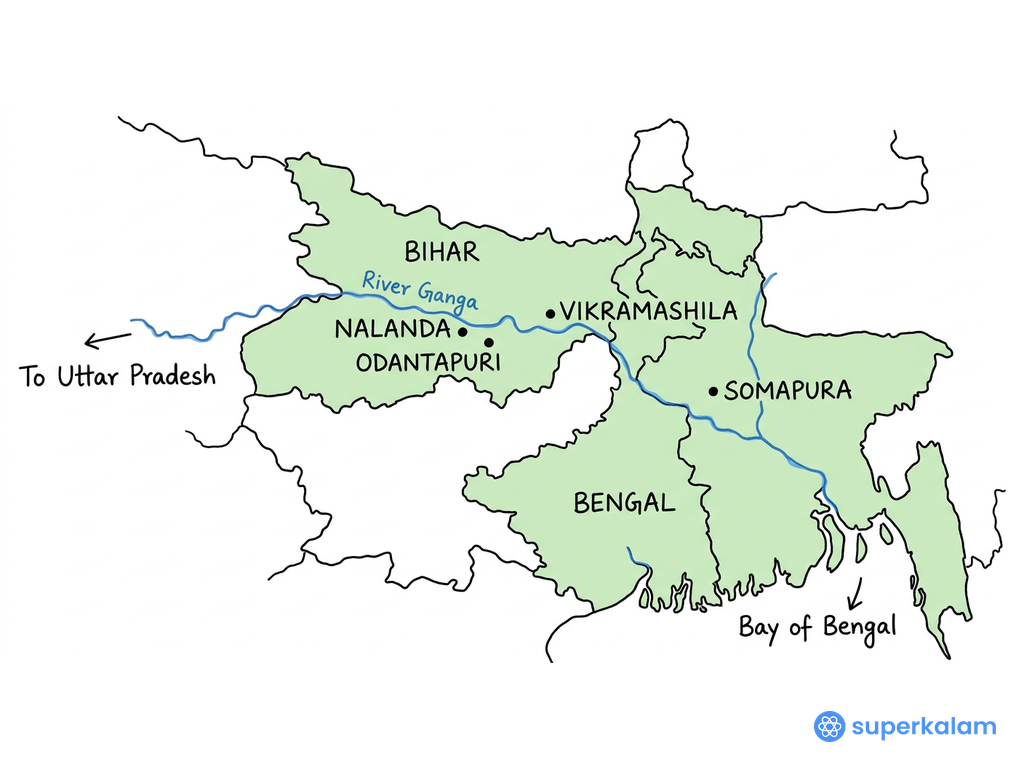
Eastern India Pala Buddhist Mahavihara Map
Institutional Development and Monastic Centers
- Nalanda University: Expanded into a massive complex with over 10,000 students and 2,000 teachers, becoming the world's premier Buddhist learning center
- Vikramshila University: Founded by Dharmapala (c. 783-820 CE), specialized in Tantric Buddhism and attracted scholars from Tibet and Southeast Asia
- Odantapuri Monastery: Served as a major center for Buddhist philosophy and debate, with extensive library collections
- Somapura Mahavihara: Constructed as the largest Buddhist monastery in the Indian subcontinent, now a UNESCO World Heritage Site
- Jagaddala University: Established as another significant center for advanced Buddhist studies and manuscript preservation
Literary and Philosophical Contributions
- Charyapada: Earliest Bengali literary work comprising mystical Buddhist songs, marking the beginning of vernacular Buddhist literature
- Tantric Buddhist Texts: Produced major works like Hevajra Tantra and Chakrasamvara Tantra that influenced Tibetan Buddhism
- Philosophical Treaties: Scholars like Śāntarakṣita wrote Tattvasaṃgraha, synthesizing Buddhist philosophy with contemporary thought
- Translation Movement: Systematic translation of Sanskrit Buddhist texts into Tibetan, preserving invaluable Buddhist literature
- Commentarial Literature: Extensive commentaries on Mahayana and Vajrayana texts that shaped Buddhist interpretation
Artistic and Architectural Excellence
| Artistic Element | Pala Contribution | Lasting Impact |
|---|---|---|
| Bronze Sculpture | Refined technique, intricate details | Influenced Tibetan and Southeast Asian art |
| Stone Carving | Sophisticated reliefs at Bodhgaya | Template for later Buddhist architecture |
| Manuscript Illumination | Palm leaf illustrations | Preserved Buddhist iconographic traditions |
| Architectural Style | Distinctive vihara design | Influenced monastery construction across Asia |
Cultural Exchange and International Influence
- Diplomatic Relations: Established strong ties with Srivijaya, Tibet, and China, facilitating Buddhist cultural exchange
- Missionary Activities: Sent Buddhist teachers like Atiśa to Tibet (1042 CE), revitalizing Tibetan Buddhism
- Trade Networks: Buddhist monasteries served as centers for international trade, spreading Buddhist culture along commercial routes
- Manuscript Preservation: Pala libraries preserved thousands of Buddhist texts later lost in India but surviving in Tibet and Nepal
- Artistic Dissemination: Pala artistic styles reached Java, Sumatra, and Burma through cultural missions
The Pala period's systematic institutional development, combined with unprecedented royal patronage under rulers like Dharmapala and Devapala, created the last great Buddhist renaissance in India. Their legacy in preserving and transmitting Buddhist knowledge to Tibet and Southeast Asia ensured Buddhism's survival beyond India's borders.
Answer Length
Model answers may exceed the word limit for better clarity and depth. Use them as a guide, but always frame your final answer within the exam’s prescribed limit.
Evaluate this PYQ now
Write your answer & evaluate in just 60 seconds




500+ students evaluated
Model Answers from
- 2020Art & Culture15 MarksView Answer
Persian literary sources of medieval India reflect the spirit of the age. Comment.
- 2020Art & Culture15 MarksView Answer
Indian Philosophy and tradition played a significant role in conceiving and shaping the monuments and their art in India. Discuss.
- 2020Art & Culture10 MarksView Answer
The rock-cut architecture represents one of the most important sources of our knowledge of early Indian art and history. Discuss.
Model Answers by Subject


Crack UPSC with your
Personal AI Mentor
An AI-powered ecosystem to learn, practice, and evaluate with discipline