India has immense potential for solar energy though there are regional variations in its developments. Elaborate.
India has immense potential for solar energy though there are regional variations in its developments. Elaborate.
India's abundant solar potential is transforming its energy landscape, with the country receiving approximately 4-7 kWh per square meter daily of solar radiation across different regions.
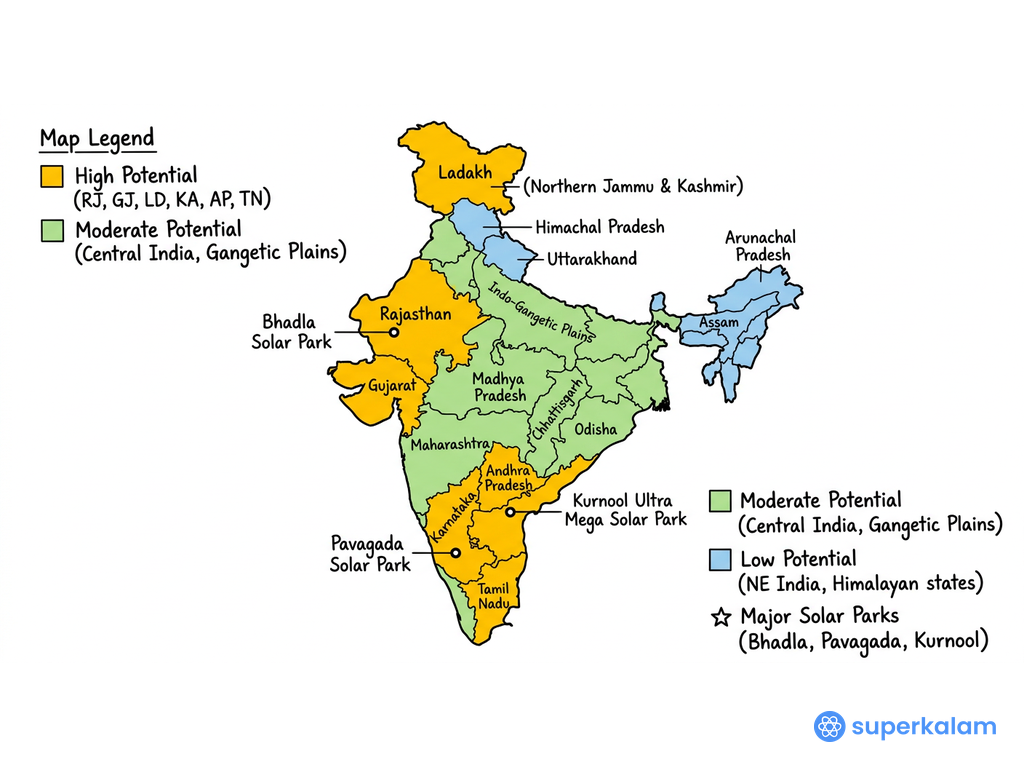
India solar energy potential outline map
India's Solar Energy Potential
- Geographic Advantage: Located between 8°4'N to 37°6'N latitude, India receives about 5,000 trillion kWh of solar energy annually with over 300 sunny days per year.
- Current Capacity: Achieved 75+ GW of installed solar capacity as of 2024, targeting 280 GW by 2030 under National Solar Mission.
- Land Availability: Possesses vast unused land areas, particularly in Rajasthan and Gujarat, suitable for large-scale solar installations.
- Government Support: Enhanced policies including Production Linked Incentive (PLI) scheme with ₹24,000 crore allocation for solar manufacturing.
- Cost Competitiveness: Solar tariffs have dropped to ₹1.99 per kWh in recent auctions, making it highly competitive with conventional sources.
Regional Development Variations
High Potential Regions
- Rajasthan: Leads with Bhadla Solar Park (2,245 MW) - world's fourth-largest solar park, receiving 5.5-6.5 kWh/m²/day
- Gujarat: Houses Charanka Solar Park and benefits from minimal cloud cover with 5.0-6.0 kWh/m²/day
- Madhya Pradesh: Rewa Solar Park (750 MW) demonstrates excellent solar irradiance of 5.5 kWh/m²/day
Moderate Potential Areas
- Maharashtra & Karnataka: Developing significant capacity despite moderate irradiance of 4.5-5.5 kWh/m²/day
- Andhra Pradesh & Telangana: Rapidly expanding with favorable state policies and 5.0-5.5 kWh/m²/day potential
Challenging Regions
- Northeastern States: Limited development due to high monsoon rainfall, cloud cover, and hilly terrain reducing irradiance to 3.5-4.5 kWh/m²/day
- Coastal Areas: Face humidity-related efficiency losses and space constraints despite moderate solar potential
Key Development Factors
| Factor | Impact | Regional Example |
|---|---|---|
| Solar Irradiance | Direct correlation with generation | Rajasthan > Northeast |
| Land Availability | Determines project scale | Desert regions advantageous |
| Grid Infrastructure | Affects project viability | Better in western/southern states |
| State Policies | Influences investment flow | Gujarat's early mover advantage |
India's National Solar Mission 2.0 and initiatives like PM-KUSUM for agricultural solar pumps are addressing regional disparities while maximizing the country's immense 748 GW theoretical solar potential across diverse geographical zones.
Answer Length
Model answers may exceed the word limit for better clarity and depth. Use them as a guide, but always frame your final answer within the exam’s prescribed limit.
Evaluate this PYQ now
Write your answer & evaluate in just 60 seconds




500+ students evaluated
Model Answers from
- 2020Indian Geography15 MarksView Answer
Examine the status of forest resources of India and its resultant impact on climate change.
- 2020Indian Geography15 MarksView Answer
The interlinking of rivers can provide viable solutions to the multi-dimensional inter-related problems of droughts, floods and interrupted navigation. Critically examine.
- 2020Indian Geography10 MarksView Answer
Account for the present location of iron and steel industries away from the source of raw material, by giving examples.
- 2020Indian Geography10 MarksView Answer
How will the melting of Himalayan glaciers have a far- reaching impact on the water resources of India?
Model Answers by Subject


Crack UPSC with your
Personal AI Mentor
An AI-powered ecosystem to learn, practice, and evaluate with discipline