The process of desertification does not have climate boundaries. Justify with examples.
The process of desertification does not have climate boundaries. Justify with examples.
Recent UNCCD reports indicate that desertification affects 1.5 billion people globally across diverse climatic zones, demonstrating its universal nature beyond traditional arid boundaries.
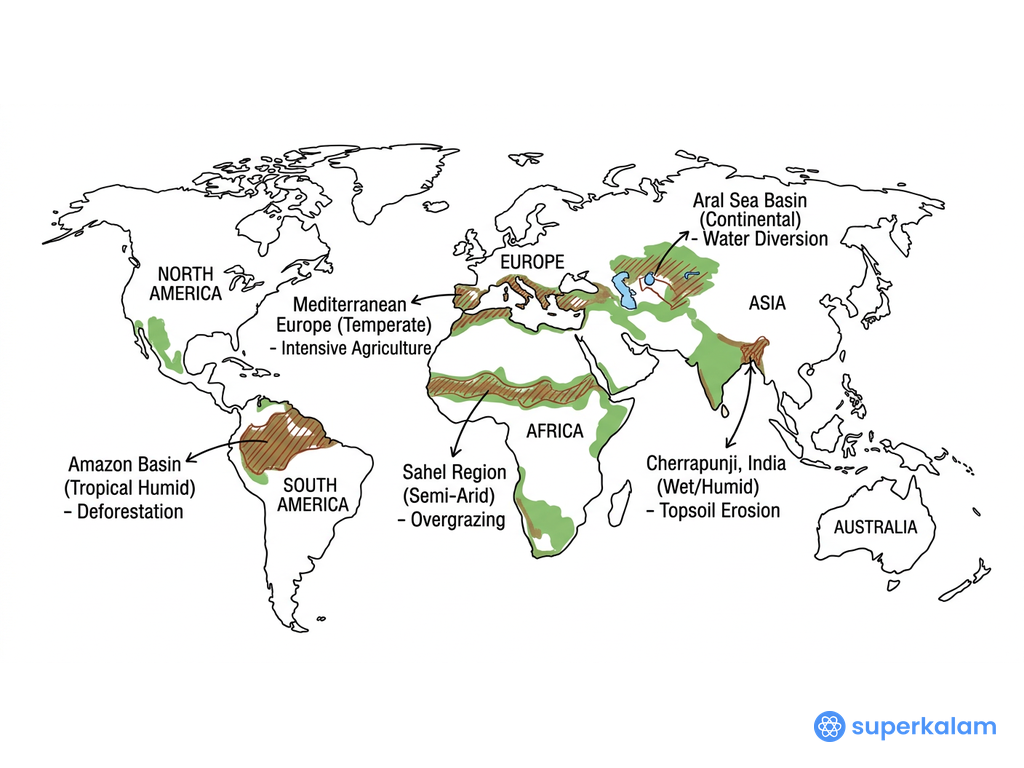
World Map of Desertification Across Climates
Desertification Across Climate Zones
Arid and Semi-Arid Regions
- Rajasthan, India: Wind erosion affects 56% of western areas while water erosion dominates 42% of southeastern parts, showing multiple degradation processes within same climate zone
- Sahel Region, Africa: Annual rainfall of 200-600mm still experiences severe land degradation due to overgrazing and poor farming practices
- Australian Outback: Despite low precipitation, mining activities and livestock overgrazing accelerate desertification processes
- Atacama Desert periphery: Human settlements create localized degradation despite extreme aridity
- Thar Desert margins: Intensive agriculture and groundwater depletion extend degradation beyond natural desert boundaries
Sub-Humid and Humid Regions
- Karnataka's Bellary District: 15.55% area (1,379 sq km) faces desertification despite 600-800mm annual rainfall due to iron ore mining
- Madagascar's Central Highlands: Receives 1,200mm rainfall annually but experiences severe soil erosion from slash-and-burn agriculture
- Northeast India: Jhum cultivation in high-rainfall areas (2,000mm+) causes rapid soil degradation and vegetation loss
- Brazilian Cerrado: Savanna ecosystem with 1,200-1,800mm rainfall faces desertification from soybean cultivation expansion
- Mediterranean Basin: Areas with 400-700mm rainfall experience land degradation from tourism and urbanization
| Climate Zone | Annual Rainfall | Primary Causes | Examples |
|---|---|---|---|
| Arid | <250mm | Wind erosion, overgrazing | Rajasthan, Sahel |
| Semi-Arid | 250-500mm | Water erosion, agriculture | Bellary, Australia |
| Sub-Humid | 500-1000mm | Mining, deforestation | Madagascar, Brazil |
| Humid | >1000mm | Shifting cultivation, urbanization | Northeast India, Mediterranean |
Universal Contributing Factors
- Human Activities: Overgrazing, deforestation, unsustainable agriculture, and mining create degradation regardless of climate
- Climate Change: Alters precipitation patterns and intensifies existing vulnerabilities across all zones
- Soil Characteristics: Poor soil structure and composition make any region susceptible to degradation
- Population Pressure: Drives unsustainable land use practices in both dry and wet regions
The National Action Programme to Combat Desertification (NAPCD) recognizes this climate-independent nature, addressing degradation across India's diverse climatic regions through integrated watershed management and sustainable land practices.
Answer Length
Model answers may exceed the word limit for better clarity and depth. Use them as a guide, but always frame your final answer within the exam’s prescribed limit.
Evaluate this PYQ now
Write your answer & evaluate in just 60 seconds




500+ students evaluated
Model Answers by Subject


Crack UPSC with your
Personal AI Mentor
An AI-powered ecosystem to learn, practice, and evaluate with discipline