Defining the blue revolution, explain the problems and strategies for pisciculture development in India.
Defining the blue revolution, explain the problems and strategies for pisciculture development in India.
The Blue Revolution represents India's comprehensive program to enhance aquaculture and fisheries productivity through scientific methods, technological integration, and sustainable resource management for achieving self-sufficiency in fish production.
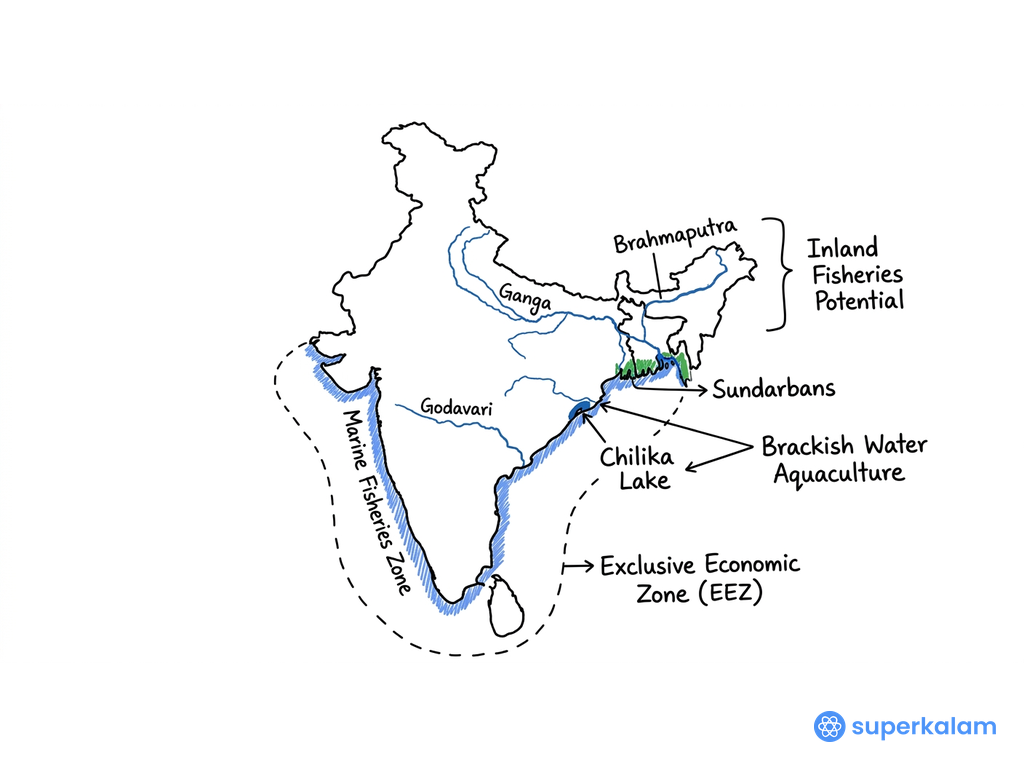
India Fisheries Potential Outline Map
Problems in Pisciculture Development
Environmental and Resource Constraints
- Water Pollution: Industrial effluents and agricultural runoff degrading aquatic ecosystems, affecting fish health and breeding
- Climate Impact: Rising temperatures altering fish migration patterns and spawning cycles
- Habitat Destruction: Wetland conversion and coastal development reducing natural breeding grounds
- Water Scarcity: Competition for freshwater resources between agriculture and aquaculture
- Disease Outbreaks: Viral and bacterial infections causing mass mortality in fish farms
Technical and Infrastructure Deficits
- Quality Seed Shortage: Limited availability of disease-resistant fish varieties and quality fingerlings
- Feed Quality Issues: Dependence on costly imported feed ingredients affecting production economics
- Processing Gaps: Inadequate cold storage facilities leading to 20-25% post-harvest losses
- Technology Access: Limited adoption of modern aquaculture techniques among small-scale farmers
- Research Limitations: Insufficient species-specific breeding and nutrition research
Socio-economic Challenges
- Credit Access: Limited institutional financing for aquaculture infrastructure development
- Market Linkages: Poor connectivity between producers and consumers, causing price volatility
- Skill Gaps: Lack of technical knowledge among traditional fishermen
- Insurance Coverage: Inadequate risk coverage for climate-related losses
- Land Rights: Unclear water body ownership affecting investment decisions
| Challenge Type | Impact Level | Primary Affected Regions |
|---|---|---|
| Water Pollution | High | Industrial corridors, urban areas |
| Technology Gap | Medium | Rural inland areas |
| Market Access | High | Coastal and remote regions |
Strategies for Pisciculture Development
Government Policy Framework
- Pradhan Mantri Matsya Sampada Yojana (PMMSY): ₹20,050 crore investment targeting 22 million tonnes fish production by 2024-25
- Fisheries Infrastructure Development Fund: Establishment of modern processing units and cold chain facilities
- Blue Economy Policy 2023: Integrated approach combining marine conservation with economic development
- National Fisheries Development Board: Coordinating research, extension services, and technology transfer
- Kisan Credit Card Extension: Financial support coverage extended to fishermen and aquaculture farmers
Technological and Scientific Interventions
- Biofloc Technology: Water recycling systems reducing production costs by 30-40%
- Cage Aquaculture: Utilizing reservoir and lake waters for intensive fish farming
- Integrated Farming: Combining fish production with poultry, agriculture, and livestock
- Genetic Improvement: Development of high-yielding fish varieties through selective breeding
- Digital Monitoring: IoT-based water quality management and disease surveillance systems
Sustainable Development Approaches
- Ecosystem-based Management: Balancing production with environmental conservation
- Community Participation: Formation of self-help groups and fishermen cooperatives
- Export Promotion: Quality certification and traceability systems for international markets
- Research Enhancement: Strengthening ICAR institutes and state fisheries universities
- Climate Resilience: Developing adaptive strategies for sea-level rise and temperature changes
The Odisha model demonstrates successful integration, achieving 8.5 lakh tonnes production in 2023-24 through scientific pond management and farmer training programs, positioning India as the world's second-largest aquaculture producer.
Answer Length
Model answers may exceed the word limit for better clarity and depth. Use them as a guide, but always frame your final answer within the exam’s prescribed limit.
Evaluate this PYQ now
Write your answer & evaluate in just 60 seconds




500+ students evaluated
Model Answers from
- 2018Indian Geography15 MarksView Answer
What is the significance of Industrial Corridors in India? Identifying industrial corridors, and explaining their main characteristics.
- 2018Indian Geography15 MarksView Answer
The ideal solution for depleting groundwater resources in India is a water harvesting system. How can it be made effective in urban areas?
- 2018Indian Geography10 MarksView Answer
Why is the Indian Regional Navigational Satellite System (IRNSS) needed? How does it help in navigation?
Model Answers by Subject


Crack UPSC with your
Personal AI Mentor
An AI-powered ecosystem to learn, practice, and evaluate with discipline



