Present an account of the Indus Water Treaty and examine its ecological, economic and political implications in the context of changing bilateral relations.
Present an account of the Indus Water Treaty and examine its ecological, economic and political implications in the context of changing bilateral relations.
The Indus Water Treaty (1960), mediated by the World Bank, remains one of the world's most successful transboundary water agreements despite evolving India-Pakistan relations and contemporary challenges.
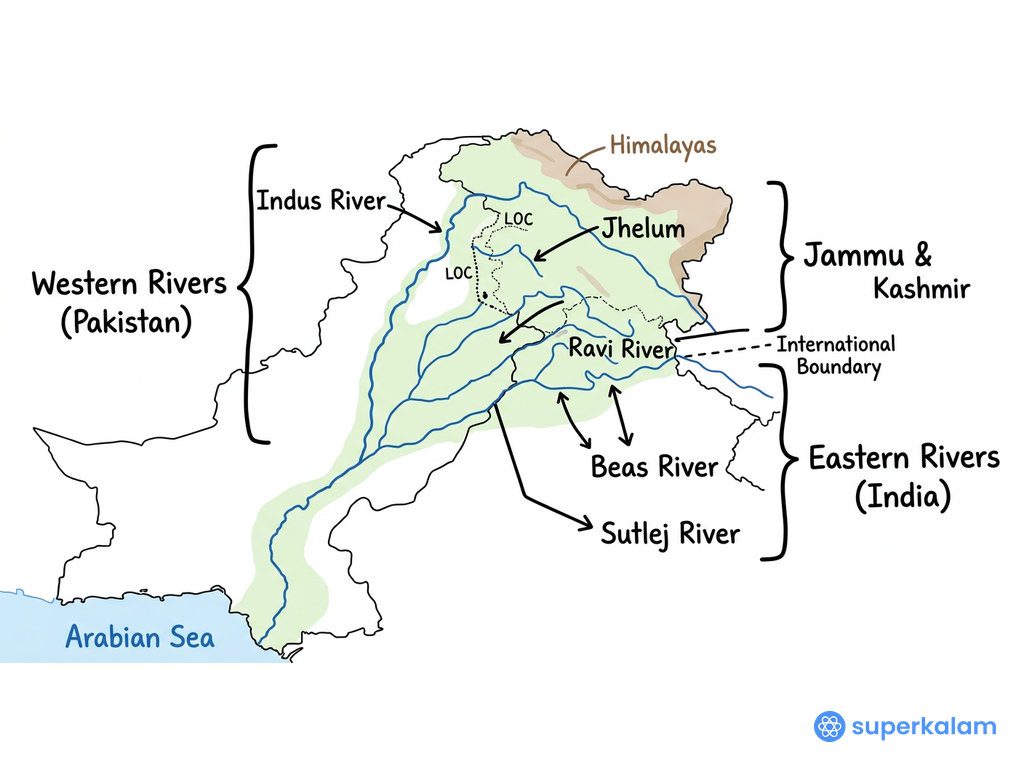
Indus River System Geographical Map
Overview of Indus Water Treaty
- Water Allocation: Eastern rivers (Ravi, Beas, Sutlej) to India; Western rivers (Indus, Chenab, Jhelum) to Pakistan
- Institutional Framework: Permanent Indus Commission with commissioners from both countries
- Dispute Resolution: Three-tier mechanism - bilateral talks, neutral expert, Court of Arbitration
- Key Provisions: India permitted limited use of western rivers for irrigation, hydroelectric generation, and domestic purposes
- World Bank Role: Continues as mediator and facilitator in dispute resolution
Ecological Implications
- River Flow Disruption: Construction of 330+ dams and barrages has altered natural flow patterns, with 90% of silt trapped behind structures
- Delta Degradation: Reduced freshwater flow to Indus Delta causing mangrove loss (80% decline since 1960s) and seawater intrusion up to 100 km inland
- Biodiversity Impact: Aquatic ecosystems severely affected; Indus River dolphin population reduced to less than 2,000
- Glacial Melt Effects: Climate change accelerating Himalayan glacial retreat, affecting long-term water availability
- Groundwater Depletion: Over-extraction leading to water table decline of 1-3 meters annually in Punjab regions
Economic Implications
- Agricultural Dependency: Treaty directly impacts 65% of Pakistan's irrigated agriculture and 25% of India's irrigated area
- Food Security: Indus basin supports 200 million people across both countries, producing major food crops
- Hydroelectric Potential: India's projects like Kishanganga (330 MW) and Ratle (850 MW) generating economic tensions
- Infrastructure Investment: Over $50 billion invested in water infrastructure projects by both nations since 1960
- Trade Impact: Water disputes affecting bilateral trade worth $2.4 billion annually (pre-2019 levels)
Political Implications in Changing Relations
- Post-2019 Escalation: Following Pulwama attack, India threatened treaty review, linking water security to terrorism concerns
- Diplomatic Tool: Water increasingly used as leverage in bilateral negotiations, moving beyond technical cooperation
- International Arbitration: Kishanganga and Ratle disputes brought to international forums, testing treaty mechanisms
- Domestic Politics: Water scarcity becoming electoral issue in both countries, pressuring governments for aggressive stances
- Strategic Competition: Treaty implementation affected by broader India-Pakistan strategic rivalry and regional power dynamics
The treaty's survival depends on depoliticizing water cooperation while adapting to climate realities and ensuring equitable development for both nations through modernized institutional frameworks.
Answer Length
Model answers may exceed the word limit for better clarity and depth. Use them as a guide, but always frame your final answer within the exam’s prescribed limit.
Evaluate this PYQ now
Write your answer & evaluate in just 60 seconds




500+ students evaluated
Model Answers by Subject


Crack UPSC with your
Personal AI Mentor
An AI-powered ecosystem to learn, practice, and evaluate with discipline



