It is said that India has substantial reserves of shale oil and gas, which can feed the needs of the country for a quarter century. However, tapping the resources doesn’t appear to be high on the agenda. Discuss critically the availability and issues involved.
It is said that India has substantial reserves of shale oil and gas, which can feed the needs of the country for a quarter century. However, tapping the resources doesn’t appear to be high on the agenda. Discuss critically the availability and issues involved.
India's pursuit of energy security has led to increased focus on unconventional hydrocarbon resources. According to recent estimates by the US Energy Information Administration, India possesses 96 trillion cubic feet of recoverable shale gas and 3.8 billion barrels of shale oil, potentially meeting energy needs for decades.
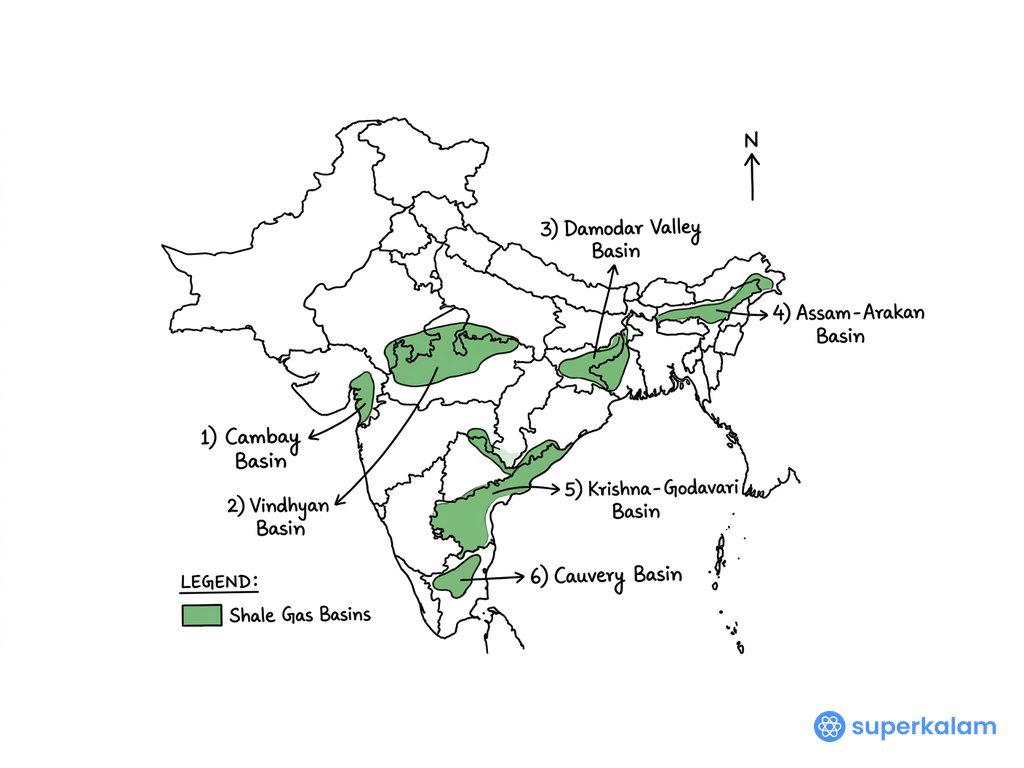
India's Major Shale Gas Basins Highlighted
Availability and Potential of Shale Resources
- Major Basins: Primary deposits located in Cambay Basin (Gujarat), Krishna-Godavari Basin (Andhra Pradesh), Cauvery Basin (Tamil Nadu), and Damodar Valley (Jharkhand-West Bengal)
- Resource Assessment: ONGC's preliminary studies indicate substantial reserves in Cambay Basin alone estimated at 26 trillion cubic feet
- Strategic Importance: Could reduce India's 85% crude oil import dependency and enhance energy security
- Policy Framework: Hydrocarbon Exploration and Licensing Policy (HELP) 2016 unified licensing for conventional and unconventional resources
- Current Status: ONGC and Oil India Limited conducting pilot projects in identified shale blocks
Issues and Challenges in Exploitation
-
Technological Barriers:
- Limited expertise in hydraulic fracturing (fracking) technology
- Lack of advanced horizontal drilling capabilities
- Inadequate processing and transportation infrastructure
- Dependence on foreign technology and equipment
-
Environmental Concerns:
- High water requirements (3-5 million gallons per well) in water-stressed regions
- Risk of groundwater contamination from chemical additives
- Potential for induced seismicity and air quality degradation
- Waste management challenges from flowback water
-
Economic Viability Issues:
- High extraction costs ($40-60 per barrel) compared to conventional oil
- Uncertain global energy prices affecting investment returns
- Competition from cheaper imported crude oil and LNG
- Limited private sector participation due to regulatory uncertainties
-
Regulatory and Land Acquisition Challenges:
- Complex environmental clearance procedures
- Land acquisition difficulties in densely populated areas
- Lack of comprehensive shale-specific regulations
- State vs. central government jurisdictional issues
Way Forward
India needs strategic technology partnerships with countries like the USA, streamlined regulatory frameworks, and comprehensive environmental impact assessments. The success of HELP policy implementation and initiatives like the National Exploration Licensing Policy will determine India's shale energy future while balancing economic benefits with environmental sustainability.
Answer Length
Model answers may exceed the word limit for better clarity and depth. Use them as a guide, but always frame your final answer within the exam’s prescribed limit.
Evaluate this PYQ now
Write your answer & evaluate in just 60 seconds




500+ students evaluated
Model Answers from
- 2013Indian Geography10 MarksView Answer
With the growing scarcity of fossil fuels, atomic energy is gaining more and more significance in India. Discuss the availability of raw materials required for the generation of atomic energy in India and the world.
- 2013Indian Geography5 MarksView Answer
Analyze the factors for the highly decentralized cotton textile industry in India.
- 2013Indian Geography5 MarksView Answer
Do you agree that there is a growing trend of opening new sugar mills in the Southern states of India? Discuss with justification.
- 2013Indian Geography5 MarksView Answer
There is no formation of deltas by rivers of the Western Ghats. Why?
- 2013Indian Geography5 MarksView Answer
Bring out the causes for more frequent landslides in the Himalayas than in the Western Ghats.
- 2013Indian Geography5 MarksView Answer
The recent cyclone on the east coast of India was called “Phailin”. How are the tropical cyclones named across the world? Elaborate.
Model Answers by Subject


Crack UPSC with your
Personal AI Mentor
An AI-powered ecosystem to learn, practice, and evaluate with discipline



