What are Rare Earth Elements? UPSC Mains GS Paper III Notes
Learn about Rare Earth Elements, their uses, global significance, India's reserves, government initiatives, challenges, and UPSC GS Paper III notes.
Jul, 2026
•7 min read
Rare Earth Minerals have emerged as one of the most strategically important resources in the 21st century. These critical minerals power modern technologies and strengthen national security. As countries compete to secure stable supply chains, Rare Earth Minerals have become a key geopolitical and economic issue.
Rare Earth Minerals are an important topic for UPSC under GS Paper III (Science & Technology, Economy, Environment, and Internal Security). The topic frequently appears in current affairs due to India's Critical Minerals Mission, global supply chain concerns, and China's dominance in rare earth processing.
Here, you will understand what Rare Earth Minerals are, their classification, properties, uses, global distribution, India's rare earth reserves, recent developments, challenges, and their relevance for UPSC Prelims and Mains.
What are Rare Earth Elements (REE)?
Rare Earth Elements (REE) are a group of 17 chemically similar metallic elements, comprising the 15 lanthanides along with scandium and yttrium. Despite their name, these elements are not truly rare in the Earth's crust. However, they are rarely found in high concentrations, making their extraction and processing technically challenging and economically expensive.
Yttrium was the first rare earth element to be discovered, Cerium is the most abundant rare earth element, and Thulium is the rarest naturally occurring rare earth element. These metals have unique properties like being magnetic, conducting electricity well, and glowing under certain conditions.

Why Are They Called "Rare"?
The term "rare earth" is somewhat misleading. Rare Earth Elements (REEs) are not actually scarce in the Earth's crust. For instance, cerium is more abundant than copper. They are called "rare" because of how they were discovered and the challenges involved in their extraction.
The name originated for the following reasons:
- Discovered in Rare Minerals: REEs were first identified during the 18th and 19th centuries in uncommon mineral deposits, leading scientists to consider them "rare."
- Difficult to Extract: Although widely distributed, REEs are rarely found in economically viable concentrations, making their mining and processing complex and expensive.
- Chemically Similar Properties: The elements have nearly identical chemical characteristics, making them extremely difficult to separate and purify using the technology available at the time.
- Historical Terminology: Despite advances in geology and extraction techniques, the term "rare earth" has remained in scientific and industrial use for over two centuries.
Types of Rare Earth Elements and Their Uses
Rare Earth Elements (REEs) are classified into 17 elements, each possessing unique physical and chemical properties that make them indispensable for modern technology, clean energy, healthcare, defence, and industrial manufacturing.
| S. No. | Element | Symbol | Major Uses |
|---|---|---|---|
| 1 | Cerium | Ce | Car exhaust catalytic converters, glass polishing, and self-cleaning ovens |
| 2 | Lanthanum | La | Camera lenses, rechargeable batteries, and petroleum refining |
| 3 | Neodymium | Nd | High-strength magnets for hard drives, electric vehicle motors, and wind turbines |
| 4 | Praseodymium | Pr | Aircraft engines, permanent magnets, lasers |
| 5 | Samarium | Sm | High-temperature magnets, nuclear reactor control rods |
| 6 | Europium | Eu | Red phosphors in television and display screens, energy-efficient lighting |
| 7 | Dysprosium | Dy | Electric vehicle motors, wind turbine magnets, and high-performance magnets |
| 8 | Terbium | Tb | Green phosphors in display screens, laser technology |
| 9 | Yttrium | Y | LED lights, cancer treatment medicines, and superconductors |
| 10 | Gadolinium | Gd | MRI contrast agents, computer memory chips, nuclear reactors |
| 11 | Erbium | Er | Fibre optic communication, infrared devices, lasers |
| 12 | Holmium | Ho | Nuclear reactor control rods, high-strength magnets |
| 13 | Thulium | Tm | Portable X-ray machines, laser equipment |
| 14 | Ytterbium | Yb | Industrial lasers, earthquake monitoring instruments |
| 15 | Lutetium | Lu | PET medical scans, petroleum refining catalysts |
| 16 | Scandium | Sc | Aerospace components, sports equipment, aluminium alloys |
| 17 | Promethium | Pm | Nuclear batteries, thickness gauges, specialised research applications |
Note: Promethium (Pm) is the only naturally radioactive rare-earth element and is extremely rare. It is primarily used in specialised scientific and industrial applications.
Also see: Oil Reserves in India | UPSC Notes
India's Position in Rare Earth Elements
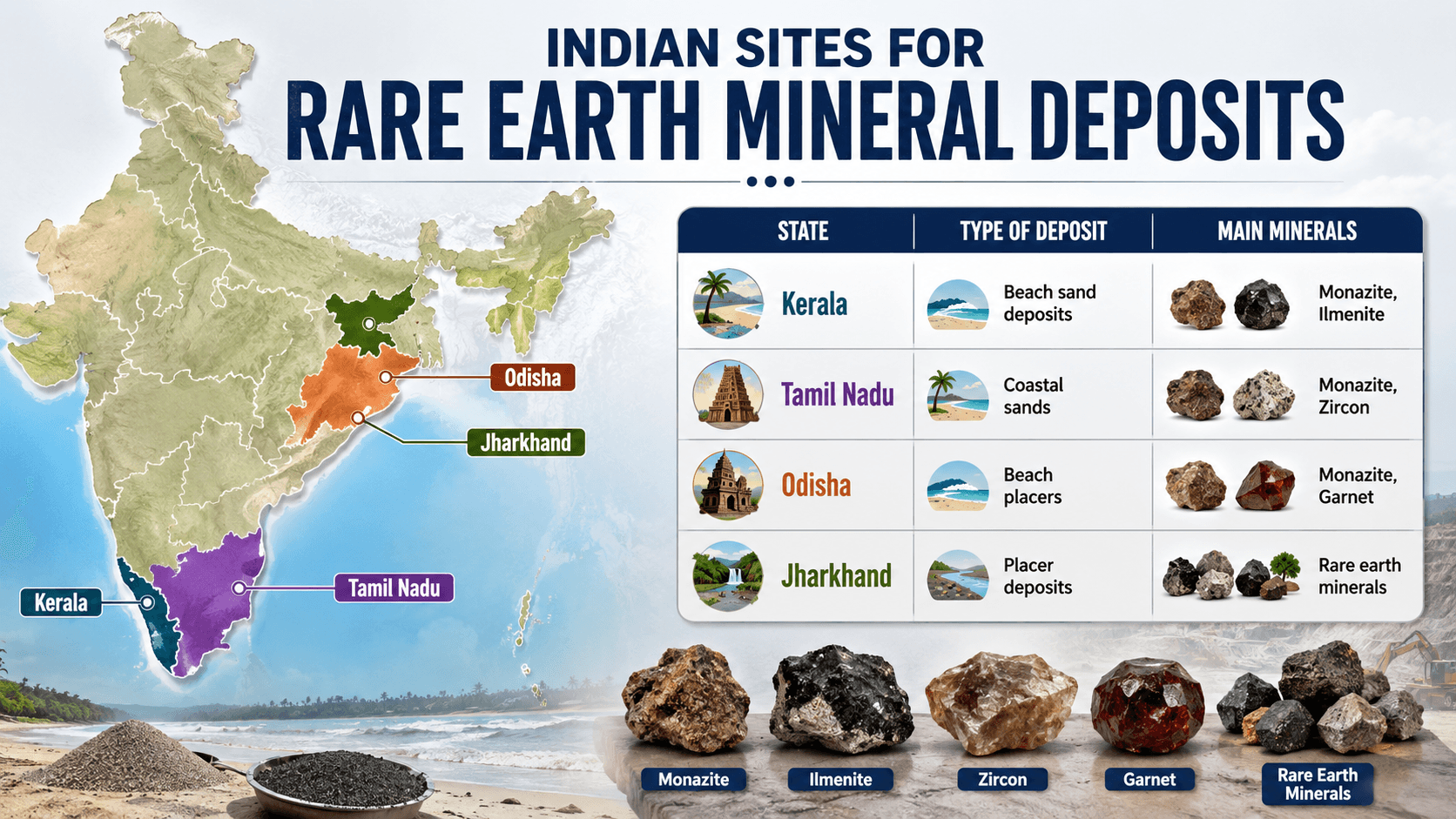
India holds the fifth-largest rare earth reserves globally, estimated at 6.9 million metric tonnes, though it was only able to produce 2,900 metric tonnes in 2023. Key challenges include:
- State Monopoly and Regulatory Barriers: The rare earth sector in India operates under a state monopoly, with IREL being the primary entity. Monazite, the main source of rare earths in India, is classified as an atomic mineral due to its thorium content, resulting in stringent regulatory controls by the Department of Atomic Energy. This monopolistic control has led to a lack of innovation.
- Slow Process: India can extract rare earth oxides but lacks downstream processing capabilities to create value-added products like permanent magnets. The technology to extract neodymium from rare earth chlorides is currently held by Japan and China
- Import Dependence: India imports an estimated 4,010 metric tonnes of rare earth elements in 2025, which will increase to 8,220 metric tonnes by 2030. More than 95% of imports are from China.
- Regulatory Constraints: Monazite, India's principal source of REE, has been an atomic mineral, limiting private industry participation. Such materials can only be mined and processed by state-owned IREL at present.
Cover this important topic here: Reducing Carbon Emissions in India's Industrial Sector
India's Position in Rare Earth Elements (REEs)
Despite possessing the world's fifth-largest rare earth reserves (around 6.9 million metric tonnes), India remains a relatively small producer in the global market. In 2023, India produced only about 2,900 metric tonnes of rare earth elements, highlighting the gap between its resource potential and production capacity.
As the demand for critical minerals grows with the expansion of electric vehicles, renewable energy, and defence technologies, strengthening India's rare earth ecosystem has become a strategic priority.
Key Challenges Facing India's Rare Earth Sector
1. State Monopoly and Limited Private Participation
- Rare earth mining and processing in India are largely controlled by IREL (India) Limited.
- Monazite, India's primary rare-earth-bearing mineral, contains thorium and is classified as an atomic mineral, bringing it under the regulatory control of the Department of Atomic Energy (DAE).
- These restrictions have limited private sector participation, competition, and technological innovation.
2. Weak Downstream Processing Capabilities
- India has the capacity to extract rare earth oxides, but lacks advanced facilities to manufacture high-value products such as permanent magnets, alloys, and electronic components.
- Critical technologies for processing elements like neodymium and dysprosium remain concentrated in countries such as China and Japan, increasing India's technological dependence.
3. High Import Dependence
- Despite abundant reserves, India continues to rely heavily on imports to meet industrial demand.
- Rare earth imports are projected to rise from about 4,010 metric tonnes in 2025 to over 8,220 metric tonnes by 2030.
- More than 95% of these imports come from China, creating significant supply chain and geopolitical risks.
4. Regulatory and Policy Constraints
- The classification of monazite as an atomic mineral has restricted its commercial mining and processing.
- At present, IREL (India) Limited remains the primary entity authorised to mine and process monazite, limiting investment, capacity expansion, and faster development of the sector.
Must read: Ethanol Blending in India: E20 Benefits & Challenges (UPSC)
India's Rare Earth Policy and Government Initiatives
India has taken several policy measures to strengthen its critical minerals ecosystem. Recent reforms focus on expanding exploration, encouraging private participation, improving domestic production, and reducing import dependence, particularly on China.
1. Amendments to the Mines and Minerals (Development and Regulation) Act, 1957
The MMDR Act has undergone key amendments to promote investment and improve the mining sector.
MMDR Amendment, 2021
The 2021 reforms aimed to make India's mining sector more competitive and investment-friendly by:
- Removing the distinction between captive and merchant mines allows greater operational flexibility.
- Permitting mining companies to sell up to 50% of their mineral production in the open market improves commercial viability.
- Simplifying the transfer of mining leases and rights, making it easier for companies to invest and operate.
MMDR Amendment, 2023
The 2023 amendment marked a major shift in India's critical minerals policy by:
- Officially identifying Rare Earth Elements (REEs) among India's critical minerals.
- Empowering the Central Government to auction mining leases for critical minerals, ensuring faster and transparent allocation.
- Introducing Exploration Licences (ELs) to encourage private companies and foreign investors to undertake high-risk mineral exploration.
- Creating a stronger policy framework to enhance domestic production and secure long-term mineral supplies.
2. National Critical Mineral Mission (NCMM)
Launched as a strategic initiative, the National Critical Mineral Mission (NCMM) aims to build a resilient and self-reliant critical minerals sector. Key highlights include:
- Budget Allocation: ₹16,300 crore for the period 2024-25 to 2030-31.
- Exploration Target: Around 1,200 critical mineral exploration projects across the country.
- Self-reliance Goal: Achieve greater domestic production and reduce import dependence for at least 15 critical minerals, including rare earth elements.
- Global Resource Security: Acquire 50 overseas mineral assets to ensure a stable supply of critical minerals for India's industries.
3. Expansion of Mineral Exploration
India has significantly intensified geological exploration to identify new deposits of rare earth and other critical minerals.
- The Geological Survey of India (GSI) increased its critical mineral exploration projects from 118 in 2021-22 to 195 in 2024-25.
- Under the National Critical Mineral Mission, GSI has been entrusted with 1,200 exploration projects between 2024-25 and 2030-31.
These efforts are expected to improve the discovery of new mineral deposits, strengthen domestic supply chains, and support industries such as renewable energy, semiconductors, electric mobility, and defence manufacturing.
Way Forward
As Rare Earth Elements (REEs) become critical for clean energy, advanced manufacturing, and national security, India must strengthen its domestic capabilities while ensuring sustainable resource management. Key priorities include:
- Increase exploration, develop refining facilities, and build a complete rare earth value chain to reduce import dependence.
- Simplify regulations, promote public-private partnerships, and attract investment in mining and downstream industries.
- Develop indigenous extraction technologies and promote recycling of rare earths from electronic waste.
- Secure overseas mineral assets and diversify supply chains through strategic collaborations such as the Minerals Security Partnership (MSP) and the Quad.
- Adopt environmentally responsible mining practices with effective waste management and ecological restoration.
Start your UPSC Preparation 2027 with SuperKalam
SuperKalam is your personal mentor for UPSC preparation, guiding you at every step of the exam journey. Practice, revise, and evaluate– all in one place.
Download Now