Oil Reserves in India | UPSC Notes
Oil reserves are recoverable crude oil deposits. Get complete UPSC notes on India’s oil reserves, distribution, strategic petroleum reserve, policies, and challenges for GS Paper III.
Jan, 2026
•8 min read
Oil plays a critical role in India’s economic growth, industrial development, and national security. Despite having vast sedimentary basins, India meets only 15–18% of its crude oil demand through domestic production, while the remaining requirement is fulfilled through imports from West Asia, Russia, and Africa.
Understanding Oil Reserves in India is crucial for the UPSC Prelims and Mains under Indian Geography, Economy, Energy Security, and Environment.
Let's study this topic in detail!
What Are Oil Reserves?
Oil reserves refer to the amount of crude oil that can be technically extracted and economically produced from known petroleum deposits using current technology, prevailing prices, and regulatory conditions.
In India, oil reserves are primarily located in sedimentary basins. They were formed over millions of years through the accumulation and transformation of organic matter under high pressure and temperature. Oil Reserves are strategically important for India due to:
- Rising energy demand
- High import dependence
- Vulnerability to geopolitical crises
- Economic and fiscal stability
- National security and energy security
Key Facts:
- India has 26 sedimentary basins covering about 3.36 million square kilometres, accounting for nearly one-third of the country’s total geographical area.
- Only around 10–15% of these basins have been explored in detail, indicating significant untapped hydrocarbon potential.
- Major oil reserves are concentrated in offshore regions (Mumbai High) and onshore basins such as Assam, Gujarat, and Rajasthan.
- The remaining 80%+ crude oil requirement is met through imports, making oil reserves a strategic concern for energy security.
Formation of Petroleum (Mineral Oil)
Petroleum, also called mineral oil, is formed through a long geological process. Let's understand!
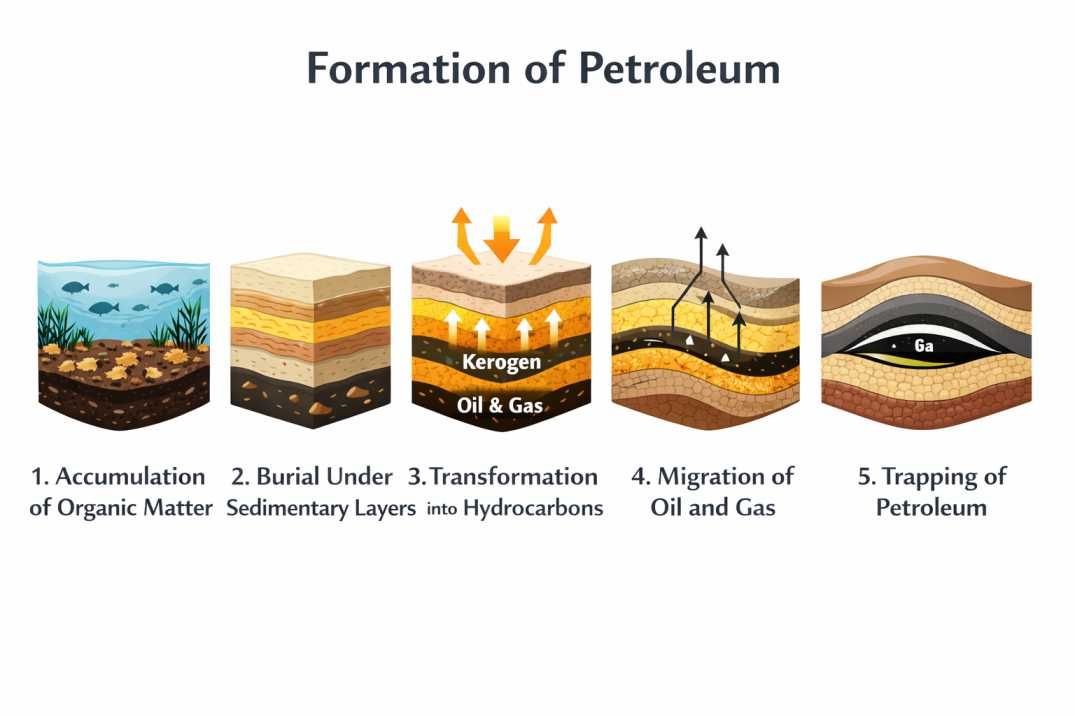
1. Accumulation of Organic Matter
Tiny marine plants and animals (plankton) died and settled at the bottom of seas and oceans. Over time, this organic matter mixed with sand, silt, and clay in oxygen-poor environments, preventing complete decomposition.
2. Burial Under Sedimentary Layers
Continuous deposition of sediments buried the organic-rich layers deeper underground. This increased pressure and temperature gradually.
3. Transformation into Hydrocarbons
Under high pressure and temperature over millions of years, the buried organic matter was chemically transformed into hydrocarbons (oil and natural gas). This transformation mainly occurs in a temperature range known as the “oil window” (60°C–120°C).
4. Migration of Oil and Gas
The formed petroleum migrated from source rocks to nearby porous and permeable reservoir rocks such as sandstone and limestone.
5. Trapping of Petroleum
Oil and gas accumulated beneath impermeable cap rocks (like shale), forming oil reservoirs. Structural features such as anticlines, fault traps, and salt domes play a crucial role in trapping petroleum.
Why Sedimentary Basins Are Important
- Petroleum is found only in sedimentary basins
- The presence of source rock, reservoir rock, and cap rock is essential
- It explains why major oil reserves in India are confined to Assam, Gujarat, Rajasthan, and offshore basins
Constituents of Petroleum and Mineral Oil
The major constituents of petroleum and mineral oil can be clearly understood from the table below, which shows their composition and relative proportions.
| Component | Percentage | Description |
|---|---|---|
| Hydrocarbons | 90–95% | Alkanes, cycloalkanes, aromatic hydrocarbons |
| Organic compounds | 5–10% | Oxygen, nitrogen, sulphur compounds |
| Organo-metallic compounds | Trace | Vanadium, nickel |
| Minor impurities | Trace | Affect refining and emissions |
Distribution of Oil Reserves in India
India has 26 sedimentary basins covering nearly 3.36 million sq km, but only a part has been explored so far.
1. Assam – Brahmaputra Valley
- Assam is the oldest oil-producing state in India.
- Oil-bearing strata extend over 320 km
- Oil occurs in Tertiary sedimentary rocks
- Trapped in anticlines and fault structures
Major Oilfields
- Digboi (the oldest oilfield in India)
- Naharkatiya
- Moran–Hugrijan
Refineries: Digboi, Guwahati, Bongaigaon, Barauni
2. Gujarat – Cambay Basin
The Cambay (Khambhat) Basin is one of the most productive onshore regions.
- Well-developed pipeline network
- Oil is transported to Koyali and Trombay refineries
Major Oilfields
- Ankleshwar (most productive)
- Kalol
- Mehsana
- Sanand
- Nawgam
3. Rajasthan – Barmer–Sanchor Basin
Rajasthan is currently India’s largest onshore oil-producing state.
- One of the largest inland oil discoveries
- Sandstone reservoir rocks
- Advanced Enhanced Oil Recovery (EOR) techniques
Major Oilfields
- Mangala
- Saraswati
- Rajeshwari
4. Mumbai High – Western Offshore Basin
Mumbai High is the largest contributor to India’s crude oil production.
- Located 160 km west of Mumbai in the Arabian Sea
- Discovered in 1974
- Lies in Miocene rock formations
- Offshore drilling platforms like Sagar Samrat
- Includes nearby fields like Bassein
5. Krishna–Godavari Basin (Eastern Offshore)
One of India’s most promising future energy regions.
- Located off the Andhra Pradesh coast
- Rich in both oil and natural gas
- Rava (offshore) is the major oilfield
6. Cauvery Basin
Located in Tamil Nadu and adjoining offshore areas.
- Oil is found in Tertiary sedimentary formations
- Moderate but steady production
Major Oilfields
- Narimanam
- Kovilappal
Also see: SHANTI Bill 2025: India’s Nuclear Sector Reforms | UPSC Notes
Top 3 Largest Oil Reserves in the World
Here are the three largest oil reserves in the world:
| Rank | Country | Share of Global Reserves (%) |
|---|---|---|
| 1 | Venezuela | ~17% |
| 2 | Saudi Arabia | ~16% |
| 3 | Canada | ~10% |
Must cover this latest current affairs topic here: Operation Absolute Resolve: The US Strike on Venezuela (2026)
Strategic Petroleum Reserve (SPR) of India
The Strategic Petroleum Reserve (SPR) is India’s emergency oil stock to handle supply disruptions due to wars, geopolitical tensions, or global price shocks. Here are the existing SPR locations:
| Location | State | Capacity |
|---|---|---|
| Visakhapatnam | Andhra Pradesh | 1.33 MMT |
| Mangaluru | Karnataka | 1.5 MMT |
| Padur | Karnataka | 2.5 MMT |
- Total Capacity: ~5.33 million metric tonnes
- Usage: Covers about 9–10 days of India’s crude oil requirement
- Implementing Agency: Indian Strategic Petroleum Reserves Limited (ISPRL)
UPSC Prelims PYQ on Oil Reserves
QUESTION 1
Consider the following statements:
Statement-I: Recently, Venezuela has achieved a rapid recovery from its economic crisis and succeeded in preventing its people from fleeing/emigrating to other countries. Statement-II: Venezuela has the world's largest oil reserves.
Which one of the following is correct in respect of the above statements?
Government Initiatives for Oil Exploration in India
The Government of India has introduced several policies and institutional reforms to boost domestic oil exploration, reduce import dependence, and ensure energy security. These initiatives focus on ease of doing business, data transparency, and faster monetisation of resources.
1. Hydrocarbon Exploration and Licensing Policy (HELP)
HELP is the flagship reform of India’s upstream oil and gas sector.
- Single licence for exploration and production of all hydrocarbons (oil, gas, CBM, shale)
- Replaced profit-sharing with a revenue-sharing model, reducing disputes
- Pricing and marketing freedom for crude oil and natural gas
- Uniform policy for onshore, offshore, and deepwater areas
2. Open Acreage Licensing Policy (OALP)
OALP operates under the HELP framework.
- Continuous bidding system instead of fixed rounds
- Companies can select blocks of their choice using available geological data
- Promotes exploration in unexplored and frontier basins
3. Discovered Small Field Policy (DSF)
The DSF policy aims at fast-tracking production from small and marginal oilfields.
- Monetisation of discovered but unproduced fields
- Participation of smaller and private operators
- Simplified contractual and fiscal terms
- Quick addition to domestic crude oil production
- Efficient utilisation of existing resources
4. National Data Repository (NDR)
NDR acts as a centralised digital platform for India’s hydrocarbon data.
- Repository of seismic, geological, and well data
- Easy access for investors and researchers
- Enhances transparency and informed bidding
5. National Seismic Programme (NSP)
The National Seismic Programme is designed to map unexplored sedimentary basins.
- Acquisition of 2D seismic data in onshore and offshore areas
- Focus on Category II and III basins (less explored regions)
- Expands the exploration footprint
- Reduces geological risk for investors
6. Liberalisation of Foreign Direct Investment (FDI)
100% FDI allowed under the automatic route in oil and gas exploration
- Applies to upstream, midstream, and downstream activities
- Encourages foreign capital and advanced technology
- Strengthens India’s exploration capability
7. Strategic Petroleum Reserve (SPR) Programme
Although primarily for energy security, the SPR indirectly supports the oil exploration strategy.
- Provides a buffer against supply disruptions
- Strengthens India’s bargaining power in global oil markets
Emerging Challenges in Boosting India’s Domestic Oil Production
Despite policy reforms and technological progress, increasing domestic oil production in India remains a complex task. The challenges are expected to intensify in the future as energy transitions accelerate.
1. Limited Proven Reserves and Geological Complexity
- India’s oil reserves are modest and unevenly distributed.
- Discoveries are increasingly located in deepwater, ultra-deepwater, or geologically complex basins such as the Krishna–Godavari offshore region.
- Exploration costs and risks will rise as India moves towards frontier basins and unconventional resources.
2. Technological and Capital Constraints
- Advanced technologies like deep-sea drilling, enhanced oil recovery (EOR), and digital reservoir modelling are capital-intensive.
- Smaller Indian operators often lack access to such technologies.
- Dependence on foreign technology could increase unless domestic R&D is strengthened.
3. High Cost of Production vs Global Oil Prices
- Domestic oil production in deepwater and mature fields is costlier compared to importing crude oil.
- Fluctuating global oil prices make investment decisions uncertain.
4. Environmental Regulations and Social Resistance
- Stricter environmental norms and public opposition in ecologically sensitive regions restrict exploration.
- Delays in environmental clearances affect project timelines.
- Opposition to oil exploration near Kaziranga National Park highlights the conflict between energy security and environmental conservation.
5. Energy Transition and Policy Uncertainty
- India’s commitment to net-zero emissions by 2070 creates uncertainty for long-term oil investments.
- Investors are cautious due to the global shift towards renewable energy and electric mobility.
- Oil may shift from being a primary energy source to a strategic transitional fuel, limiting aggressive domestic expansion.
Geopolitical Case Study: United States and the Shale Revolution
The United States offers a successful geopolitical example of enhancing domestic oil production.
- Use of hydraulic fracturing and horizontal drilling
- Strong private sector participation
- Flexible pricing and market-driven policies
- Reduced regulatory bottlenecks
Outcome
- The US became the world’s largest oil producer
- Reduced dependence on West Asian oil
- Gained strategic leverage in global energy geopolitics
Lesson for India
- Technological innovation and policy stability are crucial.
- Encouraging private investment and indigenous technology can transform energy security.
Also see: Ethanol Blending in India: E20 Policy, Benefits, Implementation, and Challenges
Environmental Impacts and Ecological Risks of Oil Exploration
Oil exploration and production occur in sensitive regions and cause serious environmental, social, and climate-related challenges in India and globally.
1. Oil Spills and Marine Pollution: Accidental oil spills during drilling or transportation can severely damage marine ecosystems.
- India: The Mumbai High offshore region has witnessed oil leak incidents affecting marine biodiversity and fishing activities along the western coast.
- World: The Deepwater Horizon oil spill (2010) in the Gulf of Mexico released millions of barrels of oil, causing long-term damage to marine life and coastal ecosystems.
Impact: Destruction of coral reefs, fish mortality, and livelihood loss for coastal communities.
2. Air Pollution and Greenhouse Gas Emissions: Oil exploration leads to air pollution through gas flaring, drilling operations, and transportation emissions.
- India: Gas flaring in the oilfields of Assam and offshore platforms releases carbon dioxide and methane.
- World: Major oil-producing regions like Nigeria’s Niger Delta experience chronic air pollution due to continuous gas flaring.
Impact: Contribution to climate change, acid rain, and respiratory health problems.
3. Water Contamination: Drilling muds, chemical waste, and accidental leakages contaminate surface and groundwater.
- India: Concerns over groundwater pollution have been raised in the Cauvery and KG basins due to onshore drilling activities.
- World: Oil extraction in Venezuela’s Orinoco Belt has resulted in large-scale water contamination.
Impact: Reduced availability of safe drinking water and damage to aquatic ecosystems.
4. Land Degradation and Deforestation: Onshore exploration requires land clearing for drilling sites, roads, and pipelines.
- India: Oil exploration in Assam’s forested regions has led to deforestation and soil degradation.
- World: Oil development in the Amazon rainforest has caused large-scale habitat destruction.
Impact: Soil erosion, loss of fertile land, and ecological imbalance.
5. Loss of Biodiversity and Wildlife Disturbance: Exploration activities disturb natural habitats and wildlife migration corridors.
- India: Oil exploration near Kaziranga National Park has raised concerns about wildlife safety.
- World: Arctic oil exploration threatens fragile polar ecosystems and species like polar bears.
Impact: Habitat fragmentation and decline in species populations.
6. Climate Change Concerns: Continued oil exploration contradicts global climate commitments.
- India: Balancing fossil fuel extraction with India’s net-zero target by 2070 is a major policy challenge.
- World: Countries face pressure to reduce oil dependency under the Paris Agreement.
Impact: Rising global temperatures and extreme climate events.
Must read: UN Framework Convention on Climate Change (UNFCCC): UPSC Notes
UPSC Mains PYQ on Oil Reserves
What are the economic significances of discovery of oil in Arctic Sea and its possible environmental consequences? (2015)
Evaluate Your Answer within 60 SecondsWay Forward
For strenthening oil reserves of India, the government should:
- Focus on deepwater and enhanced oil recovery technologies
- Strengthen public–private partnerships in exploration
- Expand strategic petroleum reserves instead of over-reliance on imports
- Integrate oil policy with energy transition goals
Start your UPSC Preparation 2026/2027 with SuperKalam
SuperKalam is your personal mentor for UPSC preparation, guiding you at every step of the exam journey. Practice, revise, and evaluate– all in one place.
Download the App Now