List of Geographical Indication (GI) Tags in India 2026 (UPSC)
A GI tag is an IPR identifying products with unique qualities linked to their geographical origin. Get complete notes of GI tags in India 2026 with a state-wise list for UPSC preparation.
Apr, 2026
•8 min read
India’s rich cultural and geographical diversity is beautifully reflected through its GI tags in India, which officially recognise products that are deeply rooted in specific regions. For UPSC aspirants, this is a high-priority topic for both Prelims & Mains under the economy, culture, and intellectual property rights.
This article will provide a curated state-wise list of GI tags in India, covering important products and categories, along with key facts to help you revise quickly. It will also strengthen your conceptual clarity on Geographical Indication tags, their legal framework, and their role in promoting “Vocal for Local” and sustainable development.
What is a Geographical Indication (GI) Tag?
A Geographical Indication (GI) tag is a distinctive sign used on products that originate from a specific geographical area and possess unique qualities, reputation, or characteristics that are essentially linked to that place of origin.
In simple terms, a GI tag acts as a certification of authenticity, ensuring that a product’s quality and identity are directly tied to its geographical environment, including natural factors (climate, soil) and human factors (traditional skills, craftsmanship). It is recognised as a form of Intellectual Property Right (IPR).
A wide variety of products can receive GI protection, including:
- Agricultural Products: rice, tea, spices, fruits
- Food Items: processed and traditional foods
- Handicrafts & Handlooms: textiles, pottery, metal crafts
- Industrial Products: region-specific manufactured goods
- Wines & Spirits
The key requirement is that the product’s distinctiveness must arise from its geographical origin.
Legal and Institutional Framework
GI tags are protected at both international and national levels:
International Framework:
- Covered under the Paris Convention for the Protection of Industrial Property
- Recognised by the TRIPS Agreement (WTO), which sets minimum standards for IPR protection
Indian Framework:
- Governed by the Geographical Indications of Goods (Registration and Protection) Act, 1999
- Administered by the GI Registry under the Controller General of Patents, Designs and Trade Marks
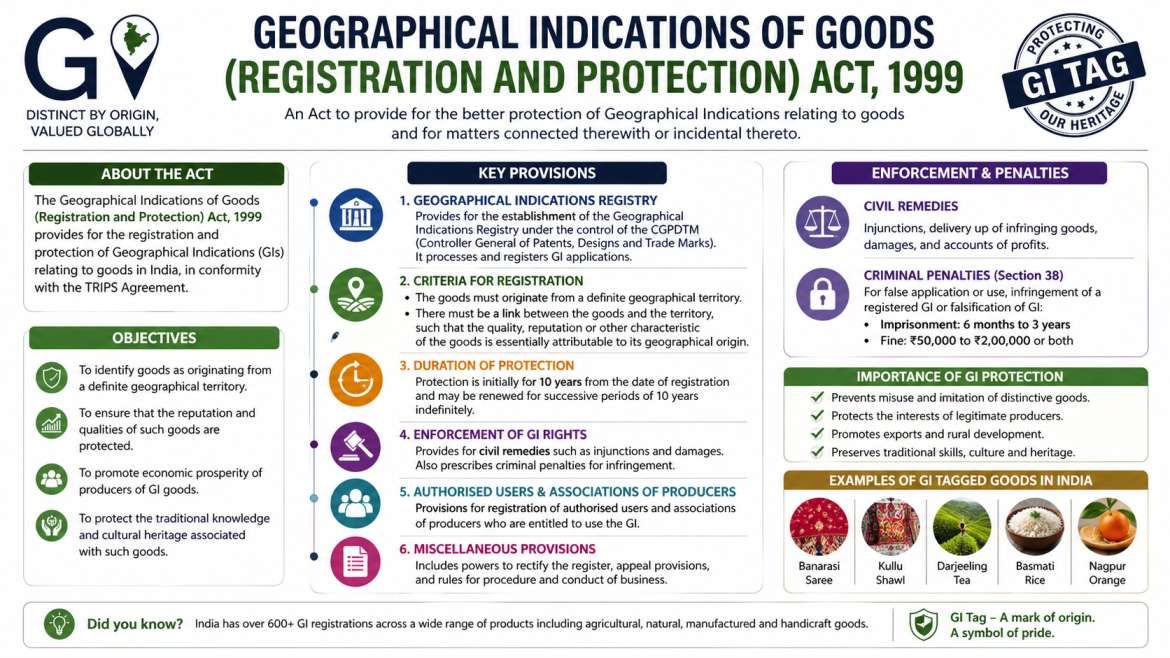
GI Tag in India: Eligibility Criteria
Obtaining a GI tag in India involves a structured process designed to ensure that only genuinely region-specific products receive legal protection. The focus is on establishing a clear, verifiable link between the product and its geographical origin.
Who Can Apply?
An application for a GI tag cannot be filed by an individual. It must be submitted by:
- Associations of producers or groups involved in production
- Organisations or institutions representing the product
- Statutory bodies or government agencies connected to the product
These entities apply on behalf of all eligible producers within the specified geographical region.
Essential Requirements for Registration
To secure a GI tag, the applicant must provide detailed evidence demonstrating authenticity and uniqueness:
- Proof of Geographical Origin: Clear identification of the region where the product is produced
- Historical Evidence & Reputation: Records showing the product’s long-standing association and recognition with the area
- Unique Characteristics: Specific qualities or features that distinguish the product from others
- Production Process Details: Description of traditional methods, skills, and techniques involved
- Defined Geographical Boundaries: Accurate demarcation of the region where the product can be produced
Authority Responsible for GI Registration
In India, the Geographical Indications Registry functions under the Department for Promotion of Industry and Internal Trade (DPIIT), which is part of the Ministry of Commerce and Industry.
This authority is responsible for:
- Examining GI applications
- Granting registration
- Ensuring legal protection of GI-tagged products
- Safeguarding the interests of producers and preserving regional identity
State-wise GI Tag Products in India
The GI Registry located in Chennai under the DPIIT, processes and registers all GI applications in India. The first GI tag in India was awarded to Darjeeling Tea. Today, India has hundreds of GI-tagged products, covering agriculture, handicrafts, food items, and manufactured goods, each representing a unique regional identity.
Below is a list of major GI tags in India for UPSC 2026 preparation:
| State | Category | GI Tagged Products (Examples) |
|---|---|---|
| Andhra Pradesh | Handicrafts | Srikalahasti Kalamkari, Kondapalli Toys, Uppada Jamdani Sarees, Etikoppaka Toys |
| Agricultural | Guntur Sannam Chilli, Banaganapalle Mango | |
| Food | Tirupati Laddu, Bandar Laddu | |
| Arunachal Pradesh | Handicrafts | Idu Mishmi Textiles |
| Agricultural | Khamti Rice, Yak Churpi | |
| Assam | Handicrafts | Muga Silk |
| Manufactured | Judima | |
| Bihar | Handicrafts | Madhubani Painting, Sujini Embroidery |
| Agricultural | Katarni Rice, Zardalu Mango | |
| Food | Silao Khaja | |
| Chhattisgarh | Handicrafts | Bastar Dhokra, Champa Silk |
| Goa | Agricultural | Khola Chilli |
| Manufactured | Feni | |
| Gujarat | Handicrafts | Sankheda Furniture, Bandhani, Tangaliya Shawl |
| Agricultural | Bhalia Wheat | |
| Himachal Pradesh | Handicrafts | Kullu Shawl |
| Agricultural | Kangra Tea | |
| Jharkhand | Handicrafts | Sohrai–Khovar Painting |
| Karnataka | Handicrafts | Mysore Silk, Kasuti Embroidery, Channapatna Toys |
| Agricultural | Coorg Orange, Byadagi Chilli, Cardamom | |
| Manufactured | Mysore Sandal Soap, Agarbathi | |
| Kerala | Handicrafts | Aranmula Mirror, Alleppey Coir |
| Agricultural | Navara Rice, Pokkali Rice, Nilambur Teak | |
| Madhya Pradesh | Handicrafts | Chanderi Saree, Maheshwari Saree |
| Agricultural | Sharbati Wheat | |
| Food | Ratlami Sev, Kadaknath Chicken | |
| Maharashtra | Agricultural | Alphonso Mango, Nashik Grapes, Onion |
| Handicrafts | Kolhapuri Chappal | |
| Manipur | Handicrafts | Shaphee Lanphee |
| Mizoram | Handicrafts | Pawndum |
| Odisha | Handicrafts | Konark Stone Carving, Khandua Saree |
| Agricultural | Kandhamal Haldi, Kalajeera Rice | |
| Rajasthan | Handicrafts | Sanganeri Print, Bagru Print, Thewa Art |
| Natural | Makrana Marble | |
| Tamil Nadu | Handicrafts | Kanchipuram Silk, Thanjavur Painting, Pattamadai Mat |
| Agricultural | Madurai Malli, Erode Turmeric | |
| Food | Kadalai Mittai, Salem Sago | |
| Telangana | Handicrafts | Pochampally Ikat, Nirmal Toys, Gadwal Sarees |
| Uttar Pradesh | Handicrafts | Khurja Pottery, Tarkashi |
| Agricultural | Dusseheri Mango, Kalanamak Rice | |
| West Bengal | Handicrafts | Baluchari Saree, Nakshi Kantha |
| Agricultural | Darjeeling Tea, Gobindobhog Rice | |
| Food | Joynagar Moa |
GI Tags of Union Territories
| Union Territory | Category | GI Tagged Products |
|---|---|---|
| Jammu & Kashmir | Handicrafts | Kani Shawl |
| Agricultural | Kashmir Saffron, Mushqbudji Rice | |
| Ladakh | Handicrafts | Pashmina Wool |
| Agricultural | Raktsey Karpo Apricot | |
| Puducherry | Handicrafts | Villianur Terracotta |
You might also like: Millets: Types, Production, Benefits & Initiatives (UPSC Notes)
Joint GI Tag Products of States
Some GI-tagged products are shared across multiple states due to common geographical conditions, cultural practices, or traditional knowledge systems. These are important for UPSC, especially for match-the-following questions.
| GI Product | States / Regions Covered |
|---|---|
| Monsooned Malabar Robusta Coffee | Karnataka, Kerala |
| Monsooned Malabar Arabica Coffee | Karnataka, Kerala |
| Alleppey Green Cardamom | Kerala, Tamil Nadu |
| Warli Painting | Maharashtra, Gujarat, Dadra & Nagar Haveli, Daman & Diu |
| Basmati Rice | Punjab, Haryana, Himachal Pradesh, Delhi, Uttarakhand, Uttar Pradesh, Jammu & Kashmir |
| Phulkari | Punjab, Rajasthan, Haryana |
| Chak-Hao (Black Rice) | Manipur, Nagaland |
UPSC Prelims PYQs
QUESTION 1
The FAO accords the status of ‘Globally Important Agricultural Heritage Systems (GIAHS)’ to traditional agricultural systems. What is the overall goal of this initiative?
- To provide modern technology, training in modern farming methods and financial support to local communities of identified GIAHS so as to greatly enhance their agricultural productivity
- To identify and safeguard eco-friendly traditional farm practices and their associated landscapes, agricultural biodiversity and knowledge systems of the local communities
- To provide Geographical Indication status to all the varieties of agricultural produce in such identified GIAHS
Select the correct answer using the code given below.
QUESTION 2
Which of the following has/have been accorded “Geographical Indication” status?
- Banaras Brocades and Sarees
- Rajasthani Dal-Bati-Churma
- Tirupati Laddu
Select the answer using the code given below:
Conclusion
Understanding GI tags in India is essential for UPSC preparation as it connects topics like culture, economy, and intellectual property rights in a factual yet analytical way. With an increasing number of GI-tagged products in India in 2026, aspirants should focus on state-wise mapping, key examples, and recent additions for effective revision.
Start your UPSC Preparation 2026/2027 with SuperKalam
SuperKalam is your personal mentor for UPSC preparation, guiding you at every step of the exam journey. Practice, revise, and evaluate– all in one place.
Download Now