Government of India Act 1935 – Modern History UPSC Notes
The Government of India Act 1935 was a British law that introduced provincial autonomy and federal features—read crisp UPSC notes covering the background, features, criticism, and constitutional impact.
Jan, 2026
•7 min read
The Government of India Act 1935 is one of the most important pieces of legislation in the Indian Constitution and modern history. For UPSC aspirants, it is a high‑weightage topic in Prelims, GS Paper I (Modern History), GS Paper II (Polity), and even Essay and Interview questions on constitutional evolution.
Often described as the "blueprint of the Indian Constitution", the Government of India Act 1935 introduced several administrative and federal features that were later adopted with modifications by the Constitution of India, 1950.
Historical Background of the Government of India Act 1935
The Government of India Act 1935 was the outcome of a long series of constitutional experiments, nationalist pressures, and negotiations between Indian leaders and the British government.
Growing Demand for Constitutional Reforms
- After the Government of India Act 1919, Indians increasingly felt that the system of dyarchy in provinces was inadequate and ineffective.
- The Indian National Congress and other political groups demanded greater self‑governance and responsible government.
- The rise of mass movements under Mahatma Gandhi brought intense pressure on the British administration to rethink its colonial policies.
Simon Commission (1927)
- The British government appointed the Simon Commission in 1927 to review the working of the GOI Act 1919.
- The commission had no Indian members, which led to widespread protests across India.
- The slogan “Simon Go Back” symbolised growing Indian resentment against unilateral British decisions.
- The boycott highlighted the demand that Indians must have a decisive role in framing their own constitution.
Nehru Report (1928)
- In response to the Simon Commission, Indian leaders prepared the Nehru Report (1928) under the leadership of Motilal Nehru.
- It was the first major Indian attempt to draft a constitutional framework for self‑governance.
- The report demanded Dominion Status, a federal structure, and fundamental rights.
- Although rejected by the British, it strengthened India’s constitutional vision and bargaining position.
Civil Disobedience Movement (1930–34)
- The launch of the Civil Disobedience Movement marked a new phase of mass resistance against British rule.
- Movements like the Salt Satyagraha exposed the moral and administrative weaknesses of colonial governance.
- British authorities realised that repression alone could not sustain imperial control.
- This movement forced the British government to initiate serious constitutional negotiations.
Round Table Conferences (1930–1932)
- Three Round Table Conferences were held in London to discuss India’s constitutional future.
- These conferences included British officials, Indian princes, and representatives of different Indian communities.
- Issues such as federal structure, provincial autonomy, minority safeguards, and representation were debated.
- Although no immediate consensus was achieved, these discussions laid the foundation for future constitutional reforms.
White Paper (1933)
- Based on the outcomes of the Round Table Conferences, the British government published a White Paper in 1933.
- It contained detailed proposals for a new constitutional framework for India.
- The White Paper recommended an All‑India Federation, provincial autonomy, and safeguards for British interests.
- A Joint Select Committee of the British Parliament examined these proposals.
Enactment of the Government of India Act 1935
- After parliamentary scrutiny and debates, the proposals were finally enacted as the Government of India Act 1935.
- It became the longest and most detailed constitutional act passed by the British Parliament for India.
- Though it fell short of Indian aspirations, it represented the most advanced constitutional experiment under British rule.
Must read: Charter Act of 1813 (UPSC Notes)
Salient Features of the Government of India Act 1935
These features are most important for UPSC Prelims and Mains.
1. All‑India Federation (Never Implemented)
- Proposed federation of British Indian Provinces and Princely States
- The princely states’ accession was voluntary
- The federation never came into existence due to the non‑participation of princely states
2. Provincial Autonomy (Most Successful)
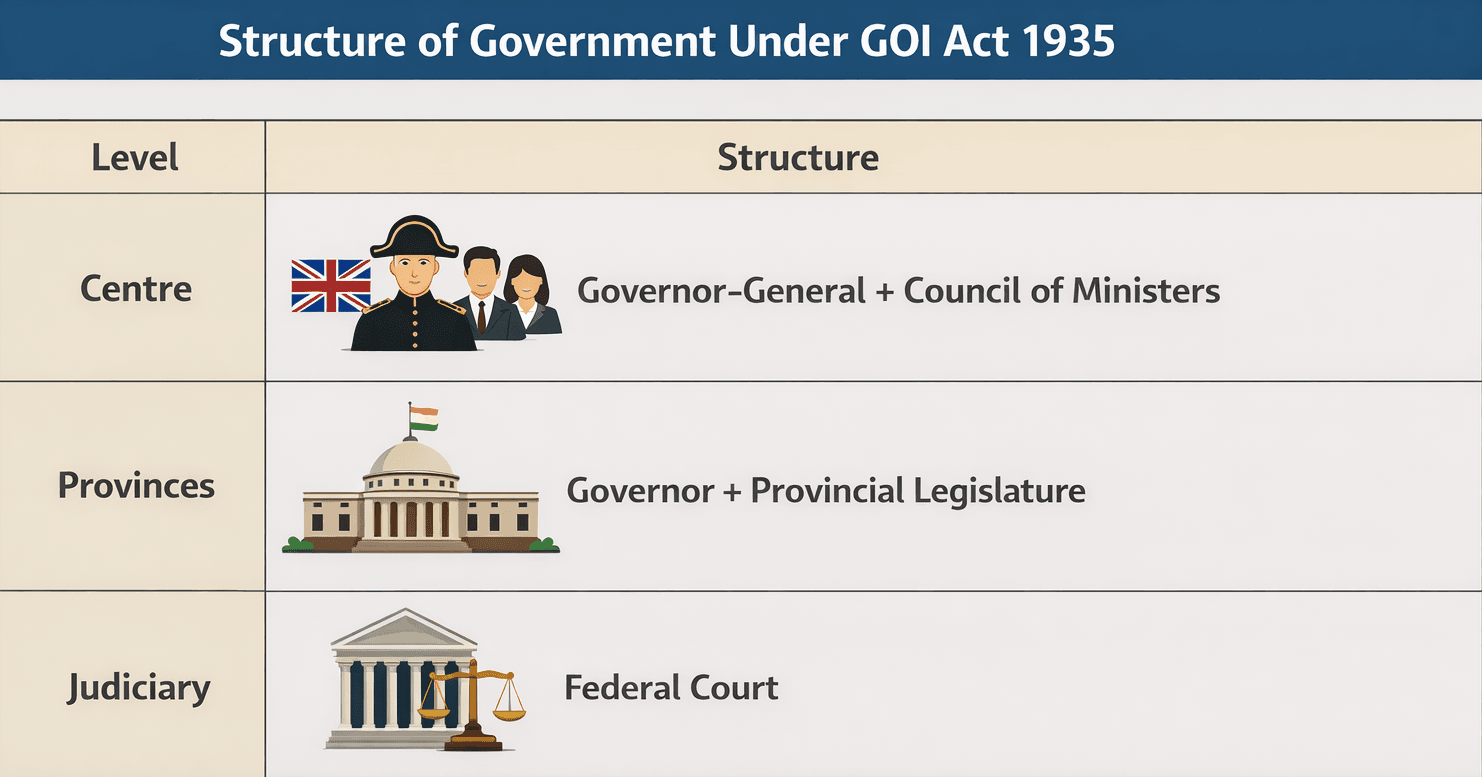
- Abolished dyarchy at the provincial level
- Provinces given autonomy in administration
- Responsible governments were formed after the 1937 elections
3. Dyarchy at the Centre (Never Implemented)
- Introduced dyarchy at the federal level
- Reserved subjects: Defence, Foreign Affairs
- Transferred subjects: Other departments
- Not implemented as the federation never came into force
4. Division of Powers
Subjects were divided into three lists:
- Federal List
- Provincial List
- Concurrent List
This structure inspired Article 246 of the Indian Constitution
5. Bicameral Legislature
- Introduced bicameralism in six provinces
- Legislative Assembly (Lower House)
- Legislative Council (Upper House)
6. Extended Franchise
- Increased electorate from 3% to about 14% of the population
- Voting was still based on property, education, and tax qualifications
7. Federal Court
- Established the Federal Court of India (1937)
- Could interpret the Act and settle disputes between units
- Precursor to the Supreme Court of India
8. Reserve Powers of Governor‑General
- The Governor‑General had overriding powers
- Governors acted as agents of the British Crown
- Limited real autonomy
Also cover: Top 10 Historical Movements in Modern Indian History for UPSC
UPSC Prelims PYQs on Government of India Act 1935
QUESTION 1
In the federation established by the Government of India Act of 1935, residuary power was given to the
QUESTION 2
With reference to the Government of India Act, 1935, consider the following statements:
- It provided for the establishment of an All India Federation based on the union of the British Indian Provinces and Princely States.
- Defence and Foreign Affairs were kept under the control of the federal legislature.
Which of the statements given above is/are correct?
Criticism of the Government of India Act 1935
Indian leaders and political organisations widely criticised the Government of India Act 1935. Let's understand why!
Excessive Safeguards and Discretionary Powers
- The Act vested the Governor‑General and provincial Governors with extensive ‘safeguards’ and ‘special responsibilities’.
- These powers acted as institutional brakes on responsible government.
- Even under provincial autonomy, Governors could override elected ministries, reserve bills, and take over administration.
- As a result, real power remained concentrated in British hands rather than with Indian representatives.
Weak Democratic Character
- At the Centre, crucial subjects like defence and external affairs were kept under the control of the Governor‑General.
- This severely limited the scope of ministerial responsibility and democratic functioning.
Promotion of Communalism
- The Act extended the system of communal electorates and provided separate representation to various interests.
- Instead of promoting national unity, this institutionalised separatist tendencies.
- These provisions deepened communal divisions, which eventually contributed to the Partition of India.
Rigid and Non‑Flexible Constitution
- The Government of India Act 1935 was rigid with no provision for internal amendment.
- The power to amend the Act rested solely with the British Parliament.
- This denied Indians the authority to adapt the constitution according to changing political needs.
Federal Scheme: Sound in Theory, Weak in Practice
- The proposed All‑India Federation was conditional upon the voluntary accession of princely states.
- The federal part of the Act was to come into force only when half of the princely states (by weight) agreed to join.
- This condition was never fulfilled, and the outbreak of the Second World War led to the indefinite postponement of the federation.
British Control Embedded in Legal Form
- The Act shows that the British government retained the legal authority to re‑assume total control whenever it deemed necessary.
- Emergency provisions and discretionary powers ensured that colonial supremacy could be restored at will.
- Thus, constitutional autonomy existed more in form than in substance.
Indian National Response
- Due to these limitations, the Act was condemned by almost all political sections in India.
- The Indian National Congress unanimously rejected the Act.
- The Congress demanded the convening of a Constituent Assembly elected based on adult franchise to frame a constitution for independent India.
Jawaharlal Nehru famously described the Act as “a machine with strong brakes but no engine” and later called it a “Charter of Slavery.”
Also read: Separation of Powers in India [UPSC Notes]
UPSC Mains PYQ on Government of India Act 1935
Did the Government of India Act, 1935 lay down a federal constitution? Discuss.(UPSC CSE Mains 2016)
Evaluate your answer within 60 secondsConclusion
The Government of India Act 1935, despite its colonial limitations and widespread criticism, introduced several constitutional features that later became the nucleus of the Indian Constitution. The Act represents a watershed moment in India’s constitutional history, bridging colonial governance and independent democratic rule.
Start your UPSC Preparation 2026/2027 with SuperKalam
SuperKalam is your personal mentor for UPSC preparation, guiding you at every step of the exam journey. Practice, revise, and evaluate– all in one place.
Download Now