Battle of Buxar 1764: Causes, Events & Outcomes (UPSC Notes)
The Battle of Buxar (1764) was fought between the British East India Company and the Mughal alliance. Cover this topic for UPSC Prelims & GS-I (Medieval History).
Jan, 2026
•6 min read
The Battle of Buxar (1764) was a decisive turning point in Indian history that reshaped the political future of the subcontinent. It was fought between the British East India Company and an alliance of Mir Qasim, Shuja-ud-Daula, and Mughal Emperor Shah Alam II, marking the rise of British political dominance in India.
The Battle of Buxar is a highly important topic for UPSC Prelims and Mains. Let’s understand the topic in detail.
About the Battle of Buxar
The Battle of Buxar was fought on October 22-23, 1764, near Buxar in Bihar. British East India Company troops, led by Major Hector Munro, defeated a combined army of Mughal Emperor Shah Alam II, Bengal's Mir Qasim, and Awadh's Shuja-ud-Daula.
This victory gave the Company control over Bengal, Bihar, and Orissa revenues, paving the way for British rule in India.
- The battle took place at Buxar, a fortified town on the banks of the Ganges River in Bihar.
- Despite being outnumbered, the British won due to their superior organisation and strong military discipline.
- The battle ended with the Treaty of Allahabad in 1765, granting the British East India Company Diwani rights (revenue collection authority) over Bengal, Bihar, and Orissa.
- Established the British as the dominant political and military power in northern India.
- Ended the puppet Nawab system and transformed the East India Company from a trading entity to a ruling authority.
- Mir Qasim became a fugitive; Shuja-ud-Daula submitted to the British; Mughal Emperor Shah Alam II lost effective power.
Also read: Bhakti Movement in India Notes for UPSC
Background of the Battle of Buxar
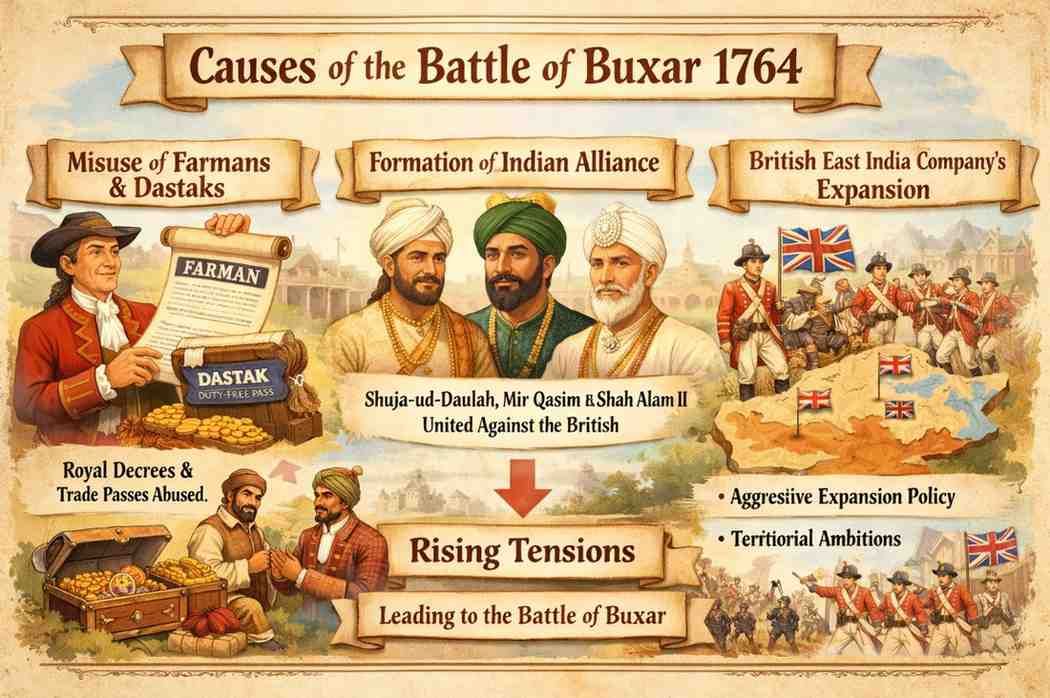
The Battle of Buxar began because of the unstable politics of Bengal and the growing concern of Indian rulers about the increasing power of the British East India Company and its expansion.
1. Battle of Plassey (1757)
- Seven years before Buxar, Robert Clive defeated the Nawab of Bengal, Siraj-ud-Daulah, through deception and conspiracy.
- This victory gave the British their first major foothold in Bengal.
- Mir Jafar was then installed as a puppet Nawab, and Robert Clive became the first Governor of Bengal.
2. Establishment of Puppet Rule
- After Plassey, the British controlled Bengal through puppet Nawabs who were completely dependent on the Company for their power.
- The Nawabs were mere figureheads, and real power rested with the Company officials.
3. Expansion of Company Influence (1757-1760)
- During Clive's first governorship (1757-1760), the Company rapidly expanded its territorial control and revenue extraction.
- Bengal's wealth was systematically transferred to the Company's coffers.
4. Mir Qasim's Appointment (1760)
- In October 1760, Mir Qasim was placed on the throne of Bengal by the Company, replacing Mir Jafar.
- Mir Qasim differed from his predecessors; he was an able administrator who wanted to rule with actual authority rather than being a mere puppet.
- The British traders had been using imperial farmans (royal decrees) and dastaks (trade passes) to bypass customs duties.
- Mir Qasim attempted to stop this exploitation by levying uniform duties on all traders, whether British or Indian.
- British forces defeated Mir Qasim in 1763 at Katwa, Giria, Udaynala, Sooty, and Monghyr, forcing him to flee to Awadh (Oudh).
- After his defeat, Mir Qasim allied with Shuja-ud-Daula and Shah Alam II, and together, they resolved to drive the British out of Bengal.
Mir JafarMir Jafar was the Nawab of Bengal who betrayed Siraj-ud-Daulah and helped the British East India Company in the Battle of Plassey (1757).
Remains a symbol of betrayal and treachery in Indian and Bengali history; his name is used synonymously with "gaddar" (traitor) in Bengal's political discourse. |
Also read: Sufi Movement in Medieval India UPSC Notes
Contending Forces in the Battle of Buxar
The Battle of Buxar was fought between the British East India Company and a powerful coalition of Indian rulers united in their resistance to expanding British dominance.
The British East India Company Forces
Major Hector Munro (also written as Sir Hector Munro) was a seasoned military officer known for his strict discipline and strategic command.
Munro divided his forces into three main sections:
- Left Flank: Commanded by Major Stibbert with regular European troops
- Right Flank: Commanded by Major Champion with Bengali troops
- Centre: Bengal cavalry supported by four companies of sepoys
Despite being heavily outnumbered, the British forces were far superior in discipline, organisation, and firepower.
The Indian Alliance
The three Indian rulers formed a confederacy to challenge British dominance. This was the only significant attempt by Indian rulers to unite against the British East India Company before the Battle of Plassey.
1. Mir Qasim (Nawab of Bengal 1760-1763)
- A more capable ruler than his predecessor, Mir Jafar.
- Installed by the Company, but wanted genuine independence.
- The primary instigator of the alliance.
- After defeat, he fled and lived in obscurity, eventually dying in May 1777.
2. Shuja-ud-Daulah (Nawab of Awadh)
- Ruler of the wealthy province of Awadh (Oudh) in northern India.
- Joined the alliance to restore Mir Qasim to power and prevent British expansion.
- After defeat, he surrendered to the British.
3. Shah Alam II (Mughal Emperor, reigned 1759-1806)
- The nominal head of the Mughal Empire, but with greatly diminished power.
- Sought to restore his authority in Bengal and northern India.
- After defeat, he became a pensioner of the British East India Company.
- His participation was the most symbolic, as he represented the last vestige of Mughal authority.
4. Supporting Forces
- Balwant Singh, Maharaja of Varanasi (Benares State): Also participated in the alliance with varying levels of commitment.
- Cavalry Units: The Indian alliance possessed strong cavalry forces, including Naga cavalry, Afghan cavalry, and Durrani cavalry units, but they lacked proper coordination.
Also read: Revolt of 1857 UPSC: Why It Happened, How it Spread, What It Left Behind
Major Outcomes of the Battle of Buxar
The Battle of Buxar concluded quickly but with overwhelming consequences for both sides.
Military Outcome
- British Victory: The disciplined British troops, led by Hector Munro's strategic command, defeated the coalition forces in direct combat.
- Capture of War Materials: The British captured 133 pieces of artillery and over 1 million rupees in cash from the defeated coalition.
- Defeat of the Alliance: Mir Qasim fled to Awadh and eventually to northern India, where he died in poverty and obscurity in May 1777.
- Surrender of Leaders: Shuja-ud-Daulah and Shah Alam II surrendered to the British, recognising the futility of further resistance.
- End of Puppet Rule: The Company no longer needed to rule Bengal through puppet Nawabs. It was now strong enough to rule directly.
- Control Over Bengal, Bihar, and Odisha: The British established firm control over these three wealthy provinces, which would become the heartland of British rule in India.
Treaty of Allahabad (1765)
The victory was formalised through the Treaty of Allahabad, signed on August 16, 1765.
- Diwani Rights Granted: Shah Alam II granted the British East India Company the Diwani rights (the authority to collect and administer revenue) over Bengal, Bihar, and Orissa.
- Annual Tribute: The Company agreed to pay an annual tribute of 26 lakh rupees (2.6 million rupees) to the Mughal Emperor as symbolic recognition of his authority.
- Territorial Grants to the Emperor: The Company granted Shah Alam II the districts of Kora and Allahabad, along with an annual revenue of 26 lakh rupees.
Dual Government System
After the battle, the Company introduced the Dual Government system (1765-1772) in Bengal:
- The Company exercised the Diwani (revenue collection) function.
- A puppet Nawab retained the Nizamat (civil administration and police) function, though in practice all real power rested with the Company.
- This system allowed the Company to extract Bengal's wealth while maintaining the pretence that the Nawab still ruled.
UPSC Prelims MCQ on Battle of Buxar 1764
QUESTION 1
Consider the following statements:
- Battle of Buxar provided the key to the English to establish their rule in India.
- The Treaty of Allahabad, concluded in 1765, enabled the British to establish their rule in Bengal.
Which of the statements given above is/are correct?
Significance of the Battle of Buxar
The Battle of Buxar is very important in Indian history because it changed the East India Company from a trading company into a powerful ruler that later controlled most of India.
- Transfer of Power: The battle marked the definitive transfer of political power from Indian rulers to the British East India Company.
- Defeat of the Last Alliance: This was the last significant attempt by Indian rulers to unite and resist British expansion.
- End of Mughal rule: Shah Alam II’s defeat ended Mughal power, and he became dependent on the British for money and protection.
- Grant of Diwani Rights: After the Treaty of Allahabad, Shah Alam II gave the British East India Company the right to collect revenue from Bengal, Bihar and Odisha.
- Nizamat Functions: The Company also charged the Emperor 53 lakh rupees (Rs 53,00,000) for providing nizamat functions, essentially the costs of maintaining law and order, police, and judicial administration.
- Proof of Military Superiority: Unlike Plassey, which relied on treachery, Buxar proved that the British possessed superior military organisation, discipline, and firepower.
- Dual Government System: Following Buxar, the Company implemented a "dual government" system in Bengal.
- Destruction of Indian Industries: The Company's monopolistic practices and revenue extraction devastated Bengal's economy:
- The Bengali silk industry was systematically destroyed.
- The cotton cloth industry, once the most developed in Bengal, collapsed.
- The Company's agents arbitrarily decided the quality, quantity, and price of goods produced.
- Artisans and weavers who objected faced harsh punishment or torture.
- Agricultural Decline: The Company's revenue contractors raised their demands on peasants without investing in productivity improvements.
UPSC Mains Practice Question
Write a brief note on the Battle of Buxar and its significance in establishing British rule in India
Evaluate Your Answer Now!Conclusion
The Battle of Buxar was a major turning point in Indian history. It showed the military strength of the British and defeated three big Indian powers at once. After this, the British East India Company stopped being just a trading company and became a ruling power.
The battle led to British control over large areas of India and weakened Indian rulers. It also caused economic damage, as British policies led to poverty and famines. This battle laid the foundation for British rule over India.
Start Your UPSC Journey Smarter with SuperKalam
Crack UPSC with AI-powered guidance, personalised feedback, PYQs, Instant Mains answer Evaluation and expert-curated notes, all in one platform.
Join SuperKalam today and take your preparation to the next level!