Netaji Subhash Chandra Bose Jayanti (Prakram Diwas) 2026
Prakram Diwas 2026 (23 January) celebrates Netaji Subhash Chandra Bose Jayanti. Know about INA, Azad Hind Fauj and Netaji's early life. Read now for UPSC GS Paper I syllabus.
Jul, 2026
•6 min read
“Give me blood, and I shall give you freedom”
These powerful words by Netaji Subhash Chandra Bose continue to inspire generations of Indians. His life symbolised courage (Prakram), sacrifice, and fearless nationalism.
To honour his unmatched contribution to India’s freedom struggle, Netaji Subhash Chandra Bose Jayanti is celebrated as Prakram Diwas every year on 23 January.
Prakram Diwas 2026 is important for students preparing for UPSC and other competitive exams, as questions related to Netaji, INA, and modern Indian history are frequently asked.
About the Prakram Diwas 2026
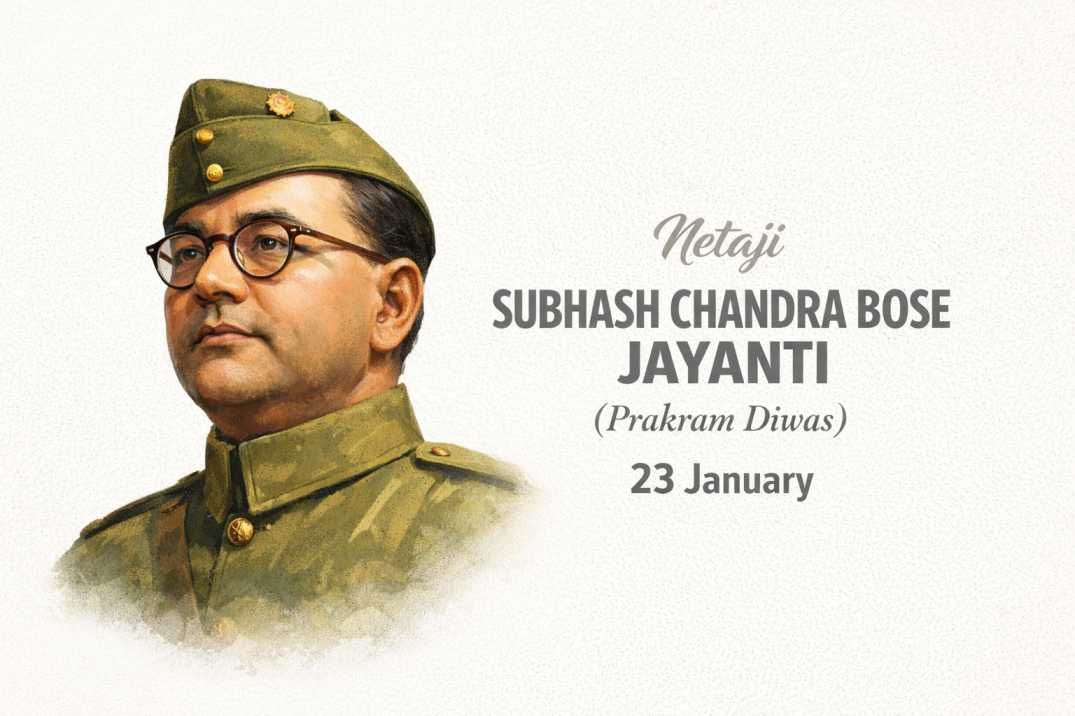
Netaji Subhash Chandra Bose Jayanti commemorates the birth anniversary of Subhash Chandra Bose, one of the most charismatic and influential leaders of India’s freedom struggle. In 2021, the Government of India officially declared 23 January as Prakram Diwas, where “Prakram” means valour, courage, and heroic effort.
Origin of Prakram Diwas
The idea of observing Prakram Diwas was announced by the Government of India in January 2021 to mark the 125th birth anniversary celebrations of Netaji Subhash Chandra Bose.
The objective was:
- To recognise Netaji’s fearless leadership
- To honour the role of the Indian National Army (INA)
- To inspire the youth with values of discipline, patriotism, and sacrifice
Since then, 23 January has been observed annually as Prakram Diwas across the country.
Who Was Netaji Subhash Chandra Bose?
Subhash Chandra Bose (1897–1945) was a nationalist leader, revolutionary thinker, and military organiser who believed that British rule could only be ended through organised resistance and armed struggle.
Unlike many contemporaries, Netaji believed that political freedom must be immediate and unconditional. His ideas, actions, and leadership style made him one of the most respected and controversial figures of India’s freedom movement.
Early Life and Education of Subhash Chandra Bose
Here are the key details of Netaji's early life and education:
| Detail | Information |
|---|---|
| Birth | 23 January 1897 |
| Birthplace | Cuttack, Odisha |
| Father | Janakinath Bose (Lawyer) |
| Mother | Prabhavati Devi |
| Schooling | Ravenshaw Collegiate School |
| Higher Education | Presidency College, Calcutta |
| Foreign Education | University of Cambridge |
| ICS Exam | Qualified in 1920 (Rank 4) |
Despite securing a top rank in the Indian Civil Services (ICS)—the most prestigious service under British rule—Netaji resigned in 1921, stating that he could not serve a colonial government that suppressed his country.
This decision marked his complete dedication to the Indian freedom struggle.
Political Journey and Role of Netaji in the Freedom Movement
Netaji Subhash Chandra Bose’s political journey reflects the evolution of the Indian national movement, from constitutional agitation to revolutionary resistance.
Association with the Indian National Congress
Subhash Chandra Bose formally entered active politics in the early 1920s by joining the Indian National Congress (INC), which was the principal platform of India’s freedom struggle at the time.
Mentorship under C.R. Das
- Netaji was deeply influenced by Chittaranjan Das (C.R. Das), a prominent nationalist leader from Bengal.
- C.R. Das recognised Netaji's organisational ability and ideological clarity.
- Netaji worked as the Chief Executive Officer of the Calcutta Municipal Corporation, gaining administrative experience and mass contact.
Emergence as a Young Nationalist Leader
- Netaji emerged as a radical nationalist voice within the Congress.
- He believed that British imperialism was sustained by economic exploitation and military power.
- Advocated mass mobilisation, sacrifice, and revolutionary preparedness.
- Opposed the gradual constitutional reforms proposed by the British.
Demand for Complete Independence (Purna Swaraj)
- He strongly advocated Poorna Swaraj (complete independence), much before it became the official Congress demand.
- He criticised Dominion status as insufficient and misleading.
- Viewed freedom as an immediate political necessity, not a long-term goal.
Congress Presidency and Leadership (1938–1939)
- Elected President of the Indian National Congress at the Haripura Session, 1938.
- He established the National Planning Committee, headed by Jawaharlal Nehru.
- He highlighted the need for economic self-reliance along with political freedom.
Tripuri Session, 1939
Re-elected as Congress President despite opposition from the Gandhian group. Differences emerged regarding:
- Strategy against British rule
- Leadership style and pace of struggle
- Unable to function effectively due to a lack of support from the Congress Working Committee
- Eventually resigned from the presidency
Formation and Role of the Indian National Army (INA)
Netaji’s most revolutionary contribution to India’s freedom struggle was his leadership of the Indian National Army (INA), also known as the Azad Hind Fauj, during World War II.
- INA was initially formed by Mohan Singh
- Netaji reorganised and revitalised the army after reaching Southeast Asia
- Provided a clear political vision and military discipline to the force
- The key objective was the complete liberation of India through armed struggle
- Senior officers of the
- were Shah Nawaz Khan, Prem Kumar Sehgal, and Gurbaksh Singh Dhillon.
Key Features of the INA
- Comprised Indian soldiers captured by Japan during World War II
- Included civilians from the Indian diaspora in Southeast Asia
- Fought alongside the Axis Powers against British forces
Popular INA Slogans
“Delhi Chalo” – Call for marching towards freedom
“Jai Hind” – National greeting symbolising unity
Also see: UPSC Notes on First World War: Causes, Consequences & Key Treaties
Provisional Government of Azad Hind (1943)
In October 1943, Netaji established the Provisional Government of Free India (Azad Hind) in Singapore, marking a historic moment in India’s freedom struggle.
- It was recognised by countries like Japan, Germany, and Italy.
- Declared war against British India.
- Had its own currency, civil code and national symbols.
Rani Jhansi Regiment
- An all-women combat unit
- Led by Captain Lakshmi Sahgal
- It symbolised gender equality, progressive vision and women’s active role in armed struggle.
The Azad Hind Government represented India’s first practical attempt at sovereign governance outside British control.
Must read: National Flag of India [UPSC Notes]
Netaji’s Ideology and Vision for Independent India
Netaji Subhash Chandra Bose envisioned an India that was politically independent, economically strong, and socially just. His vision was:
- Strong central government to maintain unity
- Secular outlook ensuring equal respect for all religions
- Socialist principles for reducing inequality
- Equality of men and women
- Emphasis on discipline, nationalism, and sacrifice
- Rapid industrial and scientific development
Netaji firmly believed that political freedom without economic justice would be incomplete.
Must read: Indian Army Day 2026: Date, History & Significance (UPSC Notes)
Death of Netaji Subhash Chandra Bose
Netaji Subhash Chandra Bose reportedly died in a plane crash in Taihoku (Taiwan) on 18 August 1945, but the absence of conclusive evidence has kept the mystery alive.
Inquiry Commissions on Netaji’s Death
- Shah Nawaz Committee (1956): Supported plane crash theory
- Khosla Commission (1970): Confirmed Shah Nawaz's findings
- Mukherjee Commission (2006): Rejected plane crash theory
Conflicting conclusions have fuelled public debate, and the declassification of files has revived public interest.
Also read: Vijay Diwas 2025: Why 16 December is Celebrated [UPSC Current Affairs]
Observance of Prakram Diwas 2026
On 23 January 2026, the Vice-President of India, Shri C. P. Radhakrishnan, will undertake his maiden visit to Odisha and West Bengal to participate in the Prakram Diwas celebrations. He will attend the Prakram Diwas events organised by the Ministry of Culture. The celebrations will be held at:
- Cuttack, Odisha (Netaji’s birthplace)
- Kolkata, West Bengal (centre of his political activities)
The events commemorate the 129th Birth Anniversary of Netaji Subhash Chandra Bose. Other activities include:
- National-level commemorative events
- Tributes by leaders
- Cultural and educational programmes
- Exhibitions on INA and Netaji’s life
- Youth-centric initiatives highlighting courage and leadership
Also see: Birsa Munda Jayanti 2025: 150th Birth Anniversary of Bhagwan Birsa Munda
UPSC Prelims PYQ on Indian National Army (INA)
QUESTION 1
In the context of Colonial India, Shah Nawaz Khan, Prem Kumar Sehgal, and Gurbaksh Singh Dhillon are remembered as
Final Words: The Spirit of Prakram Lives On
As we observe Prakram Diwas 2026, we do more than remember a leader; we renew a promise to uphold the values he lived and fought for. His call of “Delhi Chalo” still echoes, urging every generation to rise above fear and serve the nation with purpose.
Netaji may belong to history, but his Prakram belongs to India’s future. Jai Hind!
Start your UPSC Preparation 2026/2027 with SuperKalam
SuperKalam is your personal mentor for UPSC preparation, guiding you at every step of the exam journey. Practice, revise, and evaluate– all in one place.
Download the App Now