India-EU FTA: The Mother of All Deals | UPSC IR
India–EU Free Trade Agreement known as the Mother of All Deals – study about FTA, key features, tariff liberalisation, trade impact for UPSC GS Paper III. Read now!
Jul, 2026
•6 min read
Why in the News?
India and the European Union have achieved a historic milestone by concluding their long-pending Free Trade Agreement (FTA), hailed as the “mother of all deals.” This landmark pact aims to liberalise tariffs, boost bilateral trade and investment, and deepen supply chain integration, strengthening India-EU economic ties.
For UPSC aspirants, the agreement is highly relevant under GS Paper III (International Relations), offering insights into India’s strategic economic partnerships and multilateral negotiations.
What is a Free Trade Agreement (FTA)?
A Free Trade Agreement (FTA) is a pact between two or more countries to reduce or eliminate trade barriers such as tariffs, import quotas, and duties. The main aim of the FTA is to promote the free flow of goods, services, and investments. FTAs are important tools of international trade policy and economic diplomacy.
Important Features of an FTA
- Tariff Reduction or Elimination: Countries agree to lower or remove customs duties on specific goods, making products cheaper and more competitive.
- Market Access: FTAs provide businesses with easier entry into partner countries’ markets, expanding trade opportunities.
- Investment Promotion: Many FTAs include provisions to encourage cross-border investments and protect investor interests.
- Rules on Trade Facilitation: Simplified customs procedures, streamlined logistics, and cooperation on standards and regulations are often part of FTAs.
- Sectoral Cooperation: Some agreements include specific sectors like agriculture, services, or technology for deeper integration.
- Dispute Resolution Mechanism: FTAs usually have frameworks to resolve trade disputes between member countries in a structured manner.
- Strategic and Geopolitical Dimension: Beyond economics, FTAs often strengthen political and strategic ties between countries.
Also read this current affairs topic here: Asia Manufacturing Index 2026: India at 6th Position (UPSC)
UPSC Prelims PYQ on Free Trade Agreement
QUESTION 1
The term ‘Regional Comprehensive Economic Partnership’ often appears in the news in the context of the affairs of a group of countries known as
Key Features of the India–EU Free Trade Agreement (FTA)
The India–EU FTA is among the most ambitious trade agreements signed by India so far. It covers goods, services, and investment, with a strong focus on tariff liberalisation while safeguarding India’s developmental sectors.
Tariff Liberalisation
European Union’s Commitments:
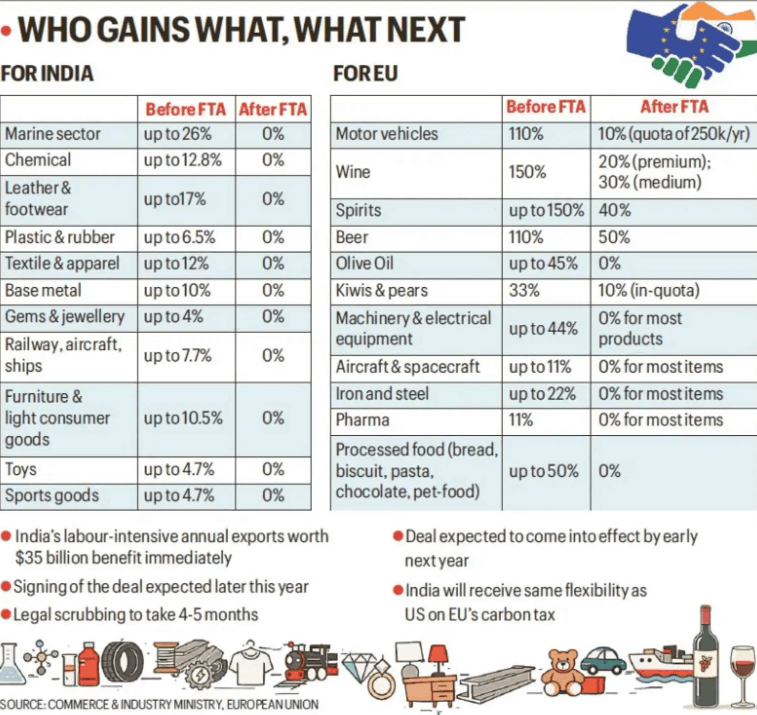
- 99.5% of Indian exports to the EU will become duty-free
- Most tariffs will be eliminated immediately once the agreement comes into force
- Major boost for Indian sectors like textiles, engineering goods, pharmaceuticals, and agriculture
India’s Commitments:
- 97–97.5% of EU exports to India to receive tariff concessions
- Tariff reductions will be phased, especially for sensitive sectors
- Reflects India’s need to balance trade openness with domestic industry protection
Sector-wise Tariff Reductions
- Automobiles: Car import tariffs to be reduced from 110% to 10% in a phased manner
- Alcoholic Beverages: Duties on wine to be cut by around 20%
- Processed Food Products: Zero tariffs on items such as pasta, chocolates and other processed food products
Overall Impact
- With a combined market size of nearly USD 24 trillion, the India–EU FTA is expected to significantly deepen economic integration between the two partners.
- Projections indicate that EU exports to India could double by 2032, while Indian manufacturers may gain access to export opportunities worth over USD 75 billion.
- The agreement can play a role as a major driver of trade expansion, industrial growth, and long-term economic partnership.
Also cover: MSMEs in India UPSC Notes: Classification, Sectors and Government Schemes & Challenges
Way Forward
With negotiations concluded, the India–EU FTA will now move through legal scrubbing, translation, and ratification by the European Parliament and all 27 EU Member States.
Once implemented, the agreement is set to become a cornerstone of India–EU economic relations, strengthening trade, investment, and strategic cooperation in an increasingly interconnected global economy.
Start your UPSC Preparation 2026/2027 with SuperKalam
SuperKalam is your personal mentor for UPSC preparation, guiding you at every step of the exam journey. Practice, revise, and evaluate– all in one place.
Download Now