16th Finance Commission Recommendations PDF 2026-2031 | UPSC
16th Finance Commission 2026–31 explained for UPSC: chairperson, recommendations, tax devolution, grants, concerns, and access to PDF notes. Click now!
Feb, 2026
•6 min read
The 16th Finance Commission, chaired by Arvind Panagariya, has submitted its recommendations for the 2026–2031 period. The government presented the report in Parliament along with the Union Budget 2026–27. These recommendations mark an important shift in India’s fiscal system, as the Finance Commission now moves away from entitlement-based transfers and focuses more on compliance, reforms, and fiscal discipline by states.
The 16th Finance Commission Recommendations (2026–31) is an important topic for GS Paper II & III. The report is also useful for UPSC Mains answers, essays, and current affairs linking.
What is the Finance Commission?
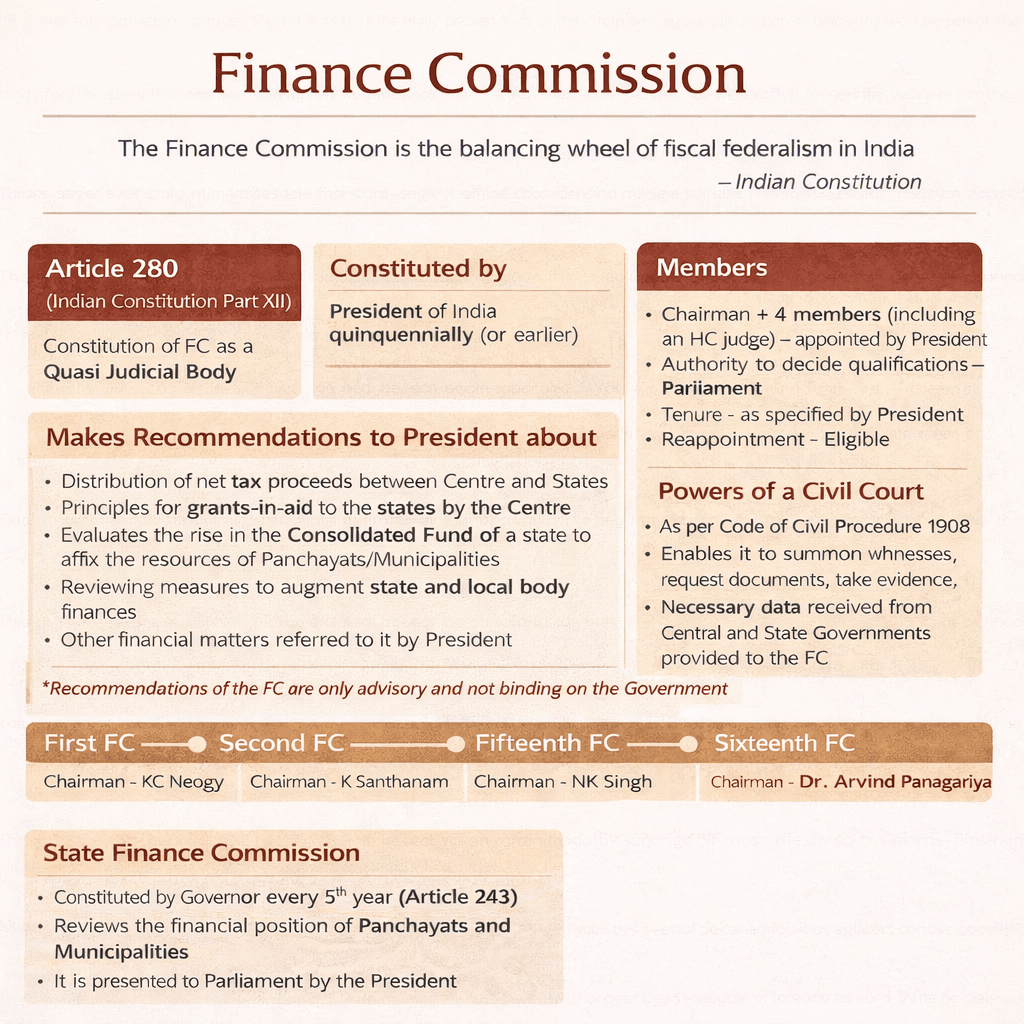
The Finance Commission is a constitutional body established under Article 280 of the Indian Constitution. It plays a key role in strengthening fiscal federalism by ensuring fair and balanced financial relations between the Union and the States. The President of India constitutes the Finance Commission every five years..
1. Key Significance:
- The Finance Commission is a key institution that promotes equitable resource distribution, fiscal discipline, and cooperative federalism in India.
2. Composition: The Finance Commission consists of:
- One Chairman
- Four Members with expertise in public finance, economics, or public administration.
3. Core Functions:
- Recommends the sharing of net tax proceeds between the Centre and States (vertical devolution).
- Decides the criteria for distribution among States (horizontal devolution).
4. Taxes Covered:
- Examines major central taxes such as Income Tax, GST, and other Union taxes included in the divisible pool.
5. Grants-in-Aid:
- Recommends grants to States under Article 275, especially to support revenue-deficient states.
6. Local Bodies:
- Suggests measures to strengthen the finances of Panchayats and Municipalities, promoting grassroots governance.
7. Fiscal Discipline:
- Advises on expenditure control, debt management, and fiscal reforms to ensure long-term sustainability.
8. Advisory Role:
- Examines any financial matter referred by the President of India.
Must see: Economic Survey 2026: Key Highlights, Analysis & Summary PDF (UPSC)
Key Recommendations of the 16th Finance Commission (2026–31)
The 16th Finance Commission focuses on fiscal discipline, performance-based transfers, and stronger local governance, while largely continuing the broad devolution framework of the previous commission.
1. Tax Devolution
(a) Vertical Devolution
- States’ share in the divisible pool of central taxes remains at 41%, the same as the 15th FC
- The divisible pool excludes cesses, surcharges, and collection costs
(b) Horizontal Devolution
Greater focus on economic performance and contribution to GDP. Revised formula includes:
- Income distance – 42.5%
- Population (2011 Census) – 17.5%
- Demographic performance – 10%
- Area – 10%
- Forest & ecology – 10%
- New: Contribution to GDP – 10%
The tax and fiscal effort criterion has been removed.
2. Grants-in-Aid
- Total grants recommended: ₹9.47 lakh crore (2026–31)
- Revenue deficit, sector-specific, and state-specific grants discontinued
- Focus shifts mainly to local bodies and disaster management
3. Grants to Local Bodies
Total allocation: ₹8 lakh crore
- Rural local bodies – ₹4.4 lakh crore
- Urban local bodies – ₹3.6 lakh crore
Conditions for grants:
- Constitutional functioning of local bodies
- Public disclosure of accounts
- Timely State Finance Commission formation
Grant structure:
- Basic grants – 80% (50% untied; 50% tied to sanitation, waste, and water management)
- Performance grants – 20%
- Urbanisation premium grant: ₹10,000 crore (one-time)
- Urban wastewater infrastructure grant: ₹56,100 crore
4. Disaster Management Grants
Total allocation: ₹2.04 lakh crore.
Cost sharing:
- 90:10 for NE and Himalayan states
- 75:25 for other states
- Centre’s share: ₹1.56 lakh crore
5. Fiscal Roadmap and Reforms
- Centre’s fiscal deficit target: 3.5% of GDP by 2030–31
- States’ fiscal deficit limit: 3% of GSDP
- End off-budget borrowings and include all liabilities in fiscal accounts
- Combined Centre–State debt projected to fall to 73.1% of GDP by 2030–31
6. Power Sector and Subsidy Reforms
- States encouraged to privatise DISCOMs
- Legacy power sector debt to be shifted to an SPV
- Recommended rationalisation of subsidies, especially cash transfers
- Stressed transparent accounting and disclosure of subsidy expenditure
7. Public Sector Enterprise Reforms
- Recommended closure of 308 inactive State PSEs
- Loss-making PSEs to be reviewed for closure, privatisation, or strategic retention
8. Transparency in Tax Data
- Recommended annual disclosure of CAG-certified net tax proceeds under Article 279
- Aims to improve clarity on the actual size of the divisible pool and tax devolution
Download the 16th Finance Commission PDF and enrich your mains answers with data, reforms, and analysis. Click below:
16th Finance Commission Recommendations PDF
Concerns and Criticisms of the 16th Finance Commission
Despite several reforms, the 16th Finance Commission (2026–31) has raised concerns among states over fiscal autonomy, equity, and the balance of Centre–State financial relations.
1. No Increase in States’ Share of Taxes
- States’ share in central taxes remains at 41%, even though many states demanded 50%
- This is seen as insufficient due to rising state spending on health, education, and welfare
- Heavy use of cesses and surcharges reduces the divisible pool and limits states’ financial freedom
2. Changes in Inter-State Distribution Formula
- Lower weight for income distance reduces focus on equity
- Higher weight for population (2011 Census) and a new 10% weight for GDP contribution favour large and industrialised states
- Southern states argue they are penalised despite better population control
Example: Tamil Nadu’s share increased only marginally (4.079% to 4.097%)
3. Reduced Incentives for Population Control
- The Commission gradually reduces rewards for demographic performance
- Southern states fear their early success in fertility reduction is no longer adequately recognised
- Raises concerns over weakening cooperative federalism
4. Removal of Revenue Deficit Grants
- Revenue deficit grants have been completely discontinued
- Hill and special category states argue that their geographical and structural constraints make deficits unavoidable
- Critics say this ignores the asymmetric nature of Indian federalism
5. Strict Limits on State Borrowing
- States must cap fiscal deficit at 3% of GSDP
- Off-budget borrowings are discouraged
- While fiscally prudent, states fear reduced spending on infrastructure and welfare
6. Growing Central Control
- A higher share of tied grants limits states’ ability to address local needs
- States worry they are becoming implementing agencies rather than fiscal decision-makers
Must cover: Important Terms, Definitions & Concepts from Budget 2026–27 (UPSC Economy)
Conclusion
The 16th Finance Commission (2026–31) reflects a shift toward performance-based and fiscally disciplined federalism. While it promotes efficiency and transparency, concerns over state autonomy and equity remain. The Finance Commission is a high-value topic for GS-II, GS-III, and current affairs, requiring a balanced understanding of both its reforms and challenges.
Start your UPSC Preparation 2026/2027 with SuperKalam
SuperKalam is your personal mentor for UPSC preparation, guiding you at every step of the exam journey. Practice, revise, and evaluate– all in one place.
Download Now