Important Terms, Definitions & Concepts from Budget 2026–27 (UPSC Economy)
Budget 2026–27 key concepts explained for UPSC: definitions, fiscal deficit, government receipts, expenditure classification, Orange Economy and more. Read now!
Feb, 2026
•7 min read
The Union Budget 2026–27 is a high‑value source for conceptual questions, analytical Mains answers, and examples for essays. UPSC does not test aspirants on Budget figures alone. Instead, it focuses on definitions, classifications, fiscal concepts, emerging economic ideas, and their implications for growth, inclusion, and stability.
This blog provides a comprehensive explanation of important terms, definitions, and concepts used in Budget 2026–27, integrating static syllabus and current relevance.
What is a Budget?
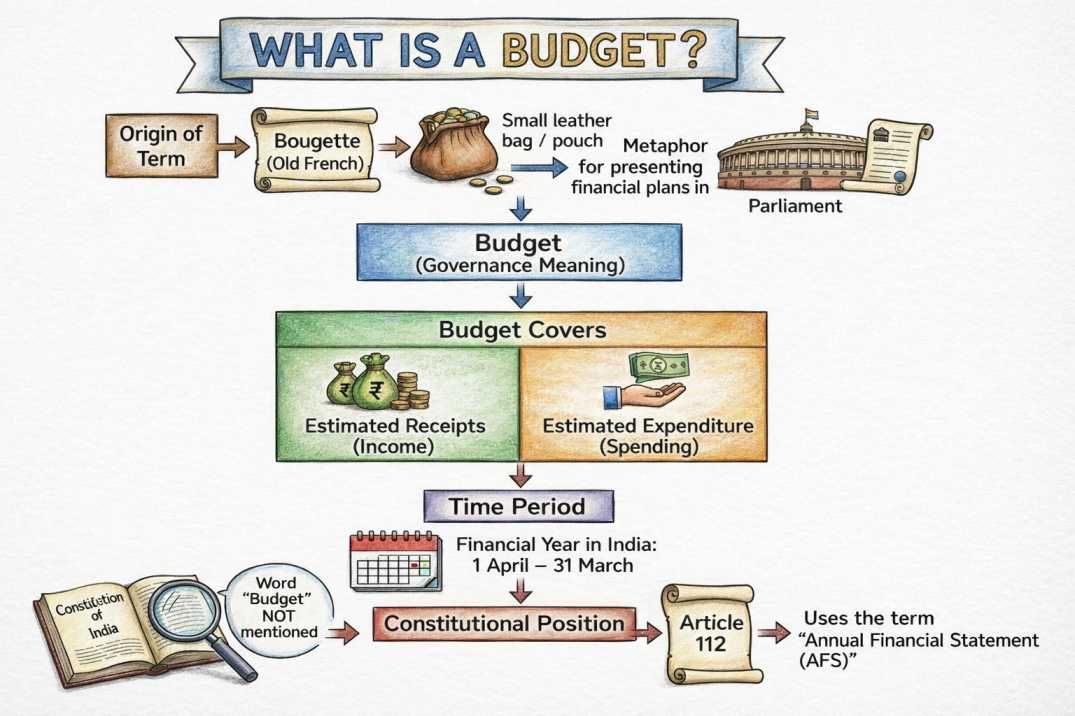
The Union Budget is the Annual Financial Statement of the Government of India, presented under Article 112 of the Constitution. It contains:
- Estimated receipts and expenditure of the Government of India
- For a financial year running from 1 April to 31 March
- Presented by the Finance Minister on behalf of the President
- Requires approval of the Lok Sabha (Money Bills)
The Budget is implemented through:
- Finance Bill (tax proposals)
- Appropriation Bill (authorisation of expenditure)
Must read: Economic Survey 2026: Key Highlights, Analysis & Summary PDF (UPSC)
Government Receipts
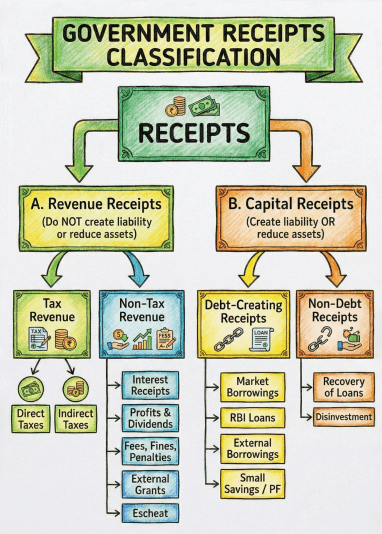
Government receipts represent all inflows of funds to the government and are broadly classified into Revenue Receipts and Capital Receipts.
Revenue Receipts
Revenue receipts are those receipts that do not result in the creation of liabilities or reduction of assets of the government.
Components of Revenue Receipts
1. Tax Revenue
- Direct Taxes: Income tax, corporate tax
- Indirect Taxes: GST, customs duty, excise duty
2. Non‑Tax Revenue
- Interest receipts on loans
- Dividends from PSUs and RBI
Capital Receipts
Capital receipts are those receipts that either create liabilities or reduce financial assets of the government.
Components of Capital Receipts
- Market borrowings
- External loans
- Recovery of loans
- Disinvestment proceeds
Government Expenditure
Government expenditure refers to all spending by the government and is classified into Revenue Expenditure and Capital Expenditure.
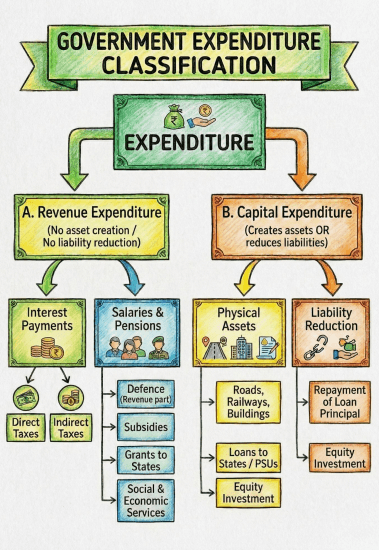
Revenue Expenditure
Revenue expenditure is expenditure incurred for the day‑to‑day functioning of the government that does not create assets or reduce liabilities.
Major Components
- Salaries and pensions
- Interest payments
- Subsidies (food, fertiliser, fuel)
Capital Expenditure (Capex)
Capital expenditure leads to the creation of assets or the reduction of liabilities and enhances the productive capacity of the economy. Examples:
- Infrastructure projects
- Railways, highways, ports
- Digital Public Infrastructure (DPI)
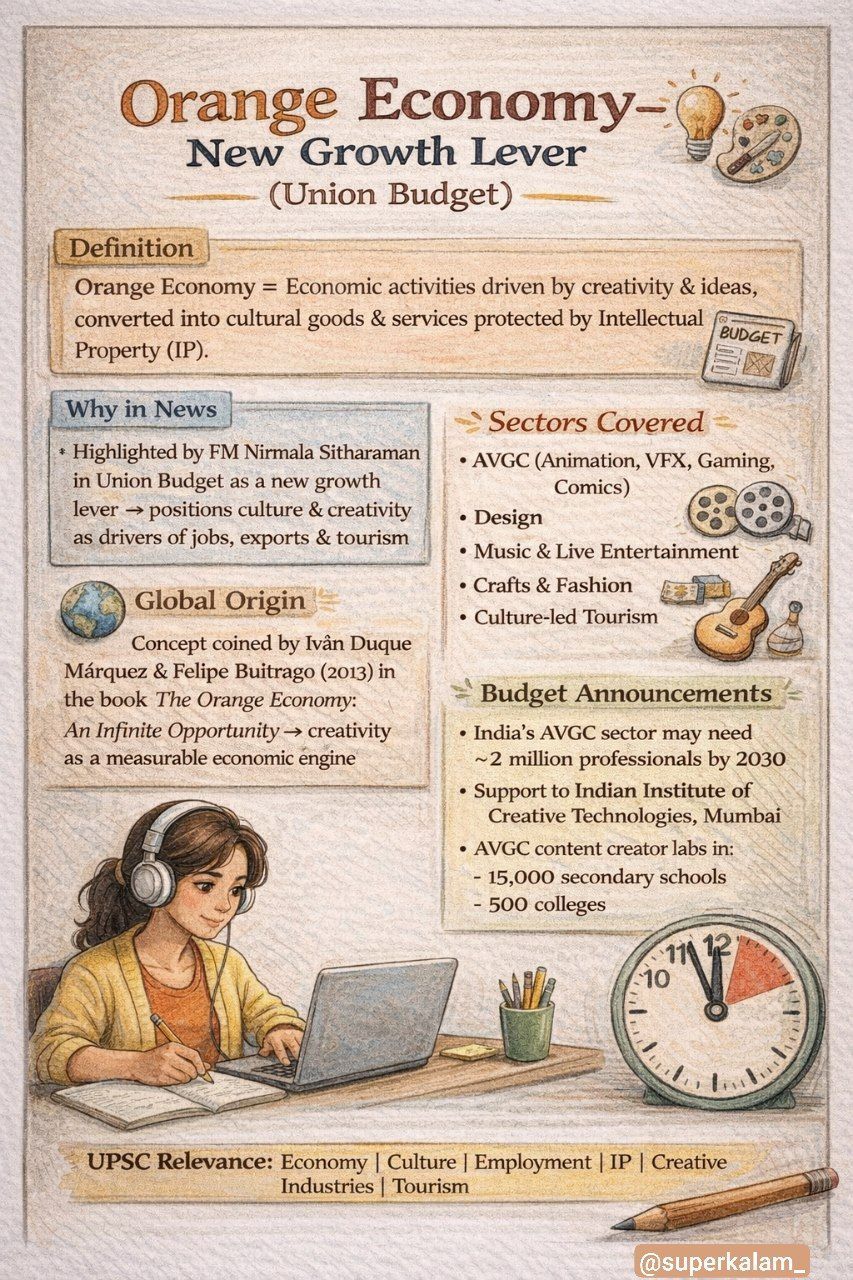
Orange Economy – Emerging Economic Concept in Budget 2026–27
The Orange Economy, also known as the Creative Economy, refers to economic activities that originate from human creativity, cultural heritage, artistic expression, innovation, and intellectual property. It includes industries such as:
- Art, culture, and heritage industries
- Media, entertainment, and digital content
- Design, fashion, architecture, and advertising
- Audio-visual services, gaming, and animation
- Knowledge-based and IP-driven activities
Economic Significance of the Orange Economy
- Employment Intensive Growth: Creative industries are labour-intensive and generate employment, especially for youth, women, and skilled professionals.
- Low Capital, High Value Creation: These sectors require relatively lower physical capital but create high economic value through innovation and intellectual property.
- Urban and Rural Linkages: The Orange Economy integrates traditional crafts and cultural heritage with modern markets, benefiting both urban and rural economies.
- Digital Economy Synergy: The growth of digital platforms has expanded market access for creative industries, enhancing scalability and global reach.
Inclusive Growth and Human Capital Development
Inclusive growth refers to an economic growth process that creates opportunities for all sections of society and ensures that the benefits of growth are equitably distributed, particularly to vulnerable and marginalised groups. It goes beyond income growth and focuses on access to education, health, skills, employment, and social security.
Human capital development forms the core foundation of inclusive growth, as long-term economic progress depends on the productivity, skills, and well-being of the population.
Must cover: Inclusive Growth UPSC Notes: Definition, Objectives and Government Schemes
Conclusion
For UPSC aspirants, Budget 2026–27 must be studied as a conceptual framework rather than a list of numbers. Understanding key concepts enables aspirants to tackle Prelims MCQs, GS‑III analytical answers, and essay questions effectively.
Now that you’ve understood the key concepts from Budget 2026–27, test your preparation. Attempt the SuperKalam practice test to check your conceptual clarity.

Attempt the test either by scanning this QR code or CLICK HERE
Start your UPSC Preparation 2026/2027 with SuperKalam
SuperKalam is your personal mentor for UPSC preparation, guiding you at every step of the exam journey. Practice, revise, and evaluate– all in one place.
Download Now