National Science Day 2026 (28th February)
National Science Day 2026 on 28 February celebrates C. V. Raman’s legacy and the theme “Women in Science: Catalysing Viksit Bharat,” highlighting STEM progress and gender inclusion for the UPSC syllabus. Read now!
Feb, 2026
•6 min read
National Science Day is celebrated every year on 28th February across India to mark the discovery of the Raman Effect by C. V. Raman on 28 February 1928. Observed every year, this day highlights the importance of scientific thinking, innovation, and research in national development. The National Science Day 2026 theme is “Women in Science: Catalysing Viksit Bharat.”
Background of National Science Day
National Science Day is celebrated to honour one of India’s greatest scientific achievements, the discovery of the Raman Effect. This discovery brought global recognition to Indian science and inspired generations of researchers and students to pursue scientific inquiry.
- Discovery of the Raman Effect (1928): On 28 February 1928, C. V. Raman discovered the Raman Effect, which explains the change in wavelength of light when it passes through a transparent material.
- Global Recognition (1930): For this groundbreaking work, C. V. Raman was awarded the Nobel Prize in Physics in 1930, becoming the first Asian to receive a Nobel Prize in the field of science.
- Proposal for National Celebration (1986): In 1986, the National Council for Science and Technology Communication (NCSTC) recommended that 28th February be observed as National Science Day.
- Official Declaration (1987): The Government of India accepted the proposal, and since 1987, National Science Day has been celebrated annually across schools, colleges, research institutions, and scientific organisations in India.
National Science Day 2026 Theme
National Science Day is observed each year with a dedicated theme that reflects India’s current scientific priorities and national goals. The theme for National Science Day 2026 is “Women in Science: Catalysing Viksit Bharat.”
- This theme emphasises the crucial role of women scientists, researchers, innovators, and technologists in building a developed and self-reliant India.
- It underlines the idea that inclusive growth in science and technology is essential for achieving the vision of Viksit Bharat.
- The theme also aligns with the initiatives and deliberations organised by the Department of Science and Technology (DST) under the Ministry of Science and Technology.
- Various seminars, panel discussions, and knowledge-sharing sessions held at Vigyan Bhawan focused on recognising women's achievements in STEM fields and addressing challenges related to representation, leadership, and equal opportunities.
Who Was C. V. Raman?
C. V. Raman (Chandrasekhara Venkata Raman) was one of India’s greatest physicists and a pioneer in the field of light scattering. His groundbreaking discovery of the Raman Effect in 1928 brought global recognition to Indian science and earned him the Nobel Prize in Physics in 1930, making him the first Asian to win a Nobel Prize in any branch of science. His work laid the foundation for modern spectroscopy and significantly advanced the study of molecular physics.

- Birth and Early Education: Born in 1888 in Tiruchirappalli, Tamil Nadu; completed higher education from the University of Madras with outstanding academic performance.
- Discovery of the Raman Effect (1928): Explained how light changes its wavelength when it passes through a transparent substance — a breakthrough in understanding light scattering.
- Nobel Laureate (1930): Awarded the Nobel Prize in Physics for his discovery, placing India prominently on the global scientific map.
- Institution Builder: Played a major role in developing scientific research in India, including his association with the Indian Institute of Science and later establishing the Raman Research Institute in 1948.
- Legacy: Awarded India’s highest civilian honour, the Bharat Ratna in 1954. His legacy continues to inspire scientists and students across generations.
C. V. Raman remains a symbol of scientific excellence and intellectual curiosity, and his contributions are commemorated every year on National Science Day.
What is the Raman Effect?
The Raman Effect is a phenomenon in physics that explains how light behaves when it passes through a transparent substance. When a beam of light travels through a liquid, solid, or gas, most of it scatters without any change in energy. However, a very small portion of the light changes its wavelength (or colour). This change happens because the light interacts with the molecules of the substance.
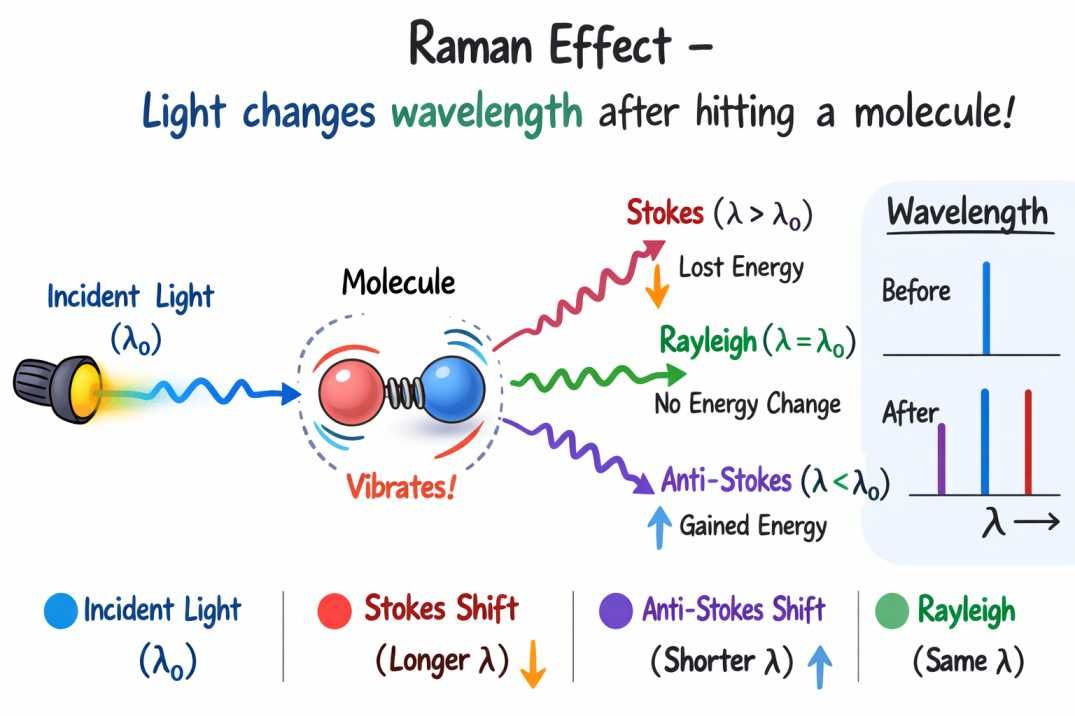
- When light hits a substance, it usually bounces back unchanged.
- But a tiny fraction of light changes its energy after interacting with molecules.
- This change in energy results in a change in wavelength.
- This shift in wavelength is called the Raman Effect.
Why is it Important?
- It helps scientists understand the molecular structure of substances.
- It forms the basis of Raman Spectroscopy, a technique widely used in chemistry, physics, medicine, and material science.
- It is used in fields like forensic science, pharmaceuticals, nanotechnology, and even space research.
Also read: Quantum Computing: Meaning, Principles & Applications - UPSC Notes
Significance of National Science Day
National Science Day is more than a commemorative event; it is a celebration of India’s scientific spirit and its journey toward innovation-driven development.
- Promotes Scientific Temper: Encourages citizens, especially students, to develop curiosity, logical reasoning, and evidence-based thinking — values enshrined in the Indian Constitution.
- Inspires Young Minds: Motivates school and college students to pursue careers in science, research, and innovation.
- Recognises Scientific Achievements: Highlights contributions of Indian scientists and institutions to global scientific advancements.
- Strengthens Innovation Ecosystem: Supports India’s vision of becoming a knowledge-based and technology-driven economy.
- Encourages Policy Dialogue: Provides a platform for discussions on science-related policies, research funding, and technological development under initiatives led by the Department of Science and Technology.
- Links Science with National Development: Connects scientific progress with goals such as sustainable development, digital transformation, healthcare innovation, and space exploration.
Overall, National Science Day serves as a reminder that science is not confined to laboratories; it plays a crucial role in governance, economic growth, and societal progress.
Women in Science & Technology: Driving Innovation for Viksit Bharat
As India moves toward becoming a developed nation, greater participation of women in STEM (Science, Technology, Engineering, and Mathematics) is not just a matter of equality but a strategic necessity for innovation, economic growth, and inclusive development. Why women’s participation is a necessity for Viksit Bharat:
- Enhances diversity in decision-making and research priorities.
- Leads to more inclusive technological solutions benefiting all sections of society.
- Contributes directly to achieving SDG 5 (Gender Equality).
- Strengthens innovation ecosystems and global competitiveness.
- Ensures science serves broader developmental goals.
Contributions & Current Developments
- Leadership in Space Missions: The Prime Minister has acknowledged the remarkable contribution of women scientists in the success of the Chandrayaan-3 mission.
- Historic ISRO Leadership: During the Chandrayaan-2 mission, for the first time, an Indian Space Research Organisation space mission was led by two women scientists.
- Missile & Rocket Leadership:
- Tessy Thomas, popularly known as the “Missile Woman of India,” has played a crucial role in India’s Agni missile programme.
- Ritu Karidhal, known as the “Rocket Woman of India,” contributed significantly to India’s Mars and lunar missions.
- Kalpana K served as Deputy Project Director in Chandrayaan missions, reflecting women’s leadership in complex space programmes.
The Gender Gap in STEM
Despite progress, structural challenges remain:
- The Global Gender Gap Report 2023 states that women constitute 27% of India’s STEM workforce, compared to 32% in non-STEM sectors.
- According to World Bank data, only 33% of researchers globally are women.
- Globally, just 18% of girls pursue higher-level STEM education, compared to 35% of boys.
- Women account for only 22% of AI professionals and 28% of engineering graduates, indicating a clear technology leadership gap.
- Scholars estimate that equal workforce participation could raise India’s GDP by nearly 10%, showing the economic importance of gender inclusion.
Policy Support & Institutional Initiatives
The Department of Science and Technology has launched multiple initiatives to promote gender equity in science:
- Science, Technology and Innovation Policy
- Indo-US Fellowship for Women in STEMM
- Vigyan Jyoti
- GATI (Gender Advancement for Transforming Institutions)
- KIRAN Scheme
- CURIE Programme
These initiatives focus on mentoring, research funding, institutional reforms, career re-entry opportunities, and improving the representation of women in leadership roles.
Must cover: AstroSat - India's First Space Observatory (UPSC Notes)
Conclusion
National Science Day 2026 reminds us that scientific progress and inclusive growth must go hand in hand. Bridging gender gaps, promoting scientific temper at the grassroots level, and supporting young innovators can transform India into a global knowledge leader. The true tribute to the legacy of C. V. Raman lies in sustained action to make science accessible, inclusive, and impactful for national development.
Start your UPSC Preparation 2027 with SuperKalam
SuperKalam is your personal mentor for UPSC preparation, guiding you at every step of the exam journey. Practice, revise, and evaluate– all in one place.
Download the App Now