The ancient civilization in the Indian sub continent differed from those of Egypt, Mesopotamia and Greece in that its culture and traditions have been preserved without breakdown to the present day. Comment.
The ancient civilization in the Indian sub continent differed from those of Egypt, Mesopotamia and Greece in that its culture and traditions have been preserved without breakdown to the present day. Comment.
The Indian subcontinent's ancient civilization uniquely demonstrates unbroken cultural continuity spanning over 5,000 years, unlike Egypt, Mesopotamia, and Greece where ancient traditions largely disappeared. This remarkable preservation distinguishes India as the world's only surviving ancient civilization.
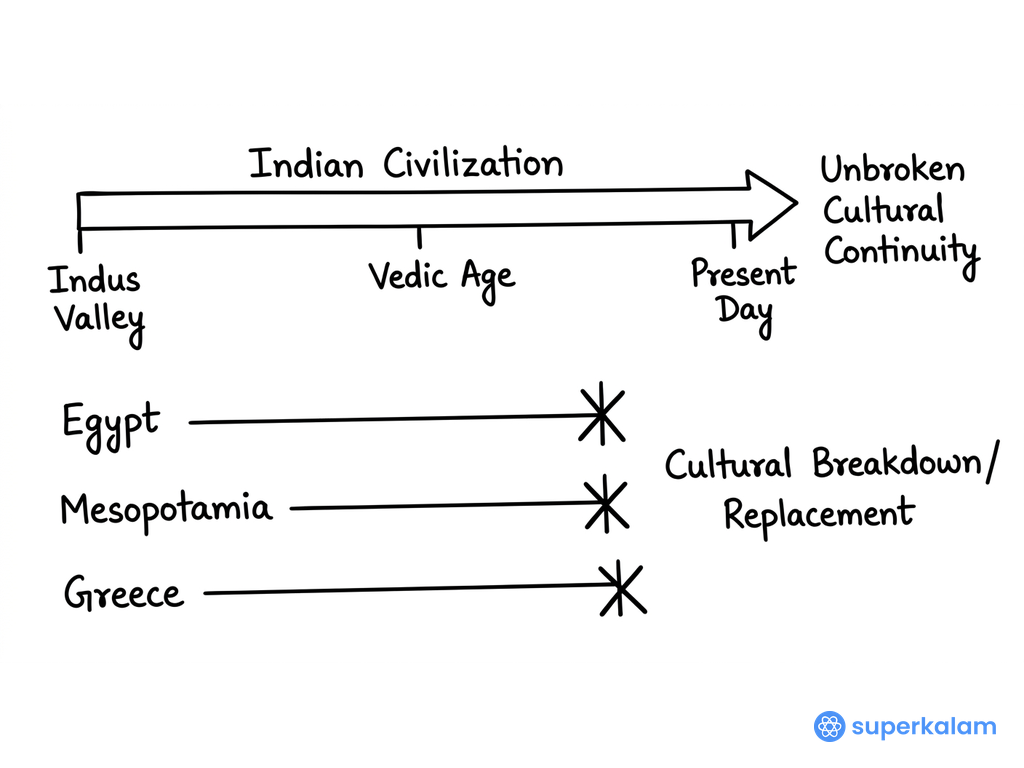
Comparative timeline with single horizontal arrow
Continuous Religious and Philosophical Traditions
- Living Religious Systems: Hinduism, Buddhism, and Jainism continue thriving with over 1.2 billion followers, while Egyptian and Greek polytheism became extinct centuries ago
- Sacred Geography: Ancient pilgrimage sites like Varanasi (3,000+ years old), Haridwar, and Kashi maintain unbroken sanctity and ritual practices
- Philosophical Continuity: Vedantic concepts from Upanishads and Bhagavad Gita actively guide modern Indian thought, unlike discontinued Greek philosophical schools
- Monastic Traditions: Shankaracharya mathas established 1,200 years ago continue functioning as centers of learning
- Festival Cycles: Ancient celebrations like Kumbh Mela (mentioned in Puranas) still draw 200+ million devotees
Linguistic and Literary Heritage Preservation
- Sanskrit Continuity: Unlike dead languages (Latin, Ancient Greek), Sanskrit remains liturgical language with 24,821 speakers (Census 2011)
- Regional Language Evolution: Tamil literary tradition spans 2,500 years continuously, while Mesopotamian Sumerian disappeared completely
- Script Development: Brahmi-derived scripts (Devanagari, Tamil, Bengali) evolved organically, unlike abandoned Egyptian hieroglyphs
- Epic Traditions: Ramayana and Mahabharata remain living oral traditions through folk performances and regional adaptations
- Manuscript Preservation: Ancient texts preserved in palm leaf manuscripts across Kerala, Tamil Nadu temples
Cultural Practices and Social Institutions
- Traditional Arts: Classical dance forms (Bharatanatyam, Odissi) maintain 2,000-year-old techniques, while Greek theater traditions ended
- Craft Continuity: Kanjeevaram silk weaving, Madhubani painting, and Tanjore art follow ancient methods unchanged
- Architectural Traditions: Dravidian and Nagara temple architecture styles continue in modern construction
- Social Systems: Ashrama (life stages) and Varna concepts persist in modified forms, showing institutional continuity
- Knowledge Systems: Ayurveda (5,000+ years old) remains practiced alongside modern medicine, unlike extinct Greek medicine
This unique civilizational continuity reflects India's extraordinary capacity for cultural synthesis and preservation. The Archaeological Survey of India documents over 3,600 protected monuments representing this unbroken heritage, making India humanity's most enduring civilization.
Answer Length
Model answers may exceed the word limit for better clarity and depth. Use them as a guide, but always frame your final answer within the exam’s prescribed limit.
Evaluate this PYQ now
Write your answer & evaluate in just 60 seconds




500+ students evaluated
Model Answers by Subject


Crack UPSC with your
Personal AI Mentor
An AI-powered ecosystem to learn, practice, and evaluate with discipline



