How far do you agree that the behaviour of the Indian monsoon has been changing due to humanising landscape? Discuss.
How far do you agree that the behaviour of the Indian monsoon has been changing due to humanising landscape? Discuss.
Recent meteorological data and climate studies indicate a significant correlation between landscape modifications and changing monsoon behavior, though the extent varies regionally across India.
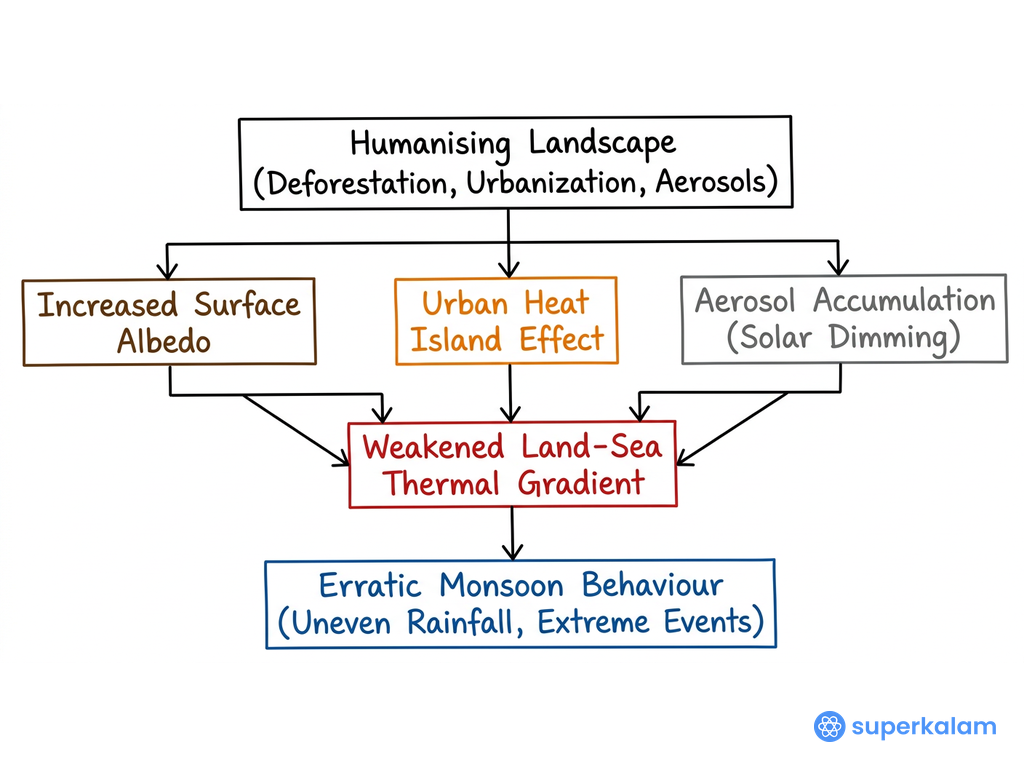
Humanizing Landscape Impact on Indian Monsoon
Urbanization Impact on Monsoon Patterns
- Urban Heat Island Effect: Cities like Mumbai and Delhi experience 2-4°C higher temperatures, creating localized convection patterns that alter rainfall timing and intensity
- Surface Modification: Concrete surfaces reduce evapotranspiration by 60-70%, disrupting the natural water cycle and moisture feedback loops
- Aerosol Pollution: Industrial emissions act as condensation nuclei, affecting cloud formation and precipitation patterns over urban areas
- Wind Pattern Disruption: High-rise buildings create turbulence, affecting natural wind corridors essential for monsoon circulation
- Demographic Pressure: India's urban population projected to reach 600 million by 2031, intensifying anthropogenic influence on local climate systems
Deforestation and Agricultural Land Conversion
- Forest Cover Loss: India lost 1.97 million hectares of forest cover between 2000-2020, reducing evapotranspiration and moisture recycling capacity
- Western Ghats Degradation: Deforestation in this biodiversity hotspot has altered orographic rainfall patterns along the west coast
- Wetland Destruction: Loss of 38% of wetlands since 1970s has reduced natural water storage and local humidity levels
- Monoculture Expansion: Replacement of diverse vegetation with single crops affects local microclimate and soil moisture retention
- Soil Degradation: Over 96.4 million hectares affected by land degradation, reducing natural water absorption capacity
| Factor | Impact on Monsoon | Evidence |
|---|---|---|
| Urbanization | Localized rainfall increase/decrease | Mumbai receives 15% more rainfall than surrounding areas |
| Deforestation | Reduced moisture recycling | 20% decline in forest-dependent rainfall |
| Agriculture | Altered evapotranspiration | Changed soil moisture patterns |
Regional Variations and Evidence
- Western Coast: Increased rainfall intensity due to urban heat islands in Mumbai and Pune regions
- Gangetic Plains: Delayed monsoon onset linked to reduced forest cover in catchment areas
- Central India: Erratic rainfall patterns correlating with mining and industrial activities
- Northeast Region: Shifting rainfall patterns due to slash-and-burn agriculture and deforestation
- Coastal Areas: Sea-level rise and coastal development affecting traditional monsoon dynamics
Climate Data Supporting Evidence
- Temperature Rise: India experienced 0.7°C warming over the past century, altering atmospheric circulation patterns
- Rainfall Variability: Increased coefficient of variation in rainfall from 12% (1951-1980) to 18% (1991-2020)
- Extreme Events: 75% increase in heavy precipitation events over urban areas since 2000
- Seasonal Shift: Monsoon onset delayed by 5-7 days in several regions due to anthropogenic factors
The evidence strongly supports that human landscape modifications have significantly altered monsoon behavior through the National Monsoon Mission and Climate Change Action Plan, requiring urgent implementation of nature-based solutions and sustainable urban planning.
Answer Length
Model answers may exceed the word limit for better clarity and depth. Use them as a guide, but always frame your final answer within the exam’s prescribed limit.
Evaluate this PYQ now
Write your answer & evaluate in just 60 seconds




500+ students evaluated
Model Answers from
- 2015Indian Geography12.5 MarksView Answer
The states of Jammu and Kashmir, Himachal Pradesh and Uttarakhand are reaching the limits of ecological carrying capacity due to tourism. Critically evaluate.
- 2015Indian Geography12.5 MarksView Answer
India is well endowed with fresh water resources. Critically examine why it still suffers from water scarcity.
- 2015Indian Geography12.5 MarksView Answer
Mumbai, Delhi and Kolkata are the three Megacities of the country but the air pollution is a much more serious problem in Delhi as compared to the other two. Why is this so?
Model Answers by Subject


Crack UPSC with your
Personal AI Mentor
An AI-powered ecosystem to learn, practice, and evaluate with discipline



