Analyse & practice 14 years of PYQs to crack UPSCPractice Now

UPSC Prelims 2021 Analysis

Subject-Wise MCQ Distribution

  • Environment & Ecology (18 questions): Consistently a major component due to its relevance in both the Civil Services Examination (CSE) and the Indian Forest Service (IFoS) prelims. Several questions required maps for identifying key environmental regions.
  • Indian Polity (18 questions): A high-weightage subject with several assertion-based and conceptual questions.
  • Economy (14 questions): Covered major economic policies, fiscal measures, and budget-related aspects.
  • Science & Technology (13 questions): Focused on innovations, emerging technologies, and applications in real-world scenarios.
  • History (24 questions total):
    • Ancient History: 3 questions
    • Medieval History: 4 questions
    • Modern History: 7 questions
    • Art & Culture: 10 questions, including match the following-based formats.
  • Geography (9 questions total):
    • Indian Geography: 5 questions
    • Physical Geography: 2 questions
    • World Geography: 2 questions
  • Social Issues & Schemes (2 questions): Covered important government initiatives and their societal impact.
  • International Relations (2 questions): Focused on international organizations and global events, underlining the importance of reading newspapers and NCERT basics.
Subject-Wise Weightage
Subject-Wise Weightage in UPSC Prelims 2021

Difficulty Analysis

  • Easy (35 questions): Required fundamental NCERT knowledge and factual recall.
  • Medium (38 questions): Needed deeper analytical abilities and elimination techniques.
  • Hard (27 questions): Demanded conceptual clarity, particularly in assertion-reasoning and interdisciplinary topics.
Difficulty-Level Distribution
Difficulty-Level Distribution in UPSC Prelims 2021

Variations in Question Framing

  • Multi-Statement Based Questions: A large portion of the paper tested analytical abilities by requiring candidates to determine the correctness of multiple statements.
  • Direct Questions: Some questions were fact-based, relying on static knowledge from textbooks and previous UPSC question papers.
  • Application-Based Questions: Many questions in Economy and Science & Technology assessed real-world applications of concepts.
  • Match the Following: Commonly seen in Art & Culture, Geography, and Environment sections.
Variations of Questions
Variations of Questions in UPSC Prelims 2021

Static vs Current Affairs Distribution

  • Static Content: Dominated the paper with key subjects like History, Polity, Geography, and Economy forming the foundation.
  • Current Affairs (22 questions): Focused on recent government policies, budget highlights, and global events influencing India.
     

Key Learnings for Future Preparation

  • Master Static & Current Affairs: A blend of both is necessary, especially for high-weightage subjects like Polity, Economy, and Environment.
  • Strengthen Analytical Abilities: Many questions required assertion-reasoning, elimination techniques, and multi-statement evaluation.
  • Focus on Budget & Economic Policies: Economy and budget-related topics remain crucial for UPSC preparation.
  • Practice Match the Following & Statement-Based MCQs: These were heavily featured in Geography, History, and Environment sections.
  • Utilize Maps for Geography & Environment: Many UPSC last year question papers have included map-based questions, making this an essential skill.
     
The UPSC Prelims 2021 exam tested both factual knowledge and analytical reasoning across diverse subjects. Environment, Polity, and Economy carried significant weight, with interdisciplinary questions integrating static and current affairs. Strong preparation in core areas like Polity, Economy, and Geography, coupled with map skills and current affairs awareness, remains essential.

QUESTION 1

GS

Easy

World Geography

Prelims 2021

The vegetation of savannah consists of grassland with scattered small trees, but extensive areas have no trees. The forest development in such areas is generally kept in check by one or more or a combination of some conditions. Which of the following are such conditions?

  1. Burrowing animals and termites
  2. Fire
  3. Grazing herbivores
  4. Seasonal rainfall
  5. Soil properties

Select the correct answer using the codes given below

A. 1 and 2

B. 4 and 5

C. 2, 3 and 4

D. 1, 3 and 5
Explanation

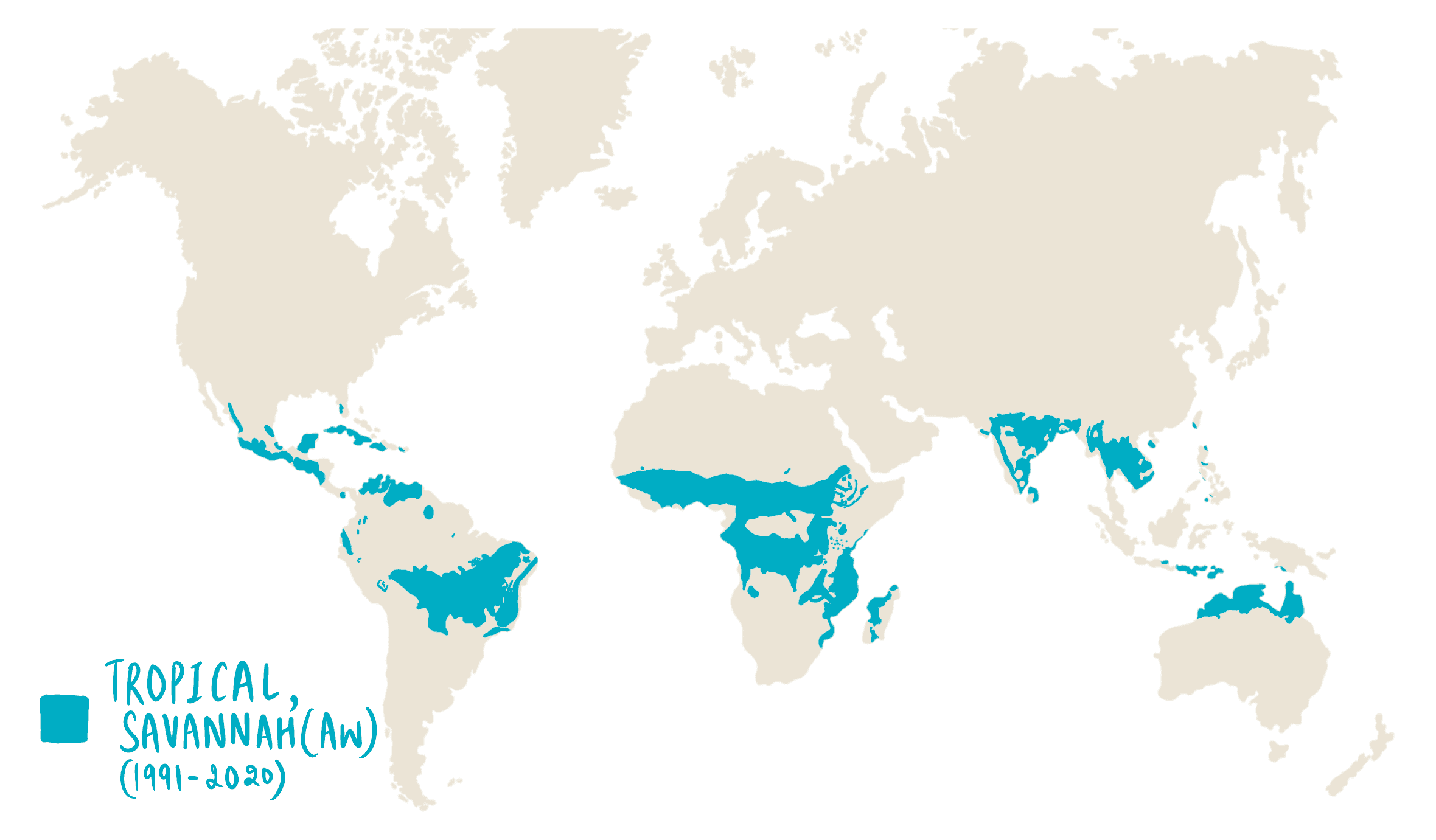
The vegetation of savannah consists of grassland with scattered small trees. The forest development in such areas is generally kept in check by one or more or a combination of some conditions. These conditions include fire, grazing herbivores, and seasonal rainfall.

2. Fire is a common occurrence in savannahs and it helps to maintain the grassland by burning out tree saplings.

3. Grazing herbivores also help to maintain the grassland by eating young tree saplings before they can grow into mature trees.

4. Seasonal rainfall also plays a role as it affects the growth of trees and grasses.

1. Burrowing animals and termites, while they do have an impact on the ecosystem, are not the primary factors controlling forest development.

5. Similarly, soil properties can affect the types of vegetation that can grow, but they are not the primary factors controlling forest development in savannahs.

Therefore, the correct answer is (c) 2, 3 and 4.

**Savannah Climate: **

  • It is a transitional climate between equatorial rainforests and hot deserts.
  • It has wet and dry seasons like the monsoon climate but with much less rainfall. Unlike the monsoon climate, it lacks a distinct rainy season.
  • It has only two seasons—winter and summer, with rain occurring in summer. The savanna landscape features tall grasses and scattered short trees.
  • The savanna is called the ‘big game country’ because thousands of animals are hunted or trapped annually by people worldwide.
Savannah Climate

Savannah Climate


QUESTION 2

GS

Hard

Indian Geography

Prelims 2021

Consider the following statements:

  1. Moringa (drumstick tree) is a leguminous evergreen tree.
  2. Tamarind tree is endemic to South Asia.
  3. In India, most of the tamarind is collected as minor forest produce.
  4. India exports tamarind and seeds of moringa.
  5. Seeds of moringa and tamarind can be used in the production of biofuels.

Which of the statements given above are correct?

A. 1, 2, 4 and 5

B. 3, 4 and 5

C. 1, 3 and 4

D. 1, 2, 3 and 5

Explanation

Statement 1 is Incorrect: Moringa oleifera (drumstick tree) is a deciduous tree, not an evergreen one. Furthermore, it belongs to the family Moringaceae and is not a leguminous plant; it does not possess root nodules for nitrogen fixation.

Statement 2 is Incorrect: The Tamarind tree (Tamarindus indica) is native to tropical Africa. While it is widely grown and naturalized in India, it is not endemic to South Asia.

Statement 3 is Correct: In India, tamarind is categorized and collected as Minor Forest Produce (MFP). It serves as a vital source of income for many tribal and forest-dwelling communities.

Statement 4 is Correct: India is a major exporter of tamarind. Similarly, moringa seeds are exported for their high oil content and medicinal properties.

Statement 5 is Correct: Seeds of both plants have biofuel potential. Moringa seeds have a high oil content (about 30-40%) that can be processed into biodiesel, and tamarind seed oil is also researched for similar applications in the energy sector.


QUESTION 3

GS

Medium

Indian Geography

Prelims 2021

With reference to India, Didwana, Kuchaman, Sargol and Khatu are the names of

A. Glaciers

B. Mangrove areas

C. Ramsar sites

D. Saline lakes

Explanation

Didwana, Kuchaman, Sargol, and Khatu are the names of saline lakes of Rajasthan.


QUESTION 4

GS

Medium

Indian Geography

Prelims 2021

Consider the following rivers:

  1. Brahmani
  2. Nagavali
  3. Subarnarekha
  4. Vamsadhara

Which of the above rise from the Eastern Ghats?

A. 1 and 2

B. 2 and 4

C. 3 and 4

D. 1 and 3

Explanation

Statement 1 is Incorrect: The Brahmani river is formed by the confluence of the Sankh and South Koel rivers near Rourkela; these headstreams originate in the Chota Nagpur Plateau of Jharkhand, not the Eastern Ghats.

Statement 2 is Correct: The Nagavali river (also known as Langulya) originates in the Eastern Ghats near Lakhbahal in the Kalahandi district of Odisha.

Statement 3 is Incorrect: The Subarnarekha river originates in the Chota Nagpur Plateau near Ranchi in Jharkhand and flows through West Bengal and Odisha before entering the Bay of Bengal.

Statement 4 is Correct: The Vamsadhara river originates in the Eastern Ghats near Lanjigarh in the Kalahandi district of Odisha and flows through Andhra Pradesh before joining the Bay of Bengal.


QUESTION 5

GS

Medium

Physical Geography

Prelims 2021

Consider the following statements:

  1. In the tropical zone, the western sections of the oceans are warmer than the eastern sections owing to the influence of trade winds.
  2. In the temperate zone, westerlies make the eastern sections of oceans warmer than the western sections.

Which of the statements given above is/are correct?

A. 1 Only

B. 2 Only

C. Both 1 and 2

D. Neither 1 nor 2
Explanation

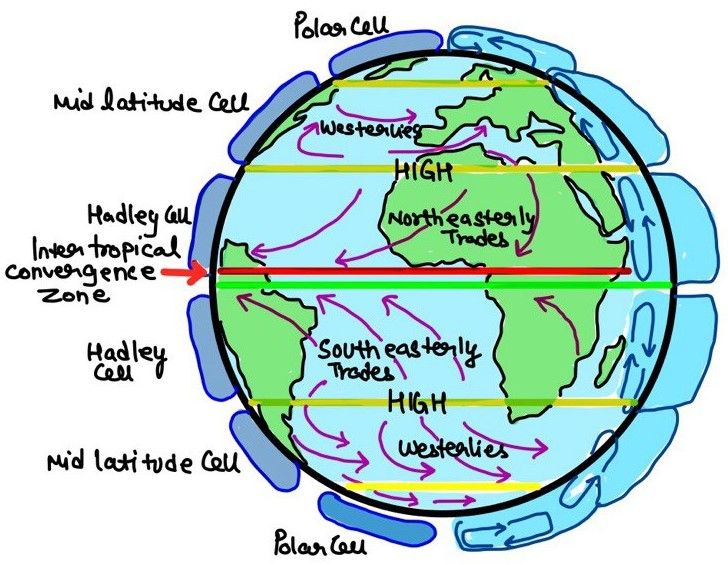
Statement 1 is correct. The trade winds in the tropical zone blow from east to west, causing the western sections of the oceans to be warmer than the eastern sections. This is because these winds push the warm surface waters towards the west.

Statement 2 is correct. On the other hand, in the temperate zone, the westerlies blow from west to east. These winds push the warm waters towards the eastern sections of the oceans, making them warmer than the western sections.

Therefore, both statements are correct.

Wind Systems

Wind Systems


QUESTION 6

GS

Hard

Indian Geography

Prelims 2021

With reference to the Indus river system, of the following four rivers, three of them pour into one of them which joins the Indus direct. Among the following, which one is such river that joins the Indus direct?

A. Chenab

B. Jhelum

C. Ravi

D. Sutlej

Explanation

The Sutlej is the river that joins the Indus directly after receiving the collective drainage of the other three rivers. According to NCERT Class 11 (India: Physical Environment), the Jhelum and Ravi rivers join the Chenab, and the Chenab subsequently joins the Sutlej in Pakistan. The Sutlej then flows into the Indus a few kilometres above Mithankot. Thus, the Sutlej acts as the final conduit for the combined waters of the Jhelum, Ravi, and Chenab before their confluence with the Indus. This geographical sequence is confirmed by the official UPSC Answer Key for the 2021 Prelims, which identifies Option D as the correct answer.


QUESTION 7

GS

Easy

World Geography

Prelims 2021

“Leaf litter decomposes faster than in any other biome and as a result the soil surface is often almost bare. Apart from trees, the vegetation is largely composed of plant forms that reach up into the canopy vicariously, by climbing the trees or growing as epiphytes, rooted on the upper branches of trees”. This is the most likely description of

A. coniferous forest

B. dry deciduous forest

C. mangrove forest

D. tropical rain forest

Explanation

The description provided is characteristic of the Tropical Rain Forest (Tropical Evergreen Forest).

  • Rapid Decomposition: Tropical rain forests are characterized by high temperatures and high humidity throughout the year. These conditions facilitate intense microbial activity, causing leaf litter to decompose much faster than in any other biome. As a result, nutrients are quickly reabsorbed by plants, leaving the soil surface almost bare of organic matter.
  • Vegetation and Epiphytes: Due to the dense, multi-layered canopy, very little sunlight reaches the forest floor. To survive, many plant forms have adapted by climbing trees (lianas) or growing as epiphytes (plants that grow on the branches of trees to access sunlight without being parasitic).
  • Key Species: Common trees include Mahogany, Rosewood, Aini, and Ebony.
  • Distribution in India: According to NCERT, these forests are found in regions with heavy rainfall (over 200 cm), specifically the Western Ghats, the Northeastern states, and the Andaman & Nicobar Islands.

In contrast, coniferous forests have slow decomposition due to cold climates; dry deciduous forests have seasonal leaf fall and less dense canopies; and mangrove forests are specialized for saline coastal environments with distinct stilt roots.


QUESTION 8

GS

Easy

Indian Geography

Prelims 2021

The black cotton soil of India has been formed due to the weathering of

A. brown forest soil

B. fissure volcanic rock

C. granite and schist

D. shale and limestone
Explanation

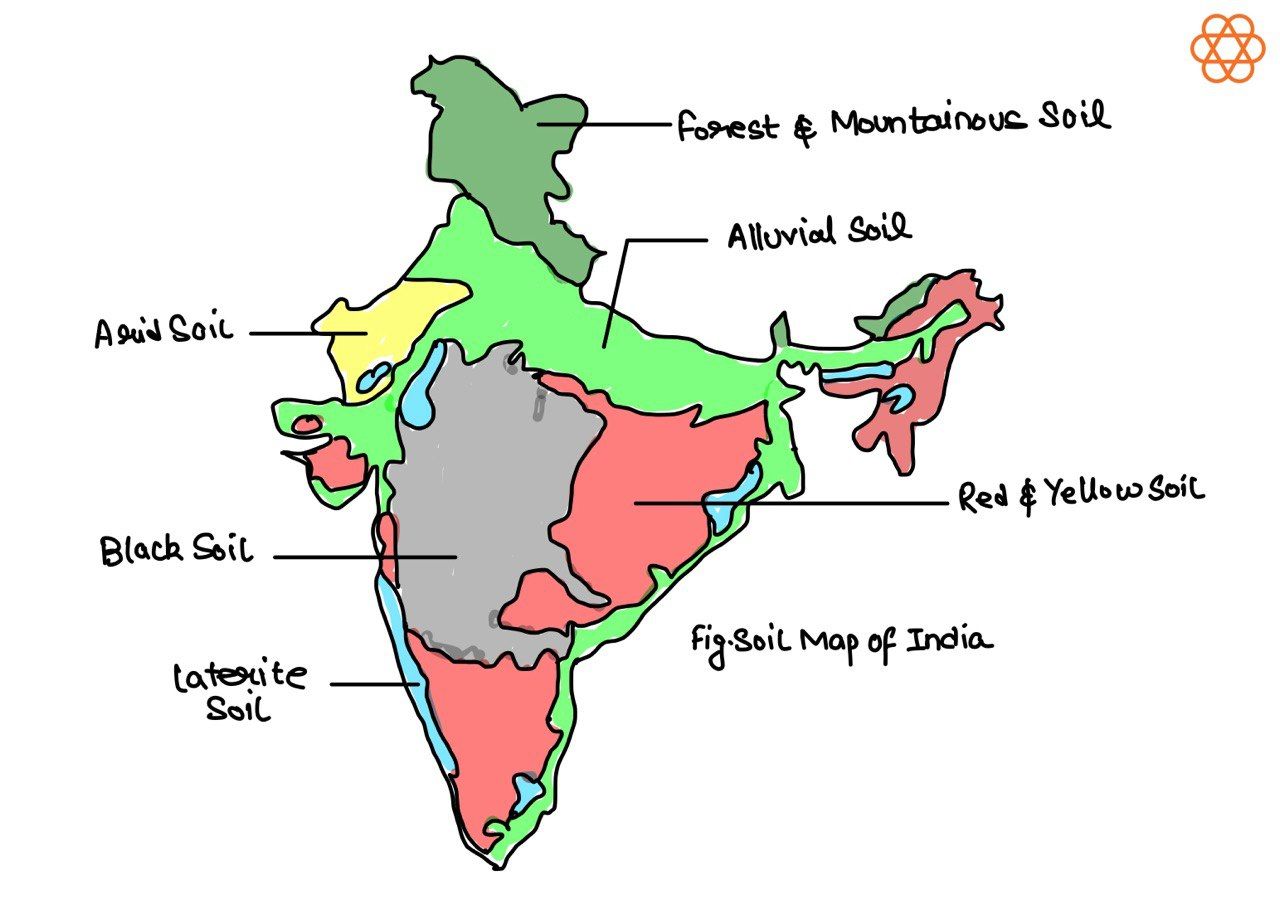
  • Black soil in India is formed by the weathering of fissure volcanic rock.
  • Climatic conditions along with the parent rock material are the important factors for the formation of black soil.
  • Black soils are spread mostly across interior Gujarat, Maharashtra, Karnataka, and Madhya Pradesh on the Deccan lava plateau and the Malwa Plateau, where there is both moderate rainfall and underlying basaltic rock.
Soils in India

Soils in India

Brown Forest Soil:

  • Develops in temperate forest regions with moderate rainfall.
  • It is rich in organic matter, fertile, and well-drained.

Granite and Schist:

  • Granite is a hard, igneous rock rich in quartz and feldspar, used in construction.
  • Schist is a metamorphic rock with flaky layers, formed under heat and pressure.

Shale and Limestone

  • Shale is a fine-grained sedimentary rock, often a source of oil and natural gas.
  • Limestone is a sedimentary rock rich in calcium carbonate, used in cement production.

QUESTION 9

GS

Medium

Physical Geography

Prelims 2021

With reference to the water on the planet Earth, consider the following statements:

  1. The amount of water in the rivers and lakes is more than the amount of groundwater.
  2. The amount of water in polar ice caps and glaciers is more than the amount of groundwater.

Which of the statements given above is/are correct?

A. 1 Only

B. 2 Only

C. Both 1 and 2

D. Neither 1 nor 2
Explanation

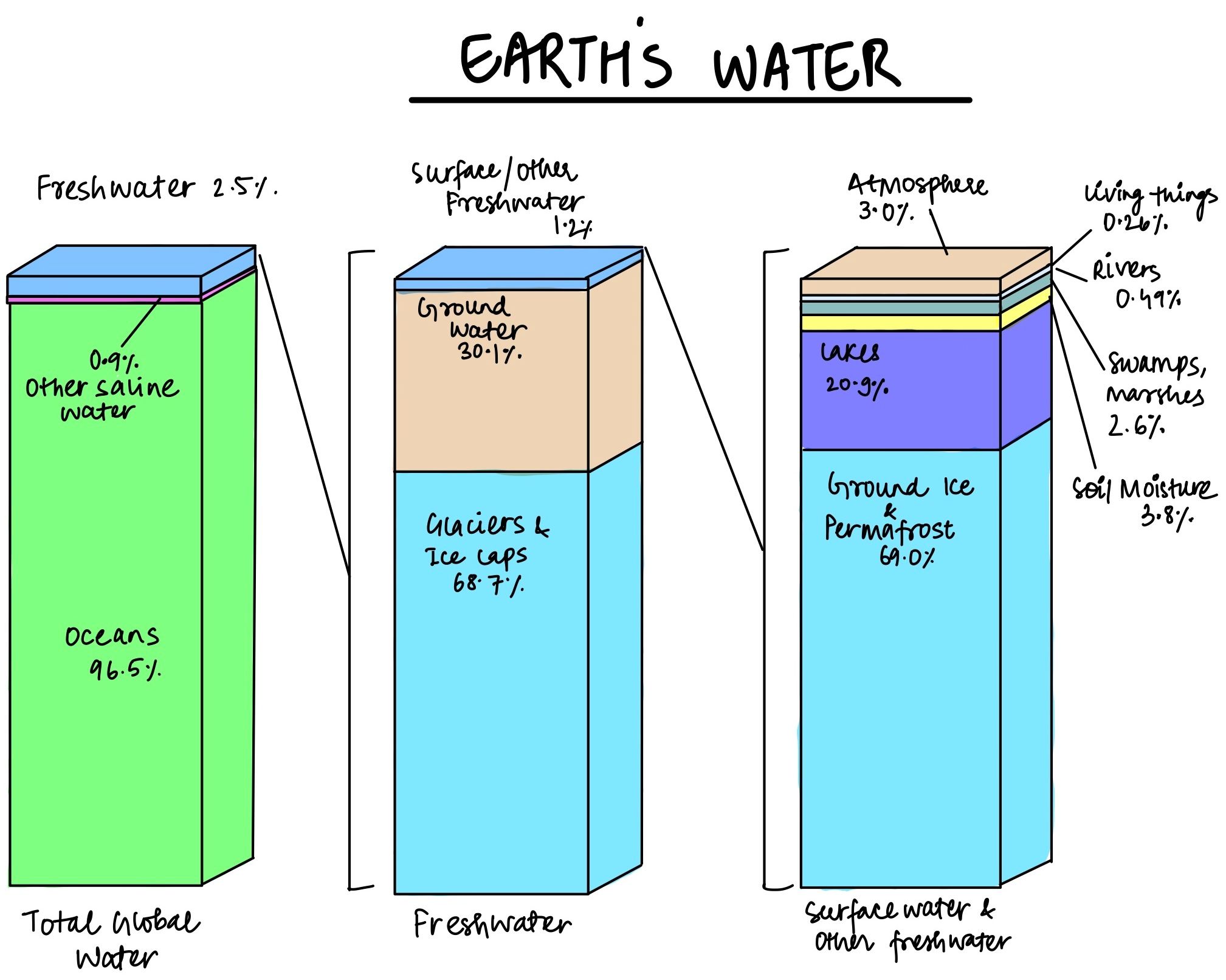
Statement 1 is incorrect. When we consider the distribution of water on Earth, we find that the amount of water in rivers and lakes is actually less than the amount of groundwater. This is because groundwater is stored in the Earth's crust, in the pores and spaces between rocks and soil, and it accounts for a significant portion of the Earth's fresh water. On the other hand, rivers and lakes, while visible and important for many ecosystems, actually hold a relatively small amount of the Earth's total water.

Earth's Water Distribution

Earth's Water Distribution

Statement 2 is correct. The amount of water in polar ice caps and glaciers is indeed more than the amount of groundwater. This is because these ice caps and glaciers, particularly those in Antarctica and Greenland, hold the majority of the Earth's fresh water.

Share
SuperKalam
SuperKalam is your personal mentor for UPSC preparation, guiding you at every step of the exam journey.

Download the App

Get it on Google PlayDownload on the App Store
Follow us

ⓒ Snapstack Technologies Private Limited


