Analyse & practice 14 years of PYQs to crack UPSCPractice Now

UPSC Prelims 2016 Analysis

Subject wise MCQ distribution

  • Environment & Ecology (22 Questions): The most dominant subject, covering biodiversity, climate change, conservation efforts, and environmental legislation. Many questions incorporated maps for better understanding.
  • Economy (17 Questions): Included monetary policies, fiscal policy, banking, government schemes, and international economic developments. This section was heavily inclined towards current affairs and required strong analytical abilities for elimination-based questions.

  • Science & Technology (13 Questions): Focused on emerging technologies, biotechnology, AI, space research, and their recent developments. Many questions followed an assertion-reasoning format to test conceptual understanding.

  • International Relations (11 Questions): Heavy emphasis on India’s foreign policy, international organizations like the New Development Bank and International Monetary and Financial Committee. Some questions required match the following format.

  • Social Issues & Schemes (11 Questions): Included government schemes & initiatives like MUDRA Yojana and Stand Up India Scheme along with policies related to education, health, and nutrition. Many questions were framed using the elimination technique.

  • Indian Polity (5 Questions): A relatively low count, marking a departure from UPSC’s usual trend of high-weightage in this section. However, the questions that appeared tested deep constitutional concepts and analytical abilities.

  • History (10 Questions Combined): Ancient (1), Medieval (3), and Modern (6), with a focus on factual recall rather than analytical aspects. Many were match the following or multi-statement-based, requiring careful reading.

  • Geography (Indian Geography: 4, World & Physical Geography: 0): Minimal representation, making it one of the least emphasized subjects in this year’s paper. Questions required strong NCERT-based conceptual clarity, especially in maps and location-based understanding.

Prelims 2016
Subject-Wise Weightage in UPSC Prelims 2016

Difficulty analysis

  • Medium Difficulty (57 Questions): The largest portion, demanding conceptual clarity and critical thinking.
  • Hard Questions (29 Questions): A significant number, testing advanced knowledge and deeper analytical skills.

  • Easy Questions (14 Questions): A relatively small proportion, offering limited direct scoring opportunities.

Prelims 2016
Difficulty-Level Distribution in UPSC Prelims 2016

Variations in Question framing

  • Multi-Statement Questions (57%) – The most common type, requiring analytical skills and elimination strategies. These appeared more frequently in Polity and Environment.
  • Direct Questions (43%) – Straightforward factual recall, mainly seen in History and Science & Technology.

Prelims 2016
Variations of Questions in UPSC Prelims 2016

Current Affairs vs. Static Questions

  • Current Affairs-Based (60 Questions): The paper marked a shift from the trend observed over the past four years. UPSC has increasingly focused on current affairs, making it crucial for aspirants to stay updated.
  • Static-Based (40 Questions): Still significant but much lower compared to previous years, highlighting UPSC’s shift towards contemporary relevance.

Key learning for Future Preparation

  • Prioritize Current Affairs: Given that 60% of the questions were current-based, aspirants should regularly follow newspapers, government reports, and international developments.
  • Strengthen Environment & Ecology Preparation: The dominance of this section indicates that topics like climate change, environmental policies, and sustainability should be high-priority study areas.
  • Develop Multi-Statement Question Solving Techniques: Since more than half the paper consisted of multi-statement questions, mastering elimination techniques is essential.
  • Balance Conceptual & Factual Knowledge: Subjects like Economy and Science & Technology require both static understanding and awareness of recent developments.
  • Focus on Analytical Thinking: The difficulty level and multi-statement nature of the paper suggest that rote memorization alone is insufficient—conceptual clarity is key.
The UPSC Prelims 2016 paper emphasized current affairs, with a strong focus on Environment, Economy, and History. Polity and Geography had moderate representation. The mix of direct and multi-statement questions required both factual knowledge and analytical skills, highlighting the importance of integrating static concepts with current events.

QUESTION 1

GS

Easy

Social Issues & Schemes

Prelims 2016

Pradhan Mantri MUDRA Yojana is aimed at -

A. Bringing the small entrepreneurs into the formal financial system

B. Providing loans to poor farmers for cultivating particular crops

C. Providing pensions to old and destitute persons

D. Funding the voluntary organization involved in the promotion of skill development and employment generation

Explanation

Pradhan Mantri MUDRA Yojana (PMMY) is aimed at providing affordable credit to micro and small enterprises (MSEs) in the non-farm sector.

Here's a breakdown of its key objectives

  • Financial Inclusion: MUDRA helps bring unbanked or underserved entrepreneurs into the formal financial system, enabling them to access loans from banks and other financial institutions.
  • Loan Products: The scheme offers a range of loan products categorized under three categories based on loan amount Shishu (up to Rs. 50,000), Kishore (above Rs. 50,000 up to Rs. 5 lakh), and Tarun (above Rs. 5 lakh up to Rs. 10 lakh).
  • Focus on Non-Farm Sector: MUDRA loans cater to income-generating micro enterprises engaged in manufacturing, trading, or service activities. - Activities allied to agriculture, like poultry, dairy, and beekeeping, are also included.

Hence, option A is the correct answer.


QUESTION 2

GS

Medium

Social Issues & Schemes

Prelims 2016

Which of the following is/are the indicator/indicators used by IFPRI to compute the Global Hunger Index Report?

  1. Undernourishment
  2. Child stunting
  3. Child mortality

Select the correct answer using the code given below:

A. 1 only

B. 2 and 3 only

C. 1, 2 and 3

D. 1 and 3 only
Explanation

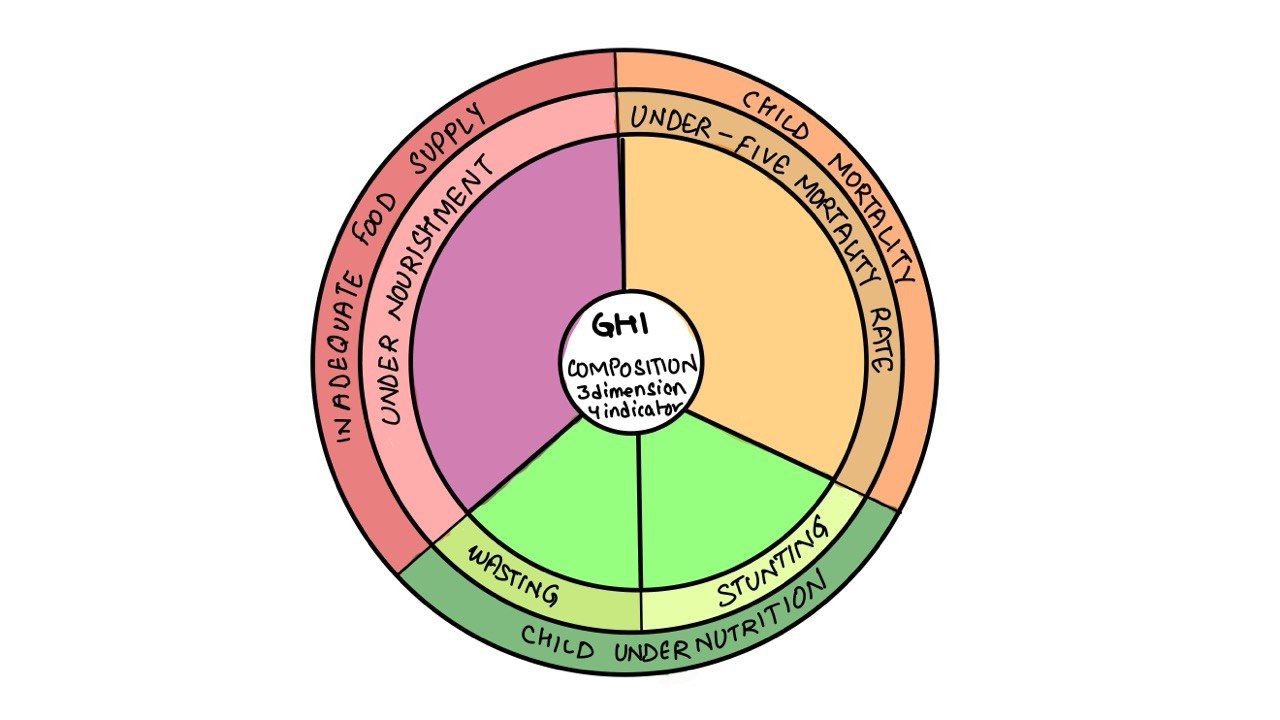
All three indicators (1, 2, and 3) are used by IFPRI (International Food Policy Research Institute) to compute the Global Hunger Index Report.

The Global Hunger Index (GHI) is a tool designed to comprehensively measure and track hunger at global, regional, and national levels. It's a peer-reviewed annual report, now jointly published by Concern Worldwide and Welthungerhilfe.

Purpose: To assess hunger severity and track progress towards ending hunger.

Each country's GHI score is calculated based on a formula that combines four indicators that together capture the multidimensional nature of hunger

  • Undernourishment - The share of the population whose caloric intake is insufficient;
  • Child Stunting - The share of children under the age of five who have low height for their age, reflecting chronic undernutrition;
  • Child Wasting - The share of children under the age of five who have low weight for their height, reflecting acute undernutrition; and
  • Child Mortality - The share of children who die before their fifth birthday, reflecting in part the fatal mix of inadequate nutrition and unhealthy environments.
Global Hunger Index

Global Hunger Index

Hence, option C is the correct answer.


QUESTION 3

GS

Medium

Social Issues & Schemes

Prelims 2016

What is/are the purpose of ‘District Mineral Foundations” in India?

  1. Promoting mineral explorative activities in mineral-rich districts
  2. Protecting the interests of the persons affected by mining operations
  3. Authorizing State Governments to issue licenses for mineral exploration

Select the correct answer using the code given below:

A. 1 and 2 only

B. 2 only

C. 1 and 3 only

D. 1, 2 and 3

Explanation

District Mineral Foundations (DMFs) were established in India under the Mines and Minerals (Development and Regulation) Amendment Act, 2015.

Statement 1 is Incorrect: Promoting mineral exploration activities in mineral-rich districts is not a stated objective of DMFs.

Statement 2 is Correct: The primary purpose of DMFs is to work for the welfare and benefit of areas and individuals affected by mining-related operations. This includes protecting the interests of the persons affected by mining operations.

Statement 3 is Incorrect: However, DMFs do not have the authority to issue licenses for mineral exploration, as this is the responsibility of the State Governments. Their focus is more on the welfare of the affected persons and areas.

Hence, option B is the correct answer.


QUESTION 4

GS

Hard

Social Issues & Schemes

Prelims 2016

With reference to ‘Initiative for Nutritional Security through Intensive Millets Promotion’, which of the following statements is/are correct?

  1. This initiative aims to demonstrate the improved production and post-harvest technologies and to demonstrate value addition techniques, in an integrated manner, with a cluster approach.
  2. Poor, small, marginal and tribal farmers have a larger stake in this scheme.
  3. An important objective of the scheme is to encourage farmers of commercial crops to shift to millet cultivation by offering them free kits of critical inputs of nutrients and micro-irrigation equipment.

Select the correct answer using the code given below.

A. 1 only

B. 2 and 3 only

C. 1 and 2 only

D. 1, 2 and 3

Explanation

Statement 1 is Correct: Launched in 2011-12 as part of the Rashtriya Krishi Vikas Yojana (RKVY), the Initiative for Nutritional Security through Intensive Millets Promotion (INSIMP) was designed to demonstrate improved production and post-harvest technologies, including value addition, using a cluster-based approach to enhance millet productivity.

Statement 2 is Correct: Millets are traditionally grown in rainfed and arid regions with poor soil quality. The primary cultivators in these regions are small, marginal, and tribal farmers who lack access to expensive irrigation; therefore, the scheme specifically targets these vulnerable groups as they have the largest stake in millet production.

Statement 3 is Incorrect: The scheme provides 'Minikits' and input kits (nutrients and plant protection) to farmers within identified millet clusters to improve existing yields. It does not include a mandate or specific incentives to encourage farmers of commercial crops to shift to millet cultivation.


QUESTION 5

GS

Medium

Social Issues & Schemes

Prelims 2016

‘Rashtriya Garima Abhiyaan’ is a national campaign to -

A. rehabilitate the homeless and destitute persons and provide them with suitable sources of livelihood

B. release the sex workers from the practice and provide them with alternative sources of livelihood

C. eradicate the practice of manual scavenging and rehabilitate the manual scavenger

D. release the bonded labourers from their bondage and rehabilitate them

Explanation

Rashtriya Garima Abhiyaan (National Campaign for Dignity and Eradication of Manual Scavenging) is a community-led national movement started in 2001 by the NGO Jan Sahas Social Development Society and other civil society organizations. Its primary objective is to eradicate the practice of manual scavenging and ensure the rehabilitation of manual scavengers through alternative livelihoods and social dignity. The campaign gained significant national attention through the 'Maila Mukti Yatra' (March for Liberation from Manual Scavenging), which mobilized thousands of women to leave the practice and demand their rights. While the Ministry of Social Justice and Empowerment implements government schemes like the 'Self Employment Scheme for Rehabilitation of Manual Scavengers' (SRMS), the specific 'Rashtriya Garima Abhiyaan' is a grassroots civil society initiative.


QUESTION 6

GS

Medium

Social Issues & Schemes

Prelims 2016

With reference to ‘Stand Up India Scheme’, which of the following statements is/are correct?

  1. Its purpose is to promote entrepreneurship among SC/ST and women entrepreneurs.
  2. It provides for refinancing through SIDBI.

Select the correct answer using the code given below.

A. 1 only

B. 2 only

C. Both 1 and 2

D. Neither 1 nor 2

Explanation

Statement 1 is Correct: The Stand-up India scheme aims at promoting entrepreneurship among women and scheduled castes and tribes.

Statement 2 is Correct: The scheme is anchored by the Department of Financial Services (DFS), Ministry of Finance, Government of India.

  • The scheme provides for a refinance window through Small Industries Development Bank of India (SIDBI) with an initial amount of Rs, 10,000 Crore.
  • Stand-Up India Scheme facilitates bank loans between Rs 10 lakh and Rs 1 Crore to at least one Scheduled Caste (SC) or Scheduled Tribe (ST) borrower and at least one woman borrower per bank branch for setting up a greenfield enterprise.
  • This enterprise may be in manufacturing, services or the trading sector.
  • In the case of non-individual enterprises, at least 51% of the shareholding and controlling stake should be held by either an SC/ST or woman entrepreneur.

Hence, option C is the correct answer.


QUESTION 7

GS

Medium

Social Issues & Schemes

Prelims 2016

‘SWAYAM’, an initiative of the Government of India, aims at

A. Promoting Self Help Groups in rural areas

B. Providing financial and technical assistance to young start-up entrepreneurs

C. Promoting the education and health of adolescent girls

D. Providing affordable and quality education to the citizens for free

Explanation

SWAYAM (Study Webs of Active-Learning for Young Aspiring Minds) is a programme initiated by the Government of India (Ministry of Education) designed to achieve the three cardinal principles of Education Policy: Access, Equity, and Quality.

Key Features of SWAYAM:

  1. Objective: To bridge the digital divide for students who have remained untouched by the digital revolution and have not been able to join the mainstream of the knowledge economy.
  2. Content: It provides an integrated platform for online courses (MOOCs), covering school (9th class) to Post-Graduation level. These courses are developed by experts from premier institutions like IITs, IIMs, and Central Universities.
  3. Cost: The courses hosted on SWAYAM are available free of cost to the citizens. However, a nominal fee is charged if a learner requires a certificate.
  4. Quadrants: The platform offers a four-quadrant approach: video lectures, specially prepared reading material that can be downloaded/printed, self-assessment tests, and an online discussion forum for clearing doubts.

QUESTION 8

GS

Medium

Social Issues & Schemes

Prelims 2016

Regarding ‘Atal Pension Yojana’, which of the following statements is/are correct?

  1. It is a minimum guaranteed pension scheme mainly targeted at unorganized sector workers
  2. Only one member of a family can join the scheme
  3. Some amount of pension is guaranteed for the spouse for life after the subscriber’s death.

Select the correct answer using the code given below:

A. 1 only

B. 2 and 3 only

C. 1 and 3 only

D. 1, 2 and 3

Explanation

Statement 1 is Correct: Atal Pension Yojana is a minimum guaranteed pension scheme primarily targeted at unorganized sector workers in India. It encourages saving for retirement through regular contributions during their working years.

Statement 2 is Incorrect: There is no restriction on the number of family members who can join the Atal Pension Yojana scheme. As long as they meet the eligibility criteria (age 18-40 and savings bank account), multiple members within a family can enroll.

Statement 3 is Correct: Atal Pension Yojana provides a pension benefit for the spouse after the subscriber's death. The spouse becomes the nominee and receives a pension, though the specific amount might differ depending on the chosen pension plan by the subscriber.

Hence, option C is the correct answer.


QUESTION 9

GS

Medium

Social Issues & Schemes

Prelims 2016

With reference to ‘Pradhan Mantri Fasal Bima Yojana’, consider the following statements:

  1. Under this scheme, farmers will have to pay a uniform premium of two per cent for any crop they cultivate in any season of the year.
  2. This scheme covers post-harvest losses arising out of cyclones and unseasonal rains.

Which of the statements given above is/are correct?

A. 1 only

B. 2 only

C. Both 1 and 2

D. Neither 1 nor 2
Explanation

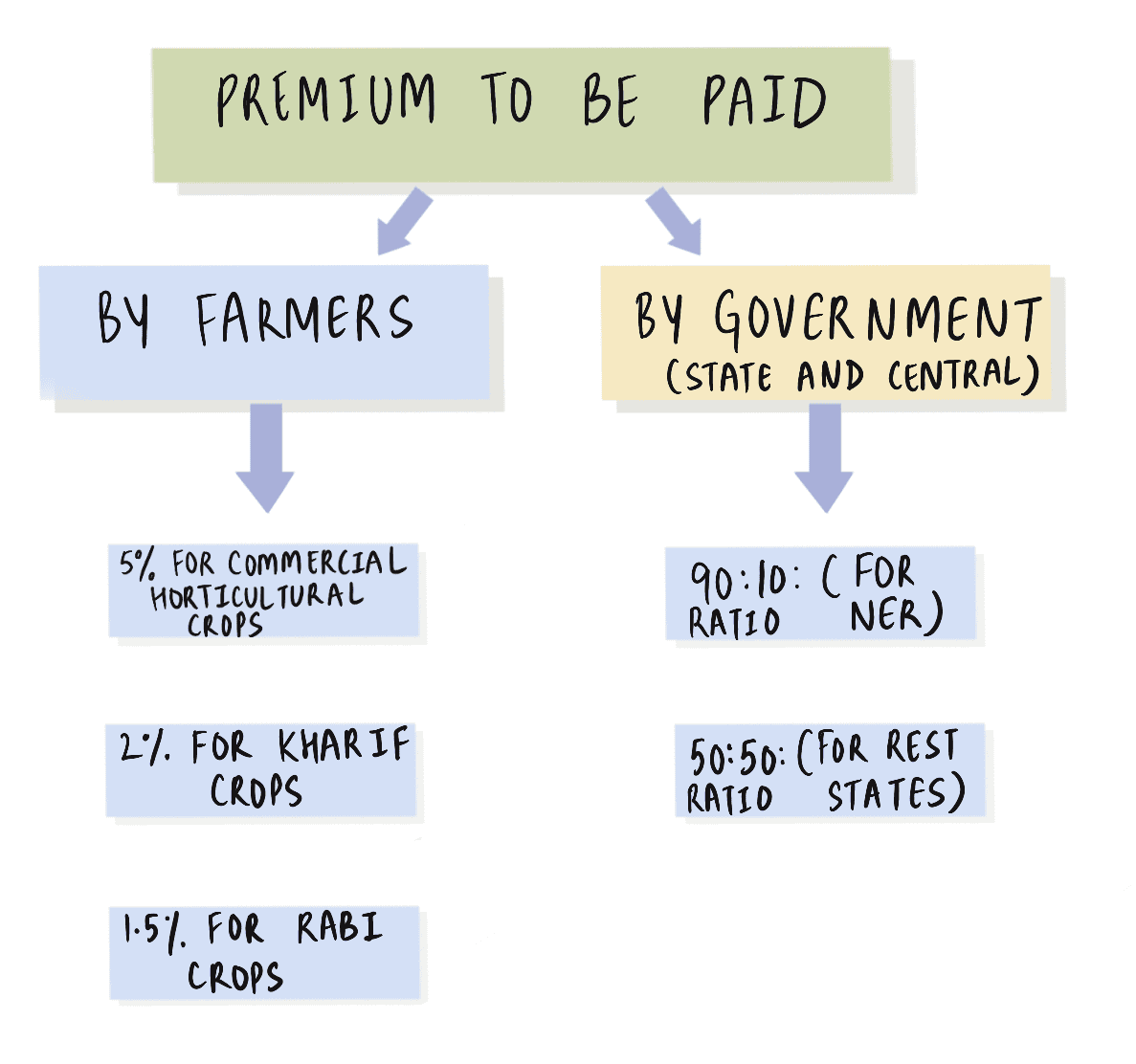
The Pradhan Mantri Fasal Bima Yojana (PMFBY) is a government-sponsored crop insurance scheme.

Statement 1 is Incorrect: Under this scheme, farmers have to pay a uniform premium of 2% for all Kharif crops, 1.5% for all Rabi crops, and 5% for commercial/horticultural crops. The premium rate is not uniform for all crops in all seasons.

PM Fasal Bima Yojana

PM Fasal Bima Yojana

Statement 2 is Correct: The scheme does cover post-harvest losses arising out of cyclones and unseasonal rains.

Hence, option B is the correct answer.


QUESTION 10

GS

Easy

Social Issues & Schemes

Prelims 2016

‘Mission Indradhanush’ launched by the Government of India pertains to -

A. Immunization of children and pregnant women

B. Construction of smart cities across the country

C. India’s own search for Earth-like planets in outer space

D. New Educational policy

Explanation

Mission Indradhanush was launched by the Ministry of Health and Family Welfare (MoHFW), Government of India, in December 2014.

Key Features of Mission Indradhanush:

  • Objective: To achieve full immunization coverage for all children up to two years of age and pregnant women.
  • Disease Coverage: It provides life-saving vaccines against several diseases, including Diphtheria, Whooping Cough, Tetanus, Polio, Tuberculosis, Measles, Meningitis, and Hepatitis B.
  • Intensified Mission Indradhanush (IMI): Subsequent phases like IMI 2.0, 3.0, 4.0, and 5.0 were launched to further reach unvaccinated or partially vaccinated children in remote and high-priority districts.

Note: Do not confuse this with the 'Indradhanush Plan' for Public Sector Banks (PSBs), which is a separate framework for banking reforms.

Hence, option A is the correct answer.

Share
SuperKalam
SuperKalam is your personal mentor for UPSC preparation, guiding you at every step of the exam journey.

Download the App

Get it on Google PlayDownload on the App Store
Follow us

ⓒ Snapstack Technologies Private Limited

