UPSC Prelims 2014 Question Paper & Analysis
Get UPSC Prelims Previous Year Question (PYQ) Papers with detailed explanations, mindmaps, organized year-wise and subject-wise for CSAT.
PYQs with Detailed Answers
- View Answer for: Out of a total of 120 musicians in a club, 5% can play all the three instruments, guitar, violin and flute. It so happens that the number of musicians who can play any and only two of the above instruments is 30. The number of musicians who can play guitar alone is 40. What is the total number those who can play violin alone or flute alone?
Out of a total of 120 musicians in a club, 5% can play all the three instruments, guitar, violin and flute. It so happens that the number of musicians who can play any and only two of the above instruments is 30. The number of musicians who can play guitar alone is 40. What is the total number those who can play violin alone or flute alone?
- View Answer for: There are 50 students admitted to a nursery class. Some students can speak only English and some can speak only Hindi. 10 student can speak both English and Hindi. If the number of students who can speak English $21$, then how many students can speak Hindi how many can speak only Hindi and how many can speak only English ?
There are 50 students admitted to a nursery class. Some students can speak only English and some can speak only Hindi. 10 student can speak both English and Hindi. If the number of students who can speak English , then how many students can speak Hindi how many can speak only Hindi and how many can speak only English ?
- View Answer for: If the 3rd day of a month is Monday, which one of the following will be the fifth day from the 21st of this month?
If the 3rd day of a month is Monday, which one of the following will be the fifth day from the 21st of this month?
- View Answer for: There are seven persons up on a ladder, A, B, C, D, E, F and G (not in that order). A is further up than E but is lower than C. B is in the middle. G is between A and B. E is between B and F. If F is between E and D, the person on the bottom step of the ladder will be
There are seven persons up on a ladder, A, B, C, D, E, F and G (not in that order). A is further up than E but is lower than C. B is in the middle. G is between A and B. E is between B and F. If F is between E and D, the person on the bottom step of the ladder will be
- View Answer for: Consider the following figures:20Change in positions of beads in the figures above follows a sequence. Follows the same sequence, which of the figures look should appear as the fifth figure above?
Consider the following figures:

20
Change in positions of beads in the figures above follows a sequence. Follows the same sequence, which of the figures look should appear as the fifth figure above?
A, B, C, D, E, F are members of a family. They are engineer, stenographer, doctor, draughtsman, lawyer and judge (not in order). A, the engineer is married to the lady stenographer. The judge is married to the lawyer. F, the draughtsman is the son of B and brother of E. C, the lawyer is the daughter-in-law of D. E is the unmarried doctor. D is the grandmother of F. There are two married couples in the family.
View Answer for: What is the profession of B?What is the profession of B?
- View Answer for: Consider the table given below in which the numbers bear certain relationship among themselves along the rows:17Which one of the following numbers is the missing number indicated above by X ?
Consider the table given below in which the numbers bear certain relationship among themselves along the rows:
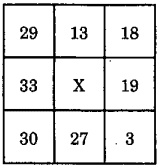
17
Which one of the following numbers is the missing number indicated above by X ?
- View Answer for: Consider the following matrix with one empty block in the lower extreme corner:18Which of the following figures could fit in the empty block and thus complete the matrix?
Consider the following matrix with one empty block in the lower extreme corner:
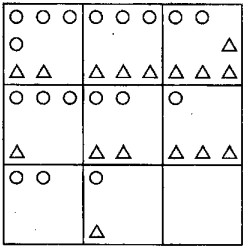
18
Which of the following figures could fit in the empty block and thus complete the matrix?
- View Answer for: In a group of six women there are four dancers, four vocal musicians, one actress and three violinists. Girija and Vanaja are among the violinists while Jalaja and Shailaja do not know how to play on the violin. Shailaja and Tanuja are among the dancers. Jalaja, Vanaja, Shailaja and Tanuja are all vocal musicians and two of them are also violinists. If Pooja is an actress, who among the following is certainly a dancer and a violinist?
In a group of six women there are four dancers, four vocal musicians, one actress and three violinists. Girija and Vanaja are among the violinists while Jalaja and Shailaja do not know how to play on the violin. Shailaja and Tanuja are among the dancers. Jalaja, Vanaja, Shailaja and Tanuja are all vocal musicians and two of them are also violinists. If Pooja is an actress, who among the following is certainly a dancer and a violinist?
- View Answer for: The number of deaths among the army personnel is 8 in 1000, but among the civilian population it is 20 per 1000. Which one of the following inferences can be drawn from this statement?
The number of deaths among the army personnel is 8 in 1000, but among the civilian population it is 20 per 1000. Which one of the following inferences can be drawn from this statement?
- View Answer for: In a row 'A' is in the 11th position from the left and 'B' is in the 10th position from the right. If 'A' and 'B' interchange, then 'A' becomes 18th from the left. How many persons are there in the row other than 'A' and 'B'?
In a row 'A' is in the 11th position from the left and 'B' is in the 10th position from the right. If 'A' and 'B' interchange, then 'A' becomes 18th from the left. How many persons are there in the row other than 'A' and 'B'?
- View Answer for: Six identical cards are placed on a table. Each card has number '1' marked on one side and number '2' marked on its other side. All the six cards are placed in such a manner that the number '1' is on the upper side. In one try, exactly four (neither more nor less) cards are turned upside down. In how many Ieast number of tries can the cards be turned upside down such that all the six cards show number '2' on the upper side?
Six identical cards are placed on a table. Each card has number '1' marked on one side and number '2' marked on its other side. All the six cards are placed in such a manner that the number '1' is on the upper side. In one try, exactly four (neither more nor less) cards are turned upside down. In how many Ieast number of tries can the cards be turned upside down such that all the six cards show number '2' on the upper side?
- View Answer for: Six books are labelled A, B, C, D, E and F and are placed side by side. Books B, C, E and F have green covers while others have yellow covers. Books A, B and D are new while the rest are old volumes. Books A, B and C are law reports while the rest are medical extracts. Which two books are old medical extracts and have green covers?
Six books are labelled A, B, C, D, E and F and are placed side by side. Books B, C, E and F have green covers while others have yellow covers. Books A, B and D are new while the rest are old volumes. Books A, B and C are law reports while the rest are medical extracts. Which two books are old medical extracts and have green covers?
- View Answer for: Consider the following matrix:15Which one of the following figures fits into blank part of the above matrix?
Consider the following matrix:
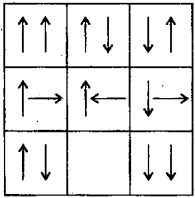
15
Which one of the following figures fits into blank part of the above matrix?
- View Answer for: Liberty, therefore, is never real unless the Government can be called to account when it invades rights."one of the following is the best justification of the above statement?
Liberty, therefore, is never real unless the Government can be called to account when it invades rights."
one of the following is the best justification of the above statement?
- View Answer for: Four children are sitting in a row. A is occupying the seat next to B but not next to C. If C is not sitting next to D, who is/are occupying seat/seats adjacent to D?
Four children are sitting in a row. A is occupying the seat next to B but not next to C. If C is not sitting next to D, who is/are occupying seat/seats adjacent to D?
- View Answer for: Four persons, Alok, Bhupesh, Chander and Dinesh have a total of Rs. 100 among themselves. Alok and Bhupesh between them have as much money as Chander and Dinesh between them, but Alok has more money than Bhupesh; and Chander has only half the money that Dinesh has. Alok has in fact Rs. 5 more than Dinesh has. Who has the maximum amount of money?
Four persons, Alok, Bhupesh, Chander and Dinesh have a total of Rs. 100 among themselves. Alok and Bhupesh between them have as much money as Chander and Dinesh between them, but Alok has more money than Bhupesh; and Chander has only half the money that Dinesh has. Alok has in fact Rs. 5 more than Dinesh has. Who has the maximum amount of money?
- View Answer for: Examine the following statements: George attends Music classes on Monday. He attends Mathematics classes on Wednesdays. His Literature classes are not on Friday. He attends History classes on the day following the day of his Mathematics classes. On Tuesday, he attends his Sports classes.If he attends just one subject in a day and his Sunday is free, then he is also free on
Examine the following statements:
- George attends Music classes on Monday.
- He attends Mathematics classes on Wednesdays.
- His Literature classes are not on Friday.
- He attends History classes on the day following the day of his Mathematics classes.
- On Tuesday, he attends his Sports classes.
If he attends just one subject in a day and his Sunday is free, then he is also free on
- View Answer for: The letters L, M, N, 0, P, Q, R, S and T in their order are substituted by nine integers 1 to 9 but not in that order. 4 is assigned to P. The difference between P and T is 5. The difference between N and T is 3. What is the integer assigned to N?
The letters L, M, N, 0, P, Q, R, S and T in their order are substituted by nine integers 1 to 9 but not in that order. 4 is assigned to P. The difference between P and T is 5. The difference between N and T is 3. What is the integer assigned to N?
- View Answer for: Consider that: A is taller than B. C is taller than A. D is taller than C. E is the tallest of all.If they are made to sit in the above order of their height, who will occupy the mid position?
Consider that:
- A is taller than B.
- C is taller than A.
- D is taller than C.
- E is the tallest of all.
If they are made to sit in the above order of their height, who will occupy the mid position?
- View Answer for: A question paper must have a question on one of the eight poets: A, B, C, D, E, F, G or H The first four belong to the medieval period while the rest are considered modern poets Generally, modern poets figure in the question paper in alternate years. Generally those who like H like G also; and those who like F like E also. The paper-setter does not like to ask about F as he has written a book on F, but he likes F. Last year, the paper contained a question on A. On the basis of the information given, this year's paper is most likely to contain a question on
A question paper must have a question on one of the eight poets: A, B, C, D, E, F, G or H The first four belong to the medieval period while the rest are considered modern poets Generally, modern poets figure in the question paper in alternate years. Generally those who like H like G also; and those who like F like E also. The paper-setter does not like to ask about F as he has written a book on F, but he likes F. Last year, the paper contained a question on A. On the basis of the information given, this year's paper is most likely to contain a question on
- View Answer for: Given the statement: "Buses are the cause of more accidents than cars, and trucks causes fewer accidents than buses", which of the following conclusions can we draw?
Given the statement: "Buses are the cause of more accidents than cars, and trucks causes fewer accidents than buses", which of the following conclusions can we draw?
- View Answer for: Consider the following statements: There are six villages A, B, C, D, E and F.F is 1 km to the west of D. B is 1 km to the east of E. A is 2 km to the north of E. C is 1 km to the east of A. D is 1 km to the south of A.Which three villages are in a line?
Consider the following statements: There are six villages A, B, C, D, E and F.
F is 1 km to the west of D. B is 1 km to the east of E. A is 2 km to the north of E. C is 1 km to the east of A. D is 1 km to the south of A.
Which three villages are in a line?
- View Answer for: Examine the following figure:Which one of the following figures has the above figure embedded in it?14
Examine the following figure:
Which one of the following figures has the above figure embedded in it?

14
A, B, C, D, E, F are members of a family. They are engineer, stenographer, doctor, draughtsman, lawyer and judge (not in order). A, the engineer is married to the lady stenographer. The judge is married to the lawyer. F, the draughtsman is the son of B and brother of E. C, the lawyer is the daughter-in-law of D. E is the unmarried doctor. D is the grandmother of F. There are two married couples in the family.
View Answer for: Which of the following is/are couple/couples?Which of the following is/are couple/couples?
A, B, C, D, E, F are members of a family. They are engineer, stenographer, doctor, draughtsman, lawyer and judge (not in order). A, the engineer is married to the lady stenographer. The judge is married to the lawyer. F, the draughtsman is the son of B and brother of E. C, the lawyer is the daughter-in-law of D. E is the unmarried doctor. D is the grandmother of F. There are two married couples in the family.
View Answer for: What is the profession of D?What is the profession of D?
- View Answer for: Assume that the hour and minute hands of a clock move without jerking. the clock shows a time between 8 o'clock and 9 o'clock. the two hands of the clock are one above the other.After how many minutes (nearest integer) with the two hands will be again lying one above the other?
Assume that
- the hour and minute hands of a clock move without jerking.
- the clock shows a time between 8 o'clock and 9 o'clock.
- the two hands of the clock are one above the other.
After how many minutes (nearest integer) with the two hands will be again lying one above the other?
Trusted by 2L aspirants
Practice UPSC Prelims PYQs Smarter
- Track accuracy & weak areas
- See past trends & repeated themes
Frequently Asked Questions
Are these the complete UPSC Prelims 2014 questions?
Can I practise these questions before seeing the answers?
Are these answers based on the official UPSC answer key?
Crack UPSC with your
Personal AI Mentor
An AI-powered ecosystem to learn, practice, and evaluate with discipline



