"The centre of global trade is gradually shifting from the Atlantic region to the Indo-Pacific region." Examine this statement.
"The centre of global trade is gradually shifting from the Atlantic region to the Indo-Pacific region." Examine this statement.
The global economic pivot is transitioning from the North Atlantic to the Indo-Pacific, a region housing 60% of the world population and generating 40% of global GDP, marking the onset of the "Asian Century."
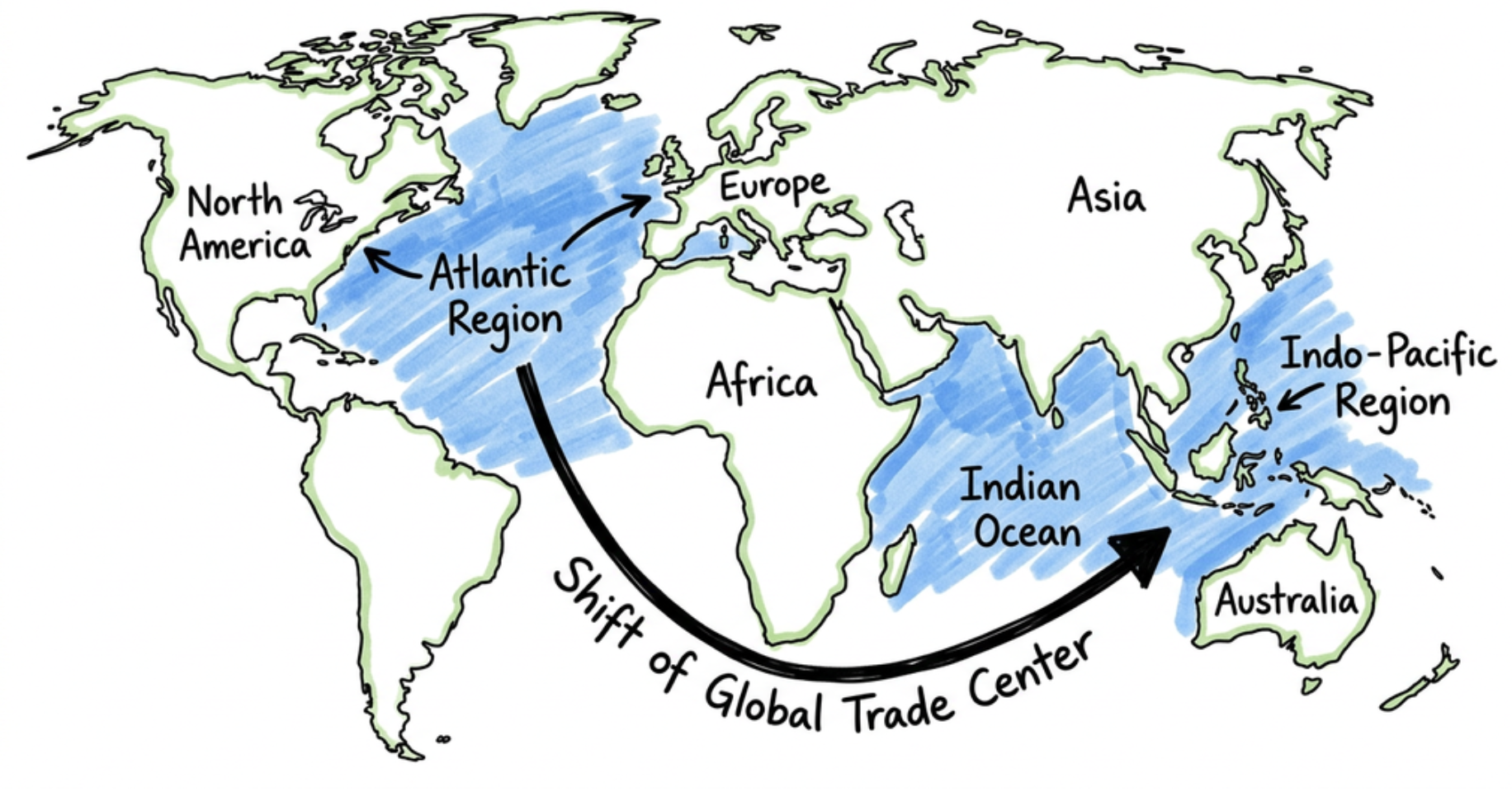
Shift of Global Trade Centre from Atlantic to Indo-Pacific
Drivers of the Shift to the Indo-Pacific
-
Demographic Dividend: Large working-age populations drive production and consumption.
- Eg: India’s median age is ~28, compared to ~43 in Europe.
-
Manufacturing Dominance: The region serves as the "Global Factory" for electronics and textiles.
- Eg: Vietnam and Thailand's growth via the "China Plus One" strategy.
-
Resource Abundance: Home to critical minerals essential for the green energy transition.
- Eg: Indonesia’s massive Nickel reserves for EV batteries.
-
Mega-Trade Blocs: Creation of large-scale integrated markets reduces tariff barriers.
- Eg: Regional Comprehensive Economic Partnership (RCEP) and CPTPP.
-
Infrastructure Expansion: Massive investments in port connectivity and maritime hubs.
- Eg: Development of the International North-South Transport Corridor (INSTC).
-
Energy Transit: Strategic chokepoints facilitate the bulk of global energy trade.
- Eg: Strait of Malacca handling over 25% of global sea-borne oil.
-
Technological Innovation: Rapid advancement in digital infrastructure and fintech.
- Eg: India’s Unified Payments Interface (UPI) and Singapore’s smart-logistics.
-
Maritime Connectivity: Shift of shipping lanes from the Mediterranean-Atlantic to the Indian Ocean.
- Eg: 9 of the 10 busiest container ports are now in the Indo-Pacific.
Indicators and Challenges to the Shift
-
FDI Inflows: The region now attracts nearly 40% of global Foreign Direct Investment.
- Eg: Record capital inflows into India and ASEAN during 2023.
-
Strategic Competition: Militarization and territorial disputes threaten trade stability.
- Eg: Overlapping claims in the South China Sea affecting freedom of navigation.
-
Institutional Resilience: The Atlantic still dominates global financial governance and rule-setting.
- Eg: Centrality of the US Dollar and the IMF/World Bank headquarters.
-
Climate Fragility: High vulnerability to extreme weather events disrupts supply chains.
- Eg: Tropical cyclones impacting Bay of Bengal shipping operations.
-
Security Partnerships: Rise of new groupings to safeguard economic interests.
- Eg: The QUAD and AUKUS focusing on a "Free and Open Indo-Pacific."
-
Trade Concentration: Excessive dependence on a single market creates supply chain risks.
- Eg: Global supply shocks during China’s "Zero-Covid" lockdowns.
-
Blue Economy Focus: Growing emphasis on sustainable ocean-based economic models.
- Eg: India’s Deep Ocean Mission for polymetallic nodules.
This shift necessitates a multi-aligned foreign policy and robust maritime security to ensure regional stability. Achieving SDG 9 (Industry and Infrastructure) through frameworks like the Indo-Pacific Economic Framework (IPEF) will be crucial for sustained global prosperity.
Answer Length
Model answers may exceed the word limit for better clarity and depth. Use them as a guide, but always frame your final answer within the exam’s prescribed limit.
Evaluate this PYQ now
Write your answer & evaluate in just 60 seconds




500+ students evaluated
Model Answers by Subject


Crack UPSC with your
Personal AI Mentor
An AI-powered ecosystem to learn, practice, and evaluate with discipline