Should education be treated primarily as a welfare obligation of the state or as a strategic investment for building a globally competitive, knowledge-driven nation? Critically evaluate.
Should education be treated primarily as a welfare obligation of the state or as a strategic investment for building a globally competitive, knowledge-driven nation? Critically evaluate.
Education in India transitions from a welfare mandate under Article 21A to a strategic national asset for leveraging the demographic dividend. The NEP 2020 reconciles these perspectives to cultivate a globally competitive, inclusive knowledge society.
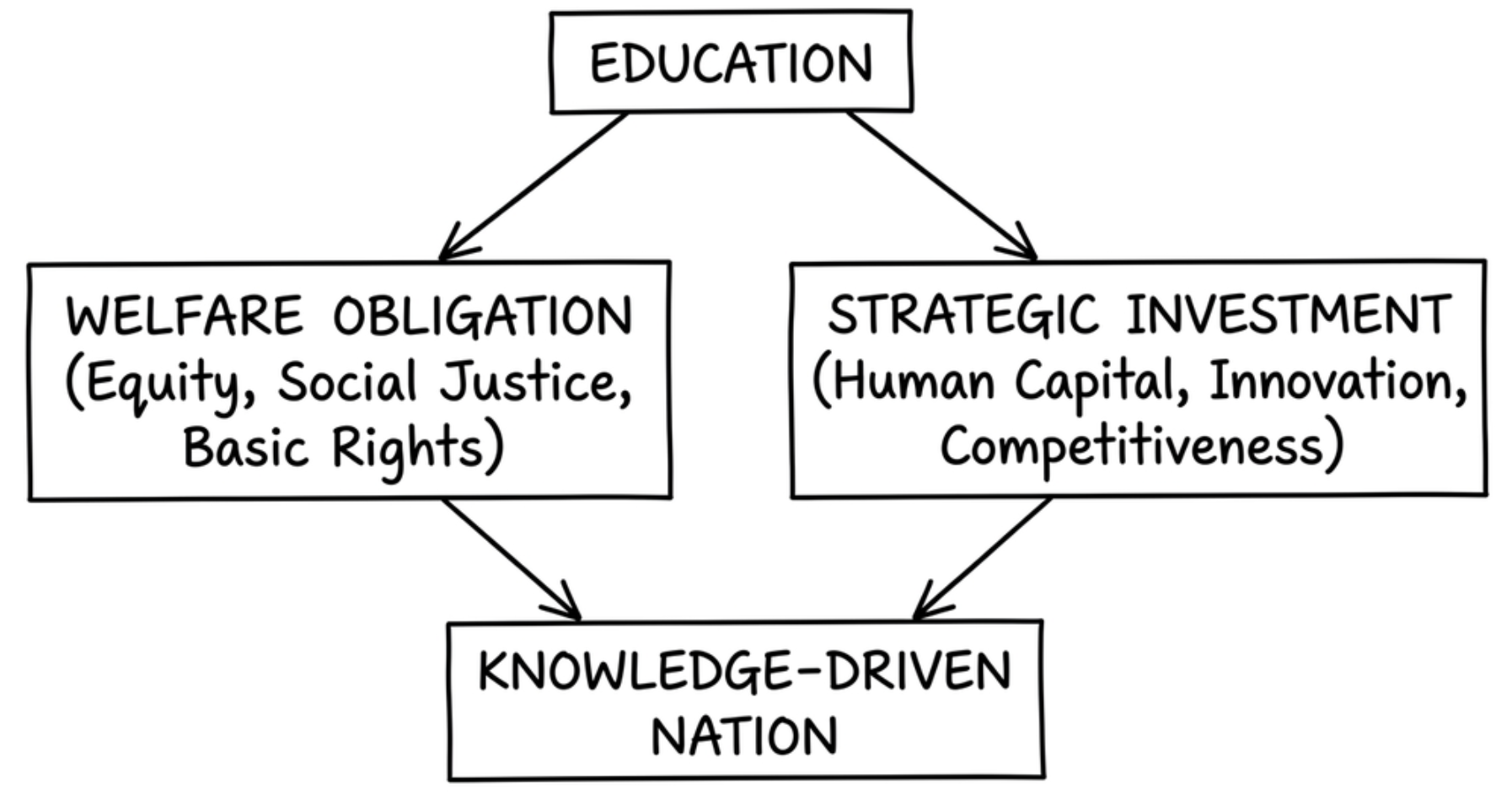
Education as Welfare Obligation and Strategic Investment for a Knowledge-Driven Nation
Education as a Welfare Obligation of the State
-
State-led equitable access ensures social justice and fulfillment of constitutional promises.
- Eg: Article 21A mandates free education for children aged 6-14.
-
Subsidies break intergenerational poverty cycles through accessible and affordable learning.
- Eg: The PM POSHAN scheme improves student retention via nutrition.
-
Targeted interventions bridge regional and gender disparities often ignored by private markets.
- Eg: Kasturba Gandhi Balika Vidyalayas serve educationally backward blocks.
-
Universal foundational skills are necessary precursors to pursuing strategic economic competitiveness.
- Eg: NIPUN Bharat targets foundational literacy and numeracy by 2026-27.
-
Welfare quotas guarantee representation for disadvantaged SC/ST and EWS categories.
- Eg: Section 12(1)(c) of the RTE Act mandates 25% reservations.
-
Public school networks ensure reach in remote areas lacking private alternatives.
- Eg: PM SHRI upgrades 14,500 schools into exemplary institutions by 2026.
-
State-funded higher education prevents cost-based exclusion, ensuring merit-based access.
- Eg: Subsidized Central Universities fees enable low-income student access.
Education as a Strategic Investment for Global Competitiveness
-
Maximizing the demographic dividend requires treating students as vital economic assets.
- Eg: NEP 2020 introduces vocational integration starting from Class 6.
-
Aligning curricula with industry needs addresses critical graduate employability gaps.
- Eg: The India Skills Report 2026 notes 54.81% employability in 2025.
-
Strategic R&D funding drives the transition toward a competitive knowledge-led economy.
- Eg: The Anusandhan National Research Foundation (ANRF) boosts research.
-
Digital infrastructure investments prepare the national workforce for Industry 4.0.
- Eg: The APAAR Digital ID creates lifelong credit tracking.
-
Quality improvements are essential for attracting global faculty and raising international rankings.
- Eg: The Institutions of Eminence (IoE) scheme targets top 500.
-
Specialized skill development in high-growth sectors establishes India as a global talent hub.
- Eg: Budget 2026-27 plans AVGC Content Creator Labs for gaming.
-
Strategic frameworks justify educational spending within national fiscal environments.
- Eg: Education expenditure stood at 2.7% of GDP in FY26.
-
Public-Private Partnerships leverage synergistic investments to bridge critical funding gaps.
- Eg: CSR funds are directed toward Skill India initiatives.
Fulfilling Article 21A through the National Education Policy 2020 will transform India into a knowledge hub, provided fiscal allocations align with the Kothari Commission targets for inclusive national prosperity.
Answer Length
Model answers may exceed the word limit for better clarity and depth. Use them as a guide, but always frame your final answer within the exam’s prescribed limit.
Evaluate this PYQ now
Write your answer & evaluate in just 60 seconds




500+ students evaluated
Model Answers from
- 2026Social Justice10 MarksView Answer
Malnutrition in India is not merely a public health concern; it is also a challenge of social equity, human development and effective welfare governance. Discuss.
- 2026Social Justice10 MarksView Answer
Does India's tribal development policy reflect the aspirations for a socially grounded and equity-based governance? Justify your answer.
- 2026Social Justice10 MarksView Answer
Right to privacy relating to self-identity is very dear to every human being and well protected under Article 21 of the Constitution. In this context, examine the effect of the amendment in 2026, to the Transgender Persons (Protection of Rights) Act, 2019.
Model Answers by Subject


Crack UPSC with your
Personal AI Mentor
An AI-powered ecosystem to learn, practice, and evaluate with discipline