Right to privacy relating to self-identity is very dear to every human being and well protected under Article 21 of the Constitution. In this context, examine the effect of the amendment in 2026, to the Transgender Persons (Protection of Rights) Act, 2019.
Right to privacy relating to self-identity is very dear to every human being and well protected under Article 21 of the Constitution. In this context, examine the effect of the amendment in 2026, to the Transgender Persons (Protection of Rights) Act, 2019.
The Transgender Persons (Amendment) Act, 2026 significantly alters the procedural requirements for gender recognition, creating a tension with the Right to Privacy as interpreted in the landmark K.S. Puttaswamy (2017) judgment.
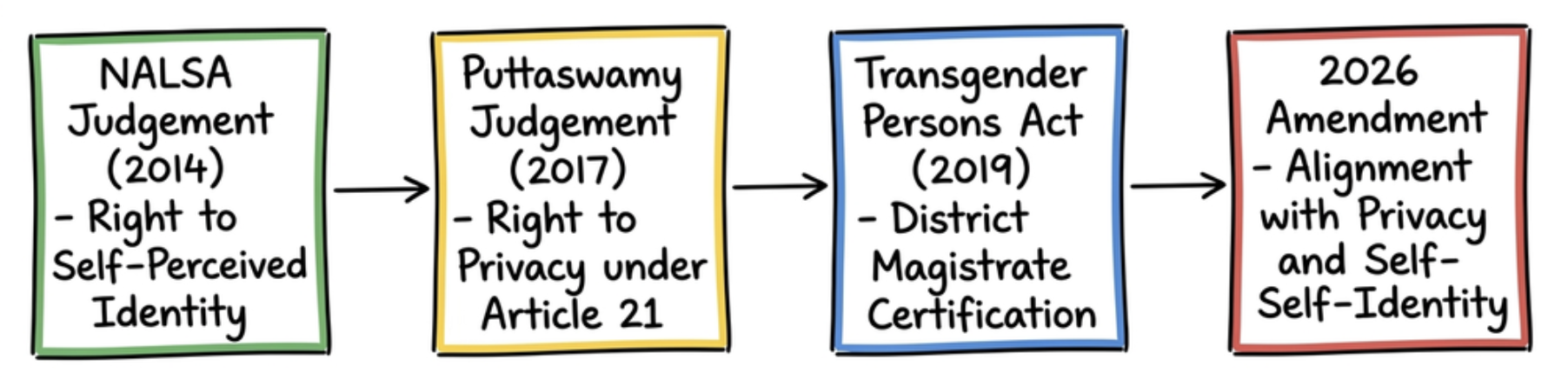
Evolution of Transgender Identity Rights in India
Impact on Right to Privacy and Self-Identity
-
The 2026 Act repeals self-perceived gender identity rights granted under the 2019 Act.
- Eg: Contradicts NALSA v. Union of India (2014) principles.
-
Identity certificates now require government-constituted medical board recommendations instead of self-declaration.
- Eg: Violates bodily autonomy via scrutiny.
-
The District Magistrate issues certificates only after medical scrutiny, increasing state intrusion.
- Eg: Parliament (March 2026) questioned narrowing recognized identities.
-
The Amendment reportedly excludes trans-men, trans-women, and genderqueer individuals from the transgender category.
- Eg: Impacts Right to Recognition for identities.
-
The Act introduces penalties for forcing individuals to assume transgender identities.
- Eg: Concerns regarding the autonomy of minors.
-
The Centre assured the Supreme Court (August 2026) that existing identity cards remain valid.
- Eg: Relief while constitutionality is debated.
Legal Challenges and Recommendations
-
The Justice Asha Menon Committee (2025) mandate continues pushing for inclusive education and employment policies.
- Eg: Seeking reasonable accommodation for individuals.
-
External verification is viewed by activists as a setback to the Right to Dignity.
- Eg: Petitions cite Articles 14, 15, and 19.
-
Mandatory medical certification may force individuals into invasive clinical environments.
- Eg: Impacts mental health and personal liberty.
-
The Supreme Court is examining whether the Act violates Privacy and Self-Identity.
- Eg: Court refused interim stay in August 2026.
Future reforms should integrate the Yogyakarta Principles into the Transgender Persons Act to uphold Article 21 and fulfill the transformative constitutionalism envisioned by the landmark NALSA Judgment for genuine social inclusion.
Answer Length
Model answers may exceed the word limit for better clarity and depth. Use them as a guide, but always frame your final answer within the exam’s prescribed limit.
Evaluate this PYQ now
Write your answer & evaluate in just 60 seconds




500+ students evaluated
Model Answers from
- 2026Social Justice15 MarksView Answer
Should education be treated primarily as a welfare obligation of the state or as a strategic investment for building a globally competitive, knowledge-driven nation? Critically evaluate.
- 2026Social Justice10 MarksView Answer
Malnutrition in India is not merely a public health concern; it is also a challenge of social equity, human development and effective welfare governance. Discuss.
- 2026Social Justice10 MarksView Answer
Does India's tribal development policy reflect the aspirations for a socially grounded and equity-based governance? Justify your answer.
Model Answers by Subject


Crack UPSC with your
Personal AI Mentor
An AI-powered ecosystem to learn, practice, and evaluate with discipline