Does India's tribal development policy reflect the aspirations for a socially grounded and equity-based governance? Justify your answer.
Does India's tribal development policy reflect the aspirations for a socially grounded and equity-based governance? Justify your answer.
India’s tribal governance seeks equity through the Tribal Panchsheel and protective measures under the Fifth Schedule, yet reaching 75 Particularly Vulnerable Tribal Groups remains a critical test of inclusive and socially grounded developmental outcomes.
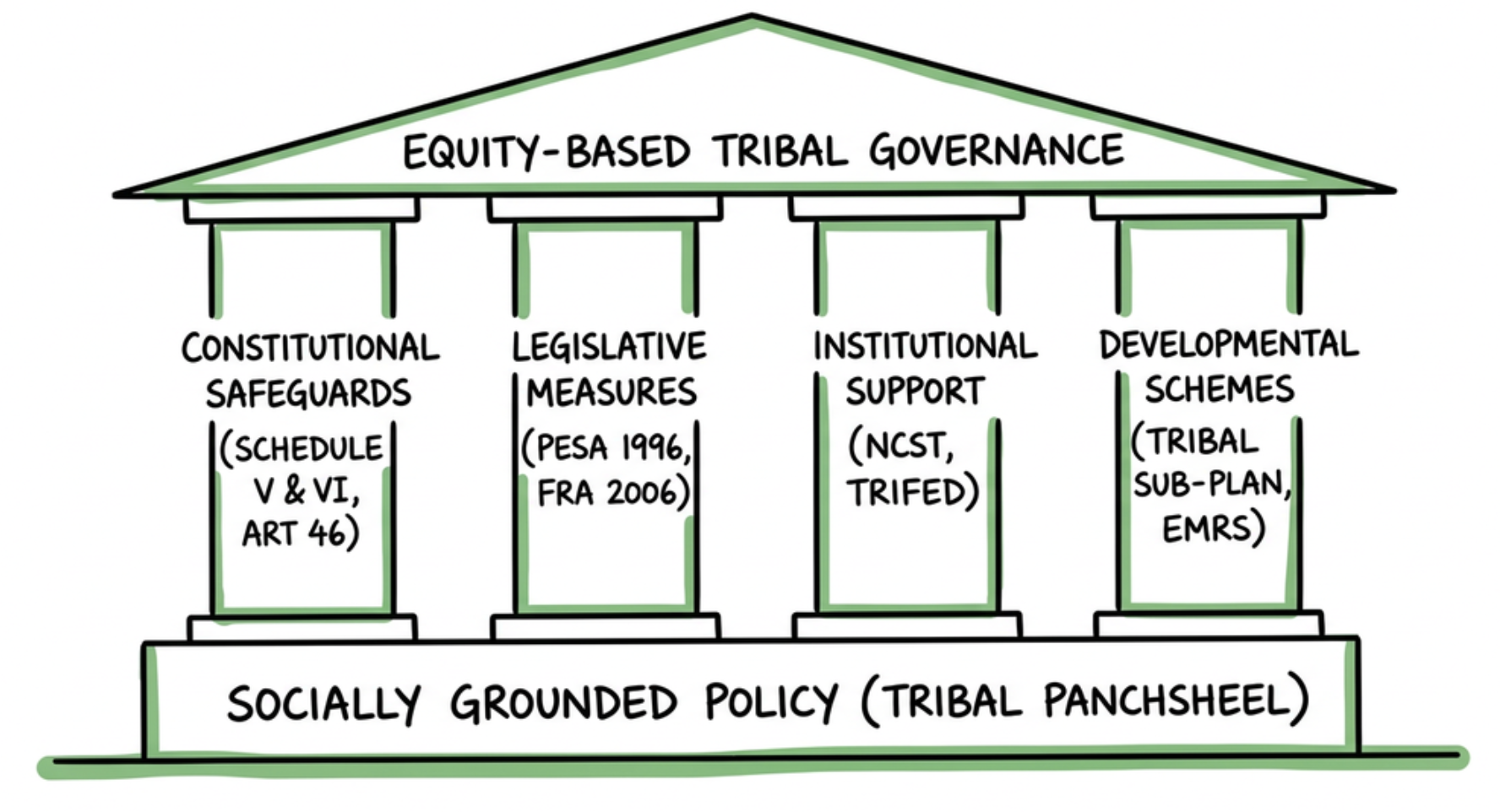
Equity-Based Tribal Governance through Constitutional, Legal, Institutional and Developmental Support
Frameworks for Equity and Social Inclusion
-
PM-JANMAN allocates ₹24,000 crore prioritizing 75 Particularly Vulnerable Tribal Groups (PVTGs) for basic amenity saturation.
- Eg: benefiting 46,000 persons via Van Dhan Vikas Kendras by August 2026.
-
Dharti Aaba Janjatiya Gram Utkarsh Abhiyan (DA-JGUA) received ₹2,000 crore in Budget 2025-26 for infrastructure in 63,843 villages.
-
Eklavya Model Residential Schools (EMRS) aim to operationalize 728 schools by March 2026 for 3.5 lakh students.
-
A July 2025 Supreme Court ruling declared tribal women's inheritance exclusion unconstitutional under Article 14.
-
The NALSA SAMVAD Scheme 2025 provides specialized legal aid to STs and Nomadic Tribes to improve justice access.
Challenges to Substantive Governance
-
ST literacy is 59% compared to the 77-80% national average as of August 2025.
- Eg: 37% ST households below poverty line versus 11% in 2025.
-
Under-5 mortality among tribal populations is 57.2 per 1000 versus 38.5 as of August 2025.
-
The Forest (Conservation) Amendment Act 2023 risks weakening Gram Sabha consent for land diversion.
-
While Jharkhand framed PESA Rules in 2025, states struggle with power devolution to tribal bodies.
-
2025 data indicates 46.3% of the ST population remains in the lowest wealth quintile, reflecting limited benefit.
Integrating Article 338A mandates with the Xaxa Committee recommendations will ensure that PM-JANMAN achieves its objective of transforming tribal lives through equity and constitutionally grounded self-governance.
Answer Length
Model answers may exceed the word limit for better clarity and depth. Use them as a guide, but always frame your final answer within the exam’s prescribed limit.
Evaluate this PYQ now
Write your answer & evaluate in just 60 seconds




500+ students evaluated
Model Answers from
- 2026Social Justice15 MarksView Answer
Should education be treated primarily as a welfare obligation of the state or as a strategic investment for building a globally competitive, knowledge-driven nation? Critically evaluate.
- 2026Social Justice10 MarksView Answer
Malnutrition in India is not merely a public health concern; it is also a challenge of social equity, human development and effective welfare governance. Discuss.
- 2026Social Justice10 MarksView Answer
Right to privacy relating to self-identity is very dear to every human being and well protected under Article 21 of the Constitution. In this context, examine the effect of the amendment in 2026, to the Transgender Persons (Protection of Rights) Act, 2019.
Model Answers by Subject


Crack UPSC with your
Personal AI Mentor
An AI-powered ecosystem to learn, practice, and evaluate with discipline