Malnutrition in India is not merely a public health concern; it is also a challenge of social equity, human development and effective welfare governance. Discuss.
Malnutrition in India is not merely a public health concern; it is also a challenge of social equity, human development and effective welfare governance. Discuss.
Stagnant indicators in NFHS-6 (2026) reveal that malnutrition is a governance failure affecting Human Capital Development, requiring Mission POSHAN 2.0 to integrate health, social equity, and the constitutional mandate under Article 47.
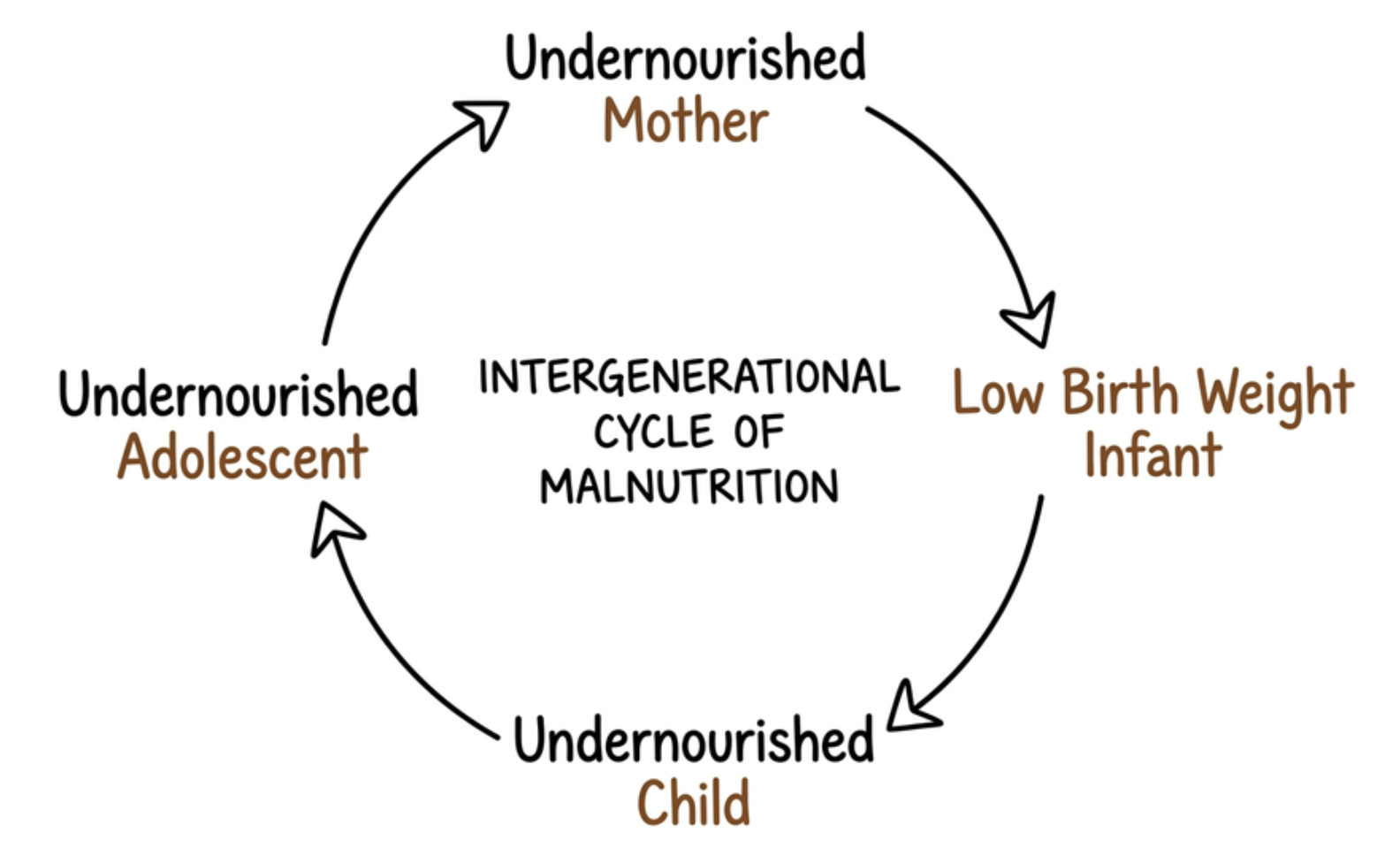
Intergenerational Cycle of Malnutrition Across the Life Course
Malnutrition as a Challenge of Social Equity
-
Caste-based Disparities: Structural inequalities cause higher malnutrition in marginalized communities.
- Eg: NFHS-6 (2026) reports underweight rates of 53% for Scheduled Castes and 56% for Scheduled Tribes.
-
Regional Imbalance: Undernutrition persists in specific belts, reflecting unequal regional development.
- Eg: Malnutrition remains concentrated in the central tribal belt and rural regions.
-
Gender Inequity: Discriminatory food distribution creates intergenerational cycles of undernutrition.
- Eg: Poor maternal education and health link directly to child malnutrition.
-
Economic Divide: The inability to afford nutritious food creates gaps between wealth quintiles.
- Eg: In 2025, 520.1 million people in India could not afford a healthy diet.
Impact on Human Development and Welfare Governance
-
Cognitive Capital: Early undernutrition causes irreversible brain development issues, hindering productivity.
-
Human Resource Potential: Malnutrition undermines India’s demographic dividend by weakening the workforce.
-
Targeting Errors: Welfare delivery is challenged by inclusion and exclusion errors.
- Eg: Mission POSHAN 2.0 introduced biometric registration in 2025 for service delivery.
-
Nutritional Inadequacy: Governance must shift focus from food security to dietary quality.
- Eg: Only 15.3% of children aged 6-23 months receive adequate diets per NFHS-6.
-
Monitoring Gaps: Real-time tracking is essential to address the granular nutritional crisis.
- Eg: 89.5 million beneficiaries are monitored via the Poshan Tracker App as of 2026.
-
Last Mile Delivery: Infrastructure transformation is vital for delivering integrated health services.
- Eg: 1.7 lakh centres were approved as Saksham Anganwadis by July 2026.
Aligning Mission POSHAN 2.0 with the National Food Security Act 2013 is essential to fulfill the mandate of Article 47, fostering a healthy, equitable, and productive nation for all.
Answer Length
Model answers may exceed the word limit for better clarity and depth. Use them as a guide, but always frame your final answer within the exam’s prescribed limit.
Evaluate this PYQ now
Write your answer & evaluate in just 60 seconds




500+ students evaluated
Model Answers from
- 2026Social Justice15 MarksView Answer
Should education be treated primarily as a welfare obligation of the state or as a strategic investment for building a globally competitive, knowledge-driven nation? Critically evaluate.
- 2026Social Justice10 MarksView Answer
Does India's tribal development policy reflect the aspirations for a socially grounded and equity-based governance? Justify your answer.
- 2026Social Justice10 MarksView Answer
Right to privacy relating to self-identity is very dear to every human being and well protected under Article 21 of the Constitution. In this context, examine the effect of the amendment in 2026, to the Transgender Persons (Protection of Rights) Act, 2019.
Model Answers by Subject


Crack UPSC with your
Personal AI Mentor
An AI-powered ecosystem to learn, practice, and evaluate with discipline



