Mention the salient features of 'Mission Drishti'. Discuss the imaging techniques used in the satellite launched on 3rd May 2026. Why is it being considered the world's first satellite of its kind?
Mention the salient features of 'Mission Drishti'. Discuss the imaging techniques used in the satellite launched on 3rd May 2026. Why is it being considered the world's first satellite of its kind?
Mission Drishti, launched on May 3, 2026 by Bengaluru-based GalaxEye, marks a shift in India's NewSpace ecosystem. This 190 kg satellite serves as a sovereign, high-resolution Geospatial Intelligence asset for critical national monitoring.
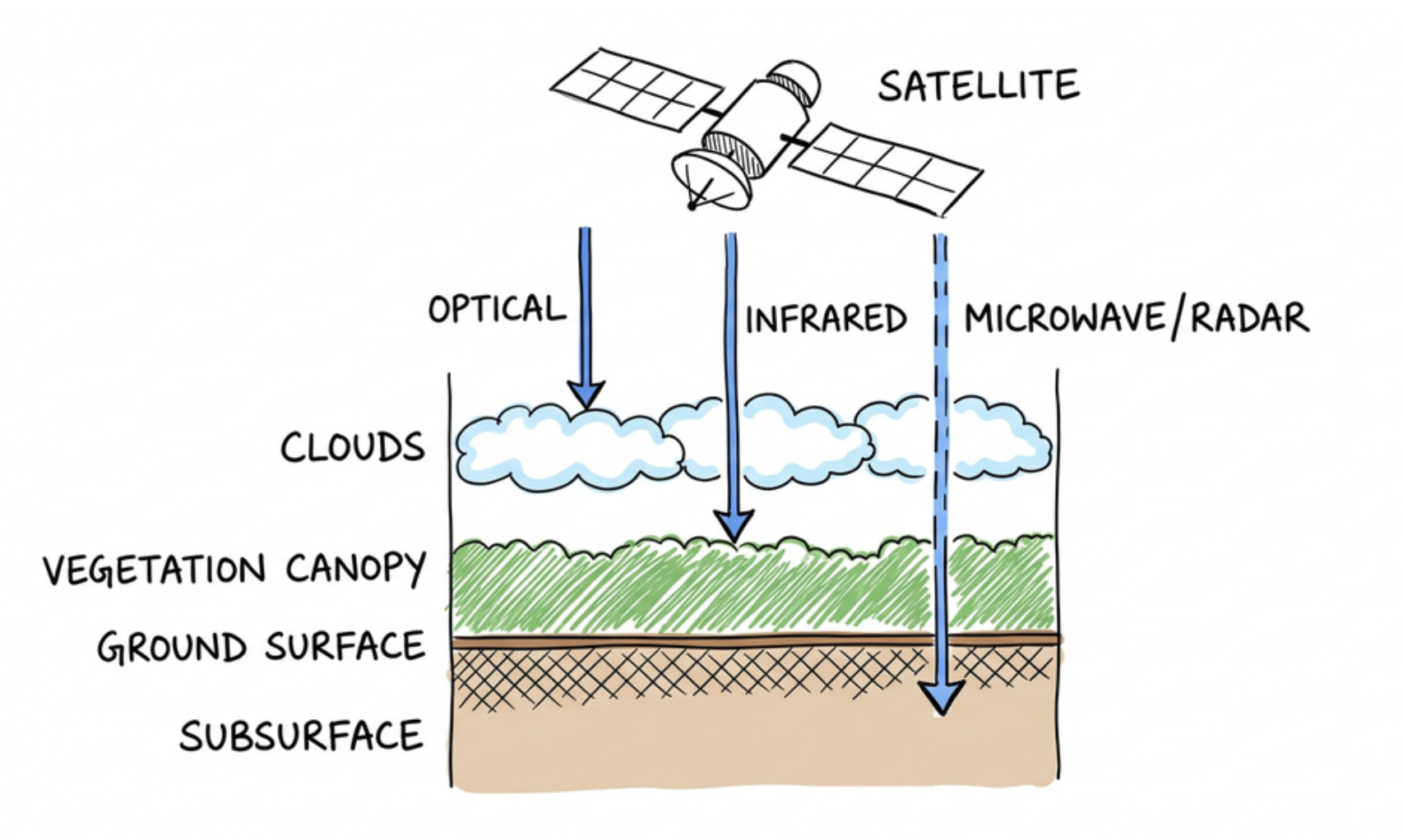
Penetration Capabilities of Optical, Infrared and Microwave Remote Sensing
Salient Features of Mission Drishti
-
Private Sector Milestone: deploying a 190 kg platform that is India's largest privately built Earth observation satellite.
- Eg: The satellite was launched via a SpaceX Falcon 9 from Vandenberg Space Force Base.
-
Persistent Monitoring Frequency: providing high revisit rates that enable near real-time data collection for rapidly changing ground conditions.
-
AI Driven Decisioning: utilizing onboard artificial intelligence for fast data processing to reduce the time from capture to insight.
-
Sovereign Border Intelligence: establishing a non-blind satellite network to monitor high-altitude Himalayan borders and strategic maritime zones.
-
Multi Domain Application: supporting sectors beyond defense, including disaster management, agriculture, and complex infrastructure planning.
- Eg: Data assists the Indian Armed Forces in overcoming weather-induced visibility limitations.
Imaging Techniques of the OptoSAR Satellite
-
OptoSAR Sensor Fusion: integrating both Electro-Optical and Synthetic Aperture Radar technologies into a single, unified hardware platform.
-
Microwave Radar Imaging: employing pulses that penetrate through thick cloud cover, dust, and smoke without losing signal clarity.
-
High Resolution Optical: capturing visual spectrum imagery that provides the spatial detail necessary for precise object identification.
-
Atmospheric Disturbance Resilience: ensuring mission continuity during extreme weather events when traditional optical satellites become effectively blinded.
-
Active Sensing Mechanism: leveraging the radar's ability to operate without sunlight, enabling consistent imaging during the night.
- Eg: This allows 24/7 surveillance of the Indian Ocean Region regardless of cloud presence.
Rationale for Global Precedence
-
Operational Integrated Hardware: representing the first time both sensor types have been combined onto one compact, operational satellite.
-
Simultaneous Data Acquisition: collecting optical and radar imagery at the exact same moment during a single orbital pass.
-
Enhanced Image Interpretability: solving the traditional difficulty of reading radar data by overlaying it with visual optical references.
-
Miniaturized Hybrid Platform: achieving the complex task of packaging dual sensors within a lightweight, cost-effective private satellite frame.
-
End to End Capability: creating a unique data stream that no other single-sensor satellite constellation can currently provide globally.
- Eg: GalaxEye’s breakthrough overcomes the need for cross-satellite data correlation from different providers.
By upholding the Indian Space Policy 2023, Mission Drishti accelerates the Atmanirbhar Bharat objective. It ensures that IN-SPACe promotes innovative private solutions for long-term national security and geospatial resilience.
Answer Length
Model answers may exceed the word limit for better clarity and depth. Use them as a guide, but always frame your final answer within the exam’s prescribed limit.
Evaluate this PYQ now
Write your answer & evaluate in just 60 seconds




500+ students evaluated
Model Answers from
- 2026Science & Technology15 MarksView Answer
What is agentic Artificial Intelligence (AI)? Explain its working. Describe its applications with suitable examples. Discuss the advantages, risks and challenges associated with agentic AI systems.
- 2026Science & Technology10 MarksView Answer
Distinguish between a Fast Breeder Reactor (FBR) and a thermal nuclear reactor. In the context of the first indigenously developed prototype FBR at Kalpakkam, explain the term 'criticality'. What are its implications for the clean energy future of our country?
- 2026Science & Technology10 MarksView Answer
Explain by giving two examples, how biotechnology has helped Indian farmers in processing their perishable crops.
Model Answers by Subject


Crack UPSC with your
Personal AI Mentor
An AI-powered ecosystem to learn, practice, and evaluate with discipline