Explain by giving two examples, how biotechnology has helped Indian farmers in processing their perishable crops.
Explain by giving two examples, how biotechnology has helped Indian farmers in processing their perishable crops.
Biotechnology in India, bolstered by the Department of Biotechnology (DBT) and the BioE3 Policy 2025, leverages genetic engineering and molecular markers to minimize post-harvest losses, currently estimated at 15-20% by the ICAR-Central Institute of Post-Harvest Engineering and Technology.
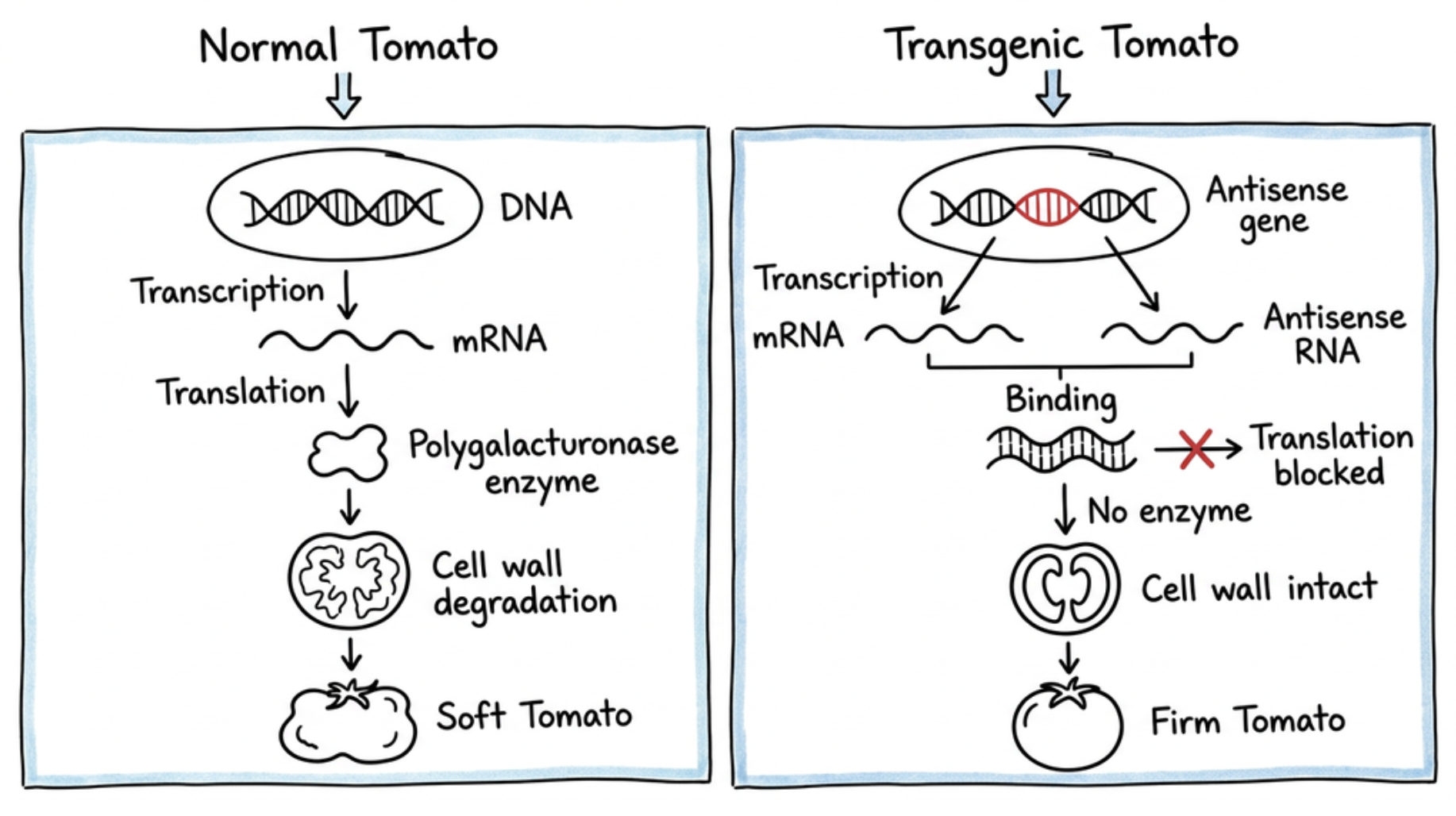
Antisense Technology for Delayed Ripening in Transgenic Tomato
Biotechnological Methods for Perishable Crop Processing
-
Ethylene Management: IIT Palakkad patented a metal-oxide catalyst in August 2026 oxidizing ethylene at 5°C.
- Eg: Fruit shelf life extension in cold storage.
-
Antisense RNA Technology: Genetic modification silences enzymes like polygalacturonase to delay softening.
- Eg: Flavr Savr tomato processing prevents transport bruising.
-
CRISPR/Cas9 Interventions: Genome editing reported in April 2025 reduces enzymatic browning.
- Eg: Non-browning crops increase food-dehydration processing windows.
-
Bio-based Edible Coatings: Bio-polymers create semi-permeable membranes regulating gas exchange and moisture.
- Eg: Microbial-derived antimicrobial coatings protect grapes and berries.
-
Fermentation-Derived Additives: Microbial biotechnology produces enzymes and natural preservatives.
- Eg: Indian processors use GRAS-classified agents for juice stabilization.
Specific Examples of Impact on Indian Farmers
-
Tomato Shelf-Life Extension: Genetic engineering delays senescence avoiding distress sales.
- Eg: Firmness maintenance facilitates tomato puree and ketchup production.
-
Climate-Resilient Rice Varieties: The May 2025 announcement of DRR Rice 100 and PUSA DST Rice-1 showcases genome-edited traits.
- Eg: Early maturity and drought tolerance ensure grain moisture optimality.
-
Bio-manufacturing Initiatives: The Bio-manufacturing Resource and Innovation Centre (BRIC) launched in 2025 supports startups.
- Eg: Startups provide decentralized bio-preservation tools for horticultural value-addition.
-
Biotech-KISAN Interventions: The scheme updated in April 2026 bridges lab research and application.
- Eg: Bio-fertilizers improve crop strength against post-harvest decay.
-
Ethylene Scavenging Solutions: Nanoparticle-based lipid coatings reduce microbial spoilage.
- Eg: Spoilage reduction enables market access through the APEDA framework.
Through the NITI Aayog AgriBio 2.0 Mission, India aims to integrate Biomanufacturing and Digital Biology by 2035, ensuring food security and doubling farmers' income under the Pradhan Mantri Kisan SAMPADA Yojana.
Answer Length
Model answers may exceed the word limit for better clarity and depth. Use them as a guide, but always frame your final answer within the exam’s prescribed limit.
Evaluate this PYQ now
Write your answer & evaluate in just 60 seconds




500+ students evaluated
Model Answers from
- 2026Science & Technology15 MarksView Answer
What is agentic Artificial Intelligence (AI)? Explain its working. Describe its applications with suitable examples. Discuss the advantages, risks and challenges associated with agentic AI systems.
- 2026Science & Technology15 MarksView Answer
Mention the salient features of 'Mission Drishti'. Discuss the imaging techniques used in the satellite launched on 3rd May 2026. Why is it being considered the world's first satellite of its kind?
- 2026Science & Technology10 MarksView Answer
Distinguish between a Fast Breeder Reactor (FBR) and a thermal nuclear reactor. In the context of the first indigenously developed prototype FBR at Kalpakkam, explain the term 'criticality'. What are its implications for the clean energy future of our country?
Model Answers by Subject


Crack UPSC with your
Personal AI Mentor
An AI-powered ecosystem to learn, practice, and evaluate with discipline