Distinguish between a Fast Breeder Reactor (FBR) and a thermal nuclear reactor. In the context of the first indigenously developed prototype FBR at Kalpakkam, explain the term 'criticality'. What are its implications for the clean energy future of our country?
Distinguish between a Fast Breeder Reactor (FBR) and a thermal nuclear reactor. In the context of the first indigenously developed prototype FBR at Kalpakkam, explain the term 'criticality'. What are its implications for the clean energy future of our country?
India's nuclear journey achieved a landmark on April 6, 2026, when the Prototype Fast Breeder Reactor (PFBR) at Kalpakkam reached criticality. This milestone, led by BHAVINI, propels India into the second stage of its Three-Stage Nuclear Power Programme.
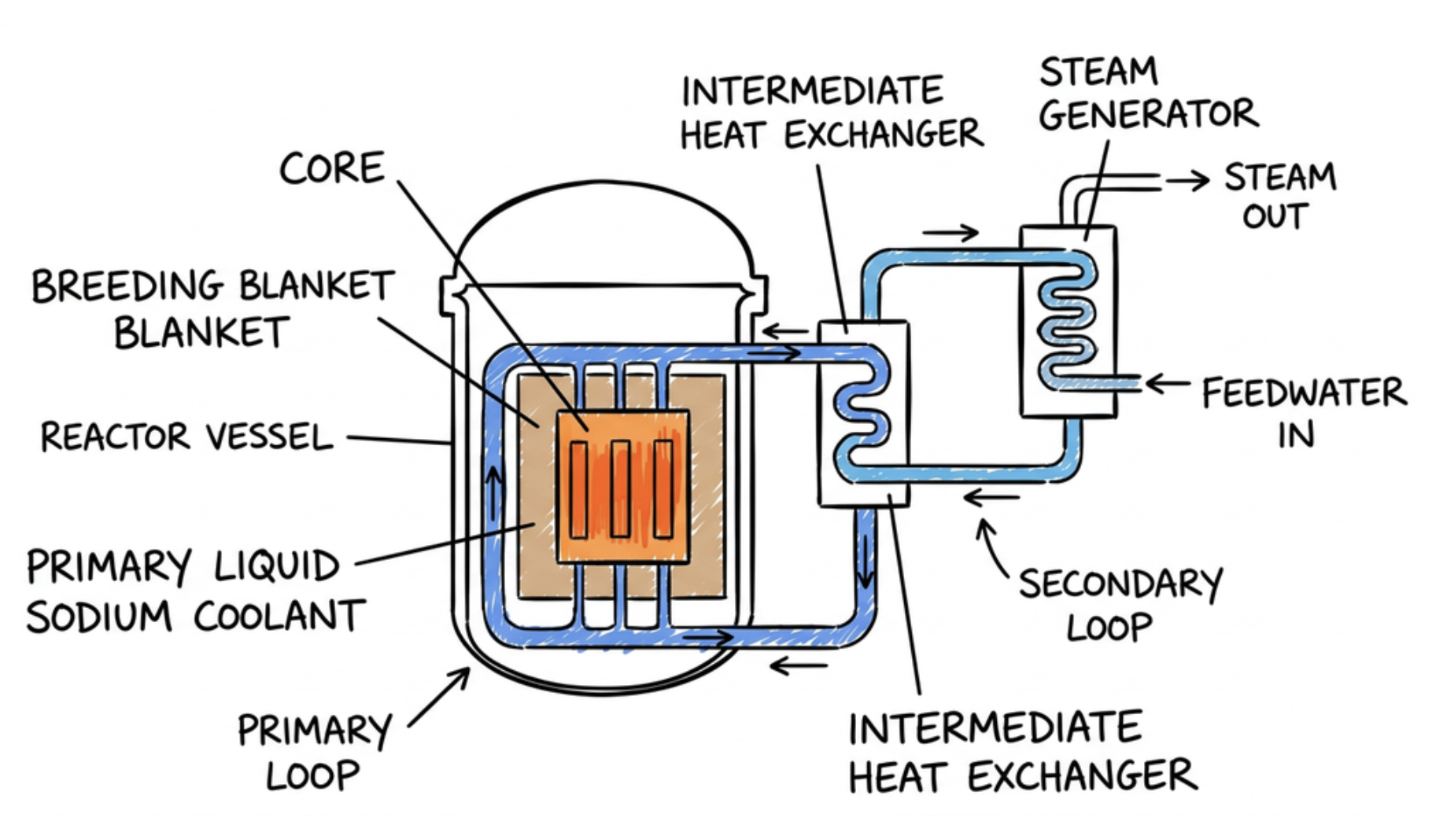
Working Mechanism and Components of a Fast Breeder Reactor
Distinguishing FBR from Thermal Nuclear Reactors
-
Neutron Speed: thermal reactors use moderators like heavy water to slow neutrons, whereas FBRs utilize high-energy fast neutrons.
-
Coolant Type: conventional reactors typically use water, but FBRs employ liquid sodium due to its superior heat transfer properties.
- Eg: The Kalpakkam PFBR utilizes liquid sodium to maintain high neutron energy.
-
Fuel Breeding: thermal reactors consume more fissile material than they produce, while FBRs generate more fuel than they consume.
-
Fuel Cycle: FBRs utilize a closed fuel cycle by converting fertile Uranium-238 into fissile Plutonium-239 for future use.
Understanding Criticality in PFBR Kalpakkam
-
Steady State: criticality refers to the point where a nuclear chain reaction becomes self-sustaining with a constant neutron population.
-
Operational Success: achieving criticality in April 2026 signifies that the reactor core configuration and control rod positions are perfectly balanced.
-
Fission Balance: it implies each fission event releases exactly enough neutrons to trigger one subsequent fission, maintaining a stable power output.
Implications for India's Clean Energy Future
-
Capacity Expansion: FBRs are vital for India to reach its target of 22 GW by 2031-32 and 100 GW by 2047.
- Eg: The Nuclear Energy Mission (2025-26) prioritizes FBRs to scale up carbon-free baseload power.
-
Resource Security: by utilizing Uranium-238, FBRs provide a bridge to the third stage involving India's vast thorium reserves.
-
Waste Management: breeder technology significantly reduces long-lived radioactive waste, supporting the SHANTI Act 2025 goals for sustainable nuclear expansion.
Successful PFBR commissioning strengthens the Department of Atomic Energy vision for Viksit Bharat, ensuring energy sovereignty through the Integrated National Energy Policy to achieve Net Zero emissions by 2070.
Answer Length
Model answers may exceed the word limit for better clarity and depth. Use them as a guide, but always frame your final answer within the exam’s prescribed limit.
Evaluate this PYQ now
Write your answer & evaluate in just 60 seconds




500+ students evaluated
Model Answers from
- 2026Science & Technology15 MarksView Answer
What is agentic Artificial Intelligence (AI)? Explain its working. Describe its applications with suitable examples. Discuss the advantages, risks and challenges associated with agentic AI systems.
- 2026Science & Technology15 MarksView Answer
Mention the salient features of 'Mission Drishti'. Discuss the imaging techniques used in the satellite launched on 3rd May 2026. Why is it being considered the world's first satellite of its kind?
- 2026Science & Technology10 MarksView Answer
Explain by giving two examples, how biotechnology has helped Indian farmers in processing their perishable crops.
Model Answers by Subject


Crack UPSC with your
Personal AI Mentor
An AI-powered ecosystem to learn, practice, and evaluate with discipline



