In what ways can an Indian Administrative Officer apply Gandhi's notion of 'trusteeship' to ensure fairness in governance?
In what ways can an Indian Administrative Officer apply Gandhi's notion of 'trusteeship' to ensure fairness in governance?
Mahatma Gandhi conceptualized Trusteeship as a socio-economic philosophy where the wealthy hold their assets not as owners, but as trustees for the benefit of society. For a civil servant, this translates to the Stewardship of public power and resources, ensuring that the State serves as a moral custodian for the marginalized.
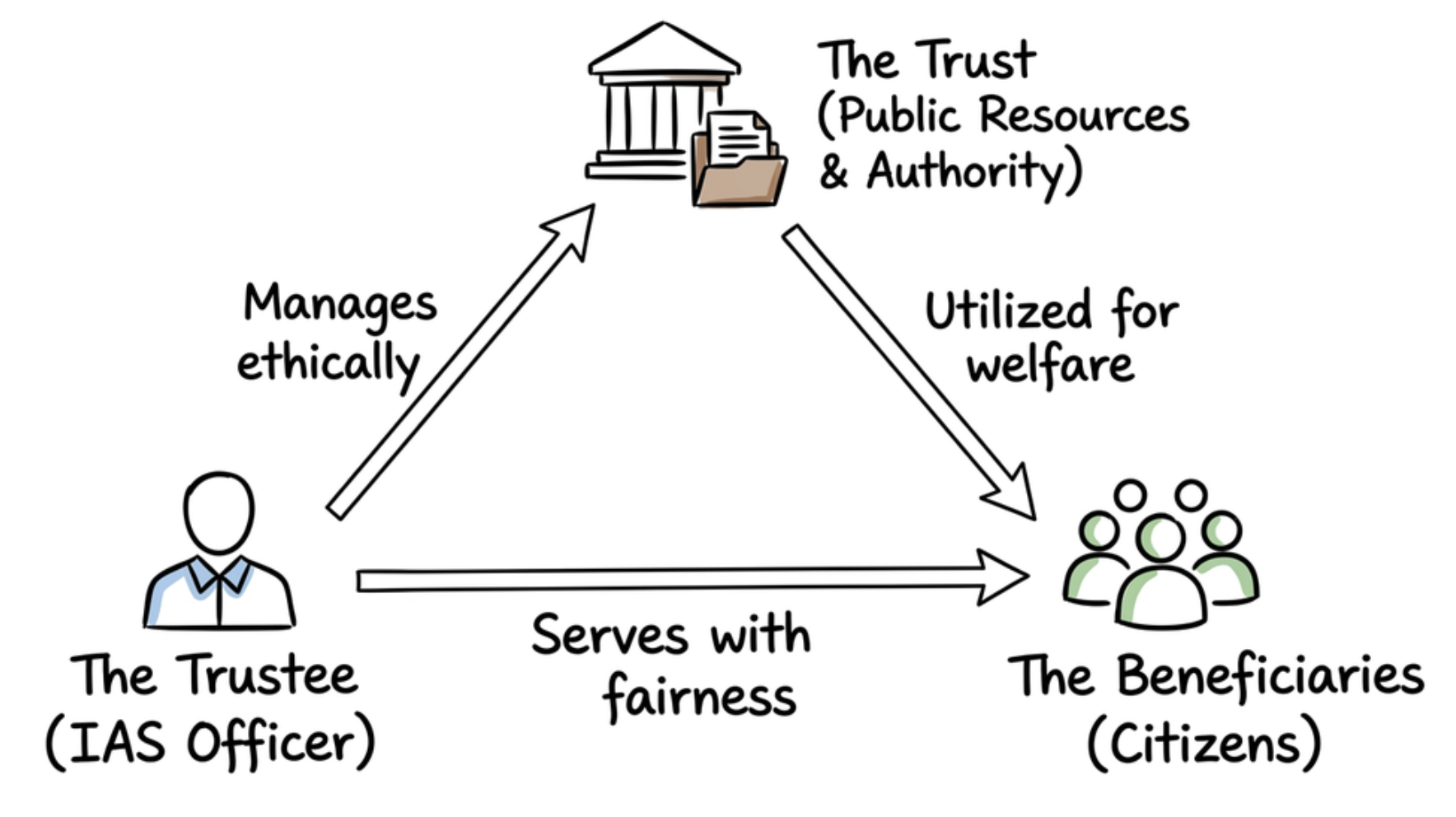
Trusteeship in Governance: Ethical Management of Public Resources for Citizens
The Application of Trusteeship in Governance
-
Fiduciary Responsibility over Public Assets: An officer must treat public funds not as state property to be controlled, but as a trust for the citizens.
- Eg: Implementing the Pradhan Mantri Awas Yojana-Grameen (PMAY-G) with a budgetary allocation of ₹54,916.70 crore in 2026-27 requires ensuring that resources reach the intended rural beneficiaries without leakage.
-
Empathetic Decentralization: Following Gandhi's vision of Gram Swaraj, officers act as facilitators for community-led development rather than top-down commanders.
- Eg: Strengthening community control over forest resources through Van Dhan Vikas Kendras to empower tribal livelihoods.
-
Antyodaya in Decision Making: In every administrative action, the officer applies the Gandhian Talisman, prioritizing the effect of a policy on the poorest individual.
- Eg: The Nirikhyana initiative in Ganjam, Odisha (2026), providing free ultrasound scans to rural pregnant women, reflects this commitment to the last mile.
-
Ethical Oversight of Emerging Technologies: Modern trusteeship involves guarding the digital rights of citizens against algorithmic bias.
- Eg: Adhering to the India AI Governance Guidelines (November 2025) which mandate Fairness & Equity and Trust as Foundation in public service delivery.
-
Accessible and Humble Leadership: Reducing the distance between the ruler and the ruled converts bureaucratic authority into a service-oriented trust.
- Eg: IAS Dr. Satish Kumar Sahu using a bicycle in Satna (2026) to interact directly with citizens, breaking the ivory tower perception of the administration.
Comparison: Traditional Bureaucracy vs. Trusteeship Model
| Dimension | Traditional Bureaucracy | Trusteeship Model |
|---|---|---|
| Source of Power | Legal-Rational Authority (Weber) | Moral Custodianship (Gandhi) |
| Resource View | Budgetary Allocation/Outlays | Public Wealth held in Trust |
| Citizen Role | Passive Beneficiary | Primary Stakeholder/Owner |
| Success Metric | Rule Compliance | Sarvodaya (Universal Upliftment) |
Applying trusteeship transforms the Indian Administrative Service from a "steel frame" of control into a "living bridge" of service, aligning administrative discretion with the Seven Social Sins framework to ensure Justice, Liberty, and Equality as enshrined in the Preamble.
Answer Length
Model answers may exceed the word limit for better clarity and depth. Use them as a guide, but always frame your final answer within the exam’s prescribed limit.
Evaluate this PYQ now
Write your answer & evaluate in just 60 seconds




500+ students evaluated
Model Answers from
- 2026Ethics: Theory10 MarksView Answer
Some moral philosophers argue that spending some of your resources, without significantly affecting your financial stability, to help other people who badly suffer is our moral duty and not merely a matter of charity. Justify this claim by explaining the distinction between duty and charity.
- 2026Ethics: Theory10 MarksView Answer
On the request of his Personal Assistant (PA), the District Magistrate (DM) stops the transfer of a schoolteacher who takes private tuition for his daughter diagnosed with learning disability. In this context, discuss the aspects of empathy versus compliance with rules.
- 2026Ethics: Theory10 MarksView Answer
In international relations, ethical considerations are often subjugated to the strategic interests of nation-states. Discuss this from an ethical perspective.
- 2026Ethics: Theory10 MarksView Answer
Usually schools, working in remote areas, do not fully comply with government regulations. However, if the rules are enforced strictly, it would lead to most schools closing down. How should an administrator strike a balance between enforcement of rules and educational rights of children?
- 2026Ethics: Theory10 MarksView Answer
Efficiency is doing things right, while effectiveness is doing the right thing. How do you strike a balance between the two to enhance productivity?
- 2026Ethics: Theory10 MarksView Answer
Citing the serious adverse effects of long-term medication, a doctor convinces the family of a female patient for surgery. This led the patient to reluctantly consent for the surgery, though her original choice was to opt for medication. Explain the concepts of paternalism and beneficence by analysing the doctor's action.
Model Answers by Subject


Crack UPSC with your
Personal AI Mentor
An AI-powered ecosystem to learn, practice, and evaluate with discipline



