Usually schools, working in remote areas, do not fully comply with government regulations. However, if the rules are enforced strictly, it would lead to most schools closing down. How should an administrator strike a balance between enforcement of rules and educational rights of children?
Usually schools, working in remote areas, do not fully comply with government regulations. However, if the rules are enforced strictly, it would lead to most schools closing down. How should an administrator strike a balance between enforcement of rules and educational rights of children?
The central dilemma involves a conflict between Deontological Ethics, which emphasizes strict adherence to the Rule of Law, and Teleological Ethics, which prioritizes the substantive outcome of securing the Right to Education under Article 21A. An administrator must navigate the tension between formal legalism and the Principle of Substantive Justice.
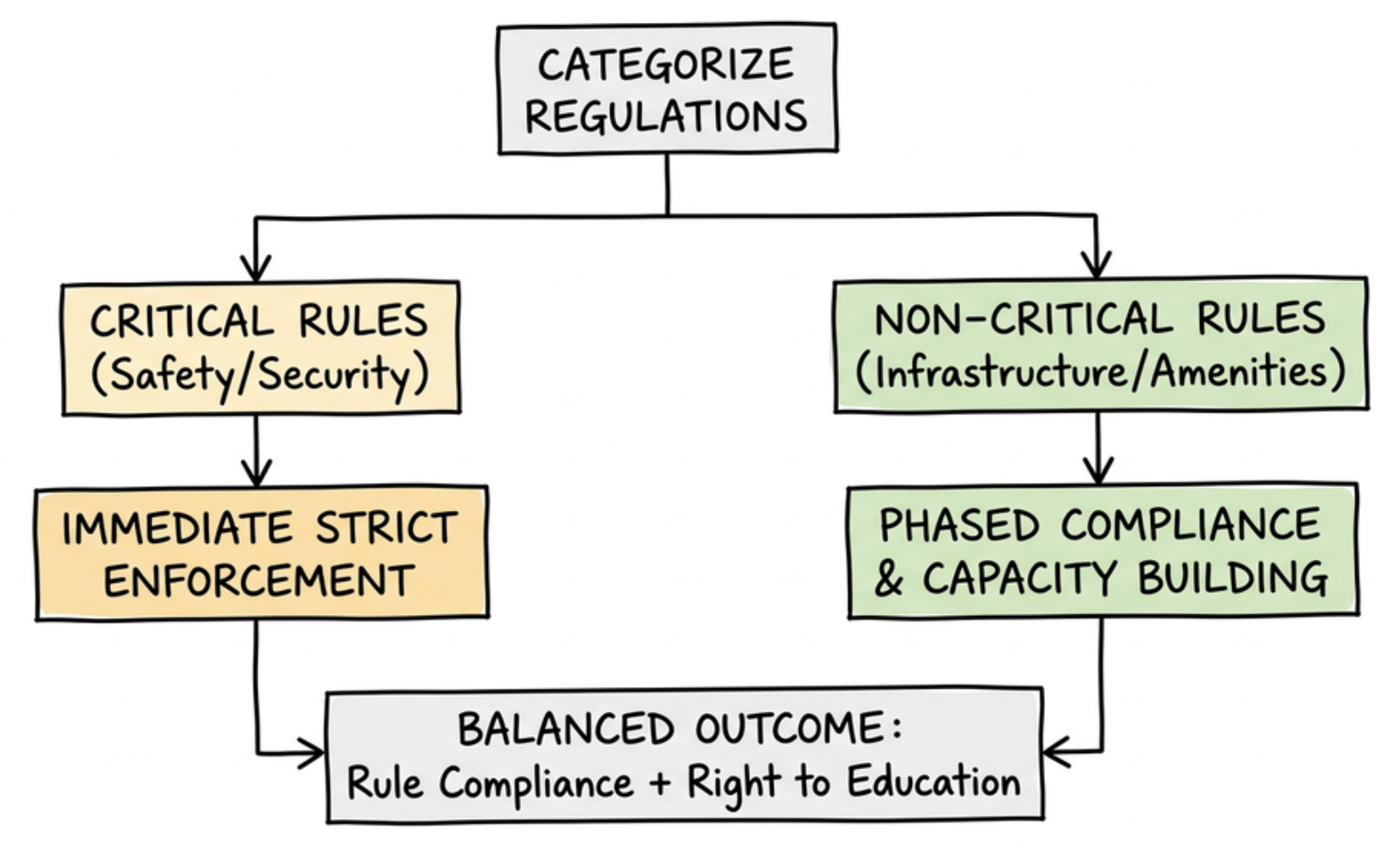
Graded Enforcement for Balancing Regulatory Compliance and Right to Education
Challenges in Balancing Enforcement and Educational Rights
-
Infrastructure Deficit: Strict enforcement of RTE Act norms regarding building stability or playground size in hilly or tribal terrains is often physically impossible.
-
Massive Learning Loss: Reports from 2026 indicate that over 94,000 government schools closed in a decade, often due to mergers or non-compliance, forcing children in Jammu and Kashmir to travel 4-6 km daily.
-
Teacher Shortages: While the national Pupil-Teacher Ratio (PTR) reached 26:1 by 2025, remote schools still struggle with vacancies, and strict punitive action may leave students with no mentors at all.
-
Regulatory Overreach: A 2026 NITI Aayog report suggests that while primary enrollment is universal, rigid regulations often stifle smaller schools that provide the only accessible learning centers in underserved regions.
-
Socio-Economic Barriers: Policy changes, such as Maharashtra's 2026 distance reduction for RTE admissions, can inadvertently leave thousands of seats vacant if local geographic realities are ignored.
Multi-Dimensional Strategy for Administrative Balance
-
Graduated Regulatory Compliance: Instead of immediate closure, administrators should use a Compliance Roadmap (2025-2027) that categorizes norms into essential (safety, drinking water) and desirable (library size), allowing schools time to upgrade.
-
Infrastructure Flexibility: Leveraging the Samagra Shiksha Abhiyan (allocated ₹42,100 crore for 2026-27) to fund improvements in non-compliant schools rather than shutting them down.
-
Digital Integration: Utilizing the PM-eVidya and BharatNet initiatives to bridge resource gaps in schools that lack physical laboratories or libraries, as recommended by NITI Aayog in 2026.
-
Community-Led Oversight: Adopting the Varanasi Model (2025), where community-based tutoring and mobile learning units supplement formal school shortfalls, ensuring the Right to Education remains uninterrupted.
-
Differentiated Frameworks: Implementing the Centre for Civil Society’s EoOS Index 2026 recommendations to simplify compliance for smaller, remote schools while maintaining quality benchmarks.
By adopting Aristotle’s Golden Mean, administrators can ensure that regulations serve as a catalyst for improvement rather than a barrier to the fundamental rights of the marginalized. An ethical administrator must act as a Compassionate Regulator, ensuring that the letter of the law does not defeat the spirit of Sarva Shiksha Abhiyan.
Answer Length
Model answers may exceed the word limit for better clarity and depth. Use them as a guide, but always frame your final answer within the exam’s prescribed limit.
Evaluate this PYQ now
Write your answer & evaluate in just 60 seconds




500+ students evaluated
Model Answers from
- 2026Ethics: Theory10 MarksView Answer
Some moral philosophers argue that spending some of your resources, without significantly affecting your financial stability, to help other people who badly suffer is our moral duty and not merely a matter of charity. Justify this claim by explaining the distinction between duty and charity.
- 2026Ethics: Theory10 MarksView Answer
On the request of his Personal Assistant (PA), the District Magistrate (DM) stops the transfer of a schoolteacher who takes private tuition for his daughter diagnosed with learning disability. In this context, discuss the aspects of empathy versus compliance with rules.
- 2026Ethics: Theory10 MarksView Answer
In international relations, ethical considerations are often subjugated to the strategic interests of nation-states. Discuss this from an ethical perspective.
- 2026Ethics: Theory10 MarksView Answer
Efficiency is doing things right, while effectiveness is doing the right thing. How do you strike a balance between the two to enhance productivity?
- 2026Ethics: Theory10 MarksView Answer
Citing the serious adverse effects of long-term medication, a doctor convinces the family of a female patient for surgery. This led the patient to reluctantly consent for the surgery, though her original choice was to opt for medication. Explain the concepts of paternalism and beneficence by analysing the doctor's action.
- 2026Ethics: Theory10 MarksView Answer
Shakespeare in Henry IV says, "The arms are fair when the intent of bearing them is just." What ethical implications does this have in governance?
Model Answers by Subject


Crack UPSC with your
Personal AI Mentor
An AI-powered ecosystem to learn, practice, and evaluate with discipline