Efficiency is doing things right, while effectiveness is doing the right thing. How do you strike a balance between the two to enhance productivity?
Efficiency is doing things right, while effectiveness is doing the right thing. How do you strike a balance between the two to enhance productivity?
Peter Drucker defines efficiency as the technical mastery of processes, whereas effectiveness represents the moral and strategic choice of goals. While efficiency focuses on Input-Output Ratios, effectiveness aligns with Teleological purposes and the Public Interest.
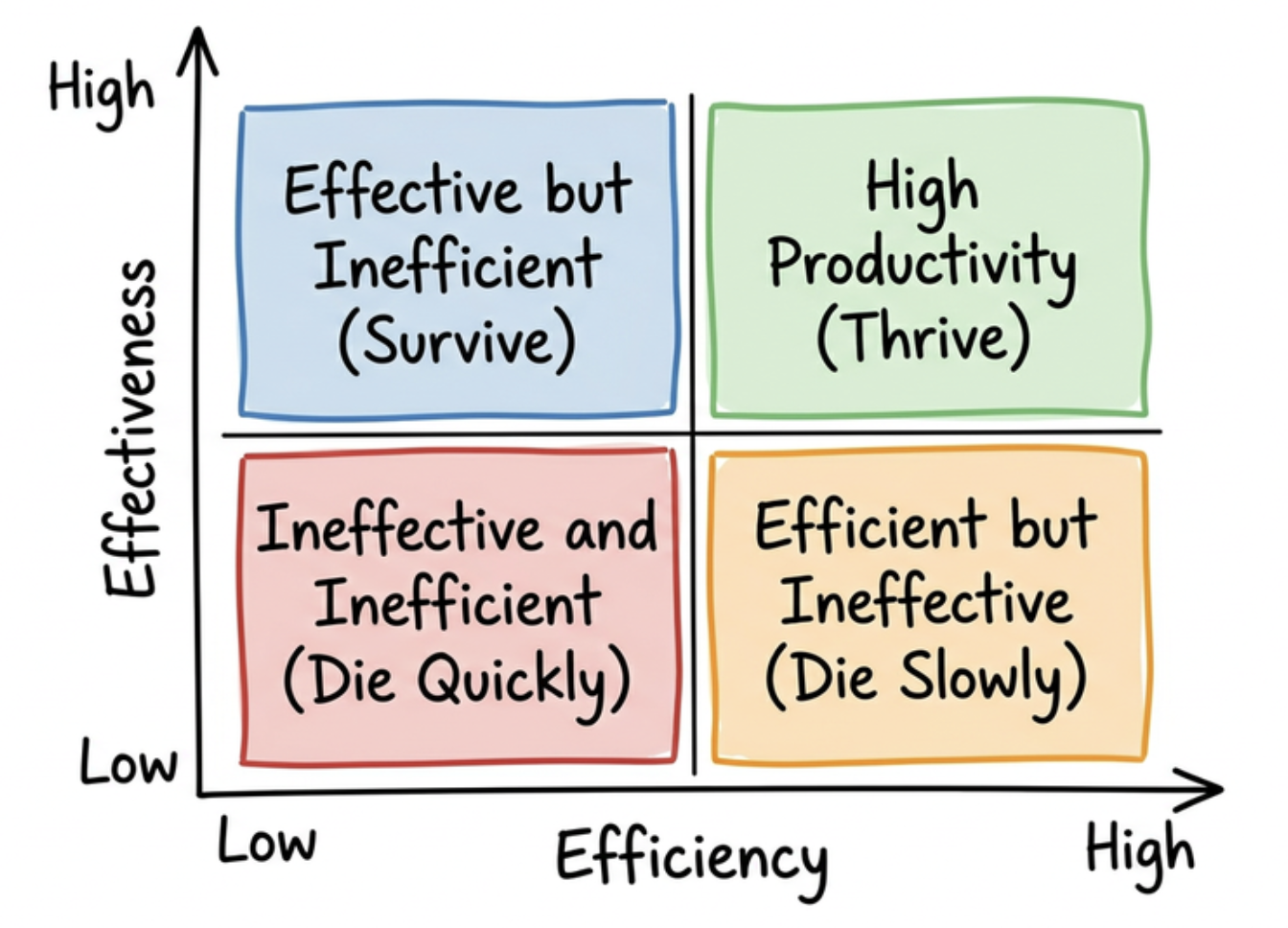
Efficiency Effectiveness Matrix for Organisational Productivity
The Dichotomy: Doing Things Right vs. Doing The Right Thing
The "Show Framework" demonstrates that one without the other leads to systemic failure or ethical decay:
-
Show through Examples: A department may process Right to Information (RTI) applications with record speed (Efficiency), but if it systematically denies information on technicalities, it fails in its core purpose of transparency (Effectiveness).
-
Show through Personalities: E. Sreedharan, known as the Metro Man, balanced efficiency by completing projects ahead of schedule while ensuring effectiveness by providing a reliable, world-class transport solution for the masses.
-
Show through Data: According to CEIC Data (December 2025), India's labor productivity grew by 8.93%, yet NITI Aayog's DPI 2.0 (2025-2035) roadmap emphasizes that this efficiency must translate into inclusive growth to be truly effective.
Comparison between Efficiency and Effectiveness
| Feature | Efficiency (Doing Things Right) | Effectiveness (Doing the Right Thing) |
|---|---|---|
| Focus | Process, Speed, and Cost. | Outcome, Impact, and Value. |
| Philosophical Base | Utilitarianism (Maximizing resource use). | Deontology or Dharma (Duty towards right ends). |
| Administrative Tool | Lean Management, Automation. | Social Audit, Ethical Reasoning. |
| Risk | "Bureaucratic Apathy" or rigid rule-following. | "Goal Displacement" or lack of sustainability. |
Striking a Balance to Enhance Productivity
-
Adopting Ethical Governance Frameworks: Use Aristotle's Golden Mean to avoid the extremes of mindless speed and directionless deliberation.
-
Leveraging Technology for Human-Centric Ends: The Goldman Sachs (July 2026) report suggests Gen-AI can boost productivity by 0.4 percentage points; however, this efficiency must be balanced with ethical data privacy and job security.
-
Outcome-Based Budgeting: Move beyond mere fund utilization (efficiency) to assessing the actual socio-economic impact (effectiveness) as highlighted in the Economic Survey 2025-26.
-
Implementing Performance Incentives: The Production Linked Incentive (PLI) Scheme attracts investment (₹2.40 lakh crore as of March 2026) by rewarding both output volume and strategic sector growth.
-
Feedback Loops and Social Audits: Incorporate citizen feedback to ensure that "efficient" delivery mechanisms like the Public Distribution System (PDS) are "effectively" reaching the intended Antyodaya beneficiaries.
-
Capacity Building: Training civil servants in Emotional Intelligence ensures they do not just follow the Manual of Office Procedure but also exercise empathy in public service.
By integrating the Karmayogi spirit with modern tools, administrators can ensure that productivity is not just a measure of speed, but a reflection of the Common Good and Constitutional Morality.
Answer Length
Model answers may exceed the word limit for better clarity and depth. Use them as a guide, but always frame your final answer within the exam’s prescribed limit.
Evaluate this PYQ now
Write your answer & evaluate in just 60 seconds




500+ students evaluated
Model Answers from
- 2026Ethics: Theory10 MarksView Answer
Some moral philosophers argue that spending some of your resources, without significantly affecting your financial stability, to help other people who badly suffer is our moral duty and not merely a matter of charity. Justify this claim by explaining the distinction between duty and charity.
- 2026Ethics: Theory10 MarksView Answer
On the request of his Personal Assistant (PA), the District Magistrate (DM) stops the transfer of a schoolteacher who takes private tuition for his daughter diagnosed with learning disability. In this context, discuss the aspects of empathy versus compliance with rules.
- 2026Ethics: Theory10 MarksView Answer
In international relations, ethical considerations are often subjugated to the strategic interests of nation-states. Discuss this from an ethical perspective.
- 2026Ethics: Theory10 MarksView Answer
Usually schools, working in remote areas, do not fully comply with government regulations. However, if the rules are enforced strictly, it would lead to most schools closing down. How should an administrator strike a balance between enforcement of rules and educational rights of children?
- 2026Ethics: Theory10 MarksView Answer
Citing the serious adverse effects of long-term medication, a doctor convinces the family of a female patient for surgery. This led the patient to reluctantly consent for the surgery, though her original choice was to opt for medication. Explain the concepts of paternalism and beneficence by analysing the doctor's action.
- 2026Ethics: Theory10 MarksView Answer
Shakespeare in Henry IV says, "The arms are fair when the intent of bearing them is just." What ethical implications does this have in governance?
Model Answers by Subject


Crack UPSC with your
Personal AI Mentor
An AI-powered ecosystem to learn, practice, and evaluate with discipline