Discuss the role of aeolian processes in desertification and land degradation.
Discuss the role of aeolian processes in desertification and land degradation.
Aeolian processes, driven by wind-mediated erosion, transport, and deposition, act as primary catalysts for land degradation in arid regions, affecting nearly 33% of global land area as per UNCCD reports.
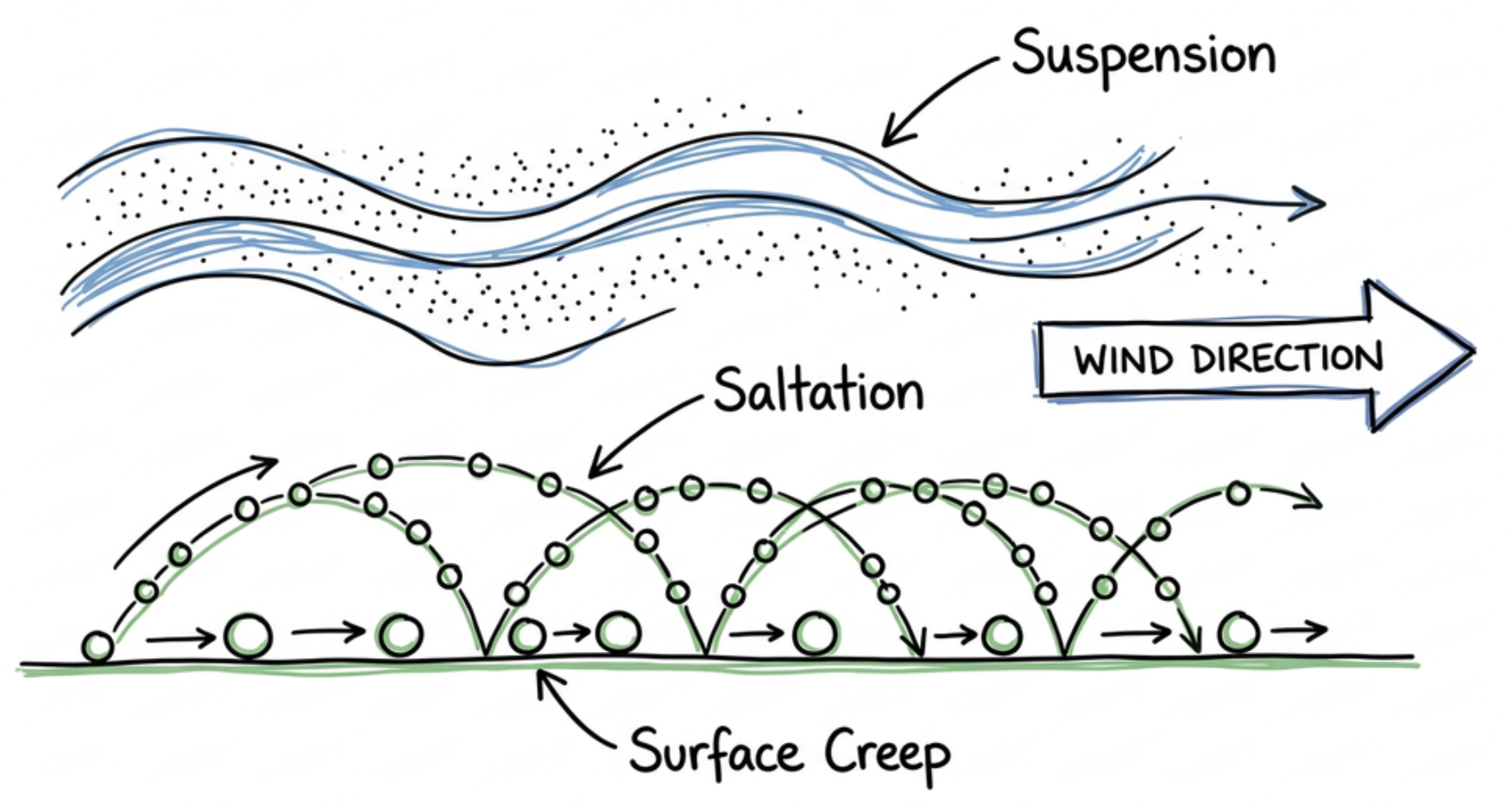
Aeolian Transport: Suspension, Saltation and Surface Creep
Role of Aeolian Processes in Desertification
-
Sand Encroachment: Active dune migration into fertile peripheries transforms arable land into wasteland.
- Eg: Expansion of the Thar Desert towards the Indo-Gangetic plains.
-
Soil Deflation: Wind removes loose, non-cohesive surface particles, lowering the land surface.
- Eg: Formation of blowouts and Hamada (stony deserts) in the Sahara.
-
Vegetation Burial: Accumulation of wind-blown sand smothers native flora, disrupting the ecological balance.
- Eg: Sahel region’s loss of acacia cover due to shifting sands.
-
Albedo Alteration: Dust deposition changes surface reflectivity, intensifying local thermal highs and aridity.
-
Hydrological Stress: High-velocity winds increase evapotranspiration rates, depleting scarce groundwater.
Impact on Land Degradation
-
Topsoil Stripping: Selective removal of nutrient-rich silt and organic matter (Humus) reduces soil fertility.
-
Saltation Damage: Bouncing sand grains break down soil aggregates, leading to surface crusting.
-
Nutrient Export: Wind carries fine clay particles, essential for cation exchange, over long distances.
-
Abrasive Erosion: Wind-borne particles physically damage plant tissues and bark through sand-blasting.
-
Atmospheric Loading: Increased PM10 dust levels reduce solar radiation, hindering crop photosynthesis.
Combatting these requires Nature-based Solutions like Shelterbelts and the Great Green Wall initiative, vital for achieving SDG 15.3 regarding Land Degradation Neutrality.
Answer Length
Model answers may exceed the word limit for better clarity and depth. Use them as a guide, but always frame your final answer within the exam’s prescribed limit.
Evaluate this PYQ now
Write your answer & evaluate in just 60 seconds




500+ students evaluated
Model Answers from
- 2026Physical Geography15 MarksView Answer
Compare the Loo, Chinook and Foehn winds with respect to their regions of prevalence, their nature and climatic impacts.
- 2026Physical Geography10 MarksView Answer
What is the Fujiwhara effect? Explain its impact on the movement and intensity of tropical cyclones.
Model Answers by Subject


Crack UPSC with your
Personal AI Mentor
An AI-powered ecosystem to learn, practice, and evaluate with discipline



