Compare the Loo, Chinook and Foehn winds with respect to their regions of prevalence, their nature and climatic impacts.
Compare the Loo, Chinook and Foehn winds with respect to their regions of prevalence, their nature and climatic impacts.
Local winds are meso-scale atmospheric phenomena triggered by regional pressure gradients and specific topography. Winds like the Loo, Chinook, and Foehn serve as critical regulators of regional micro-climates, influencing both ecology and human activity.
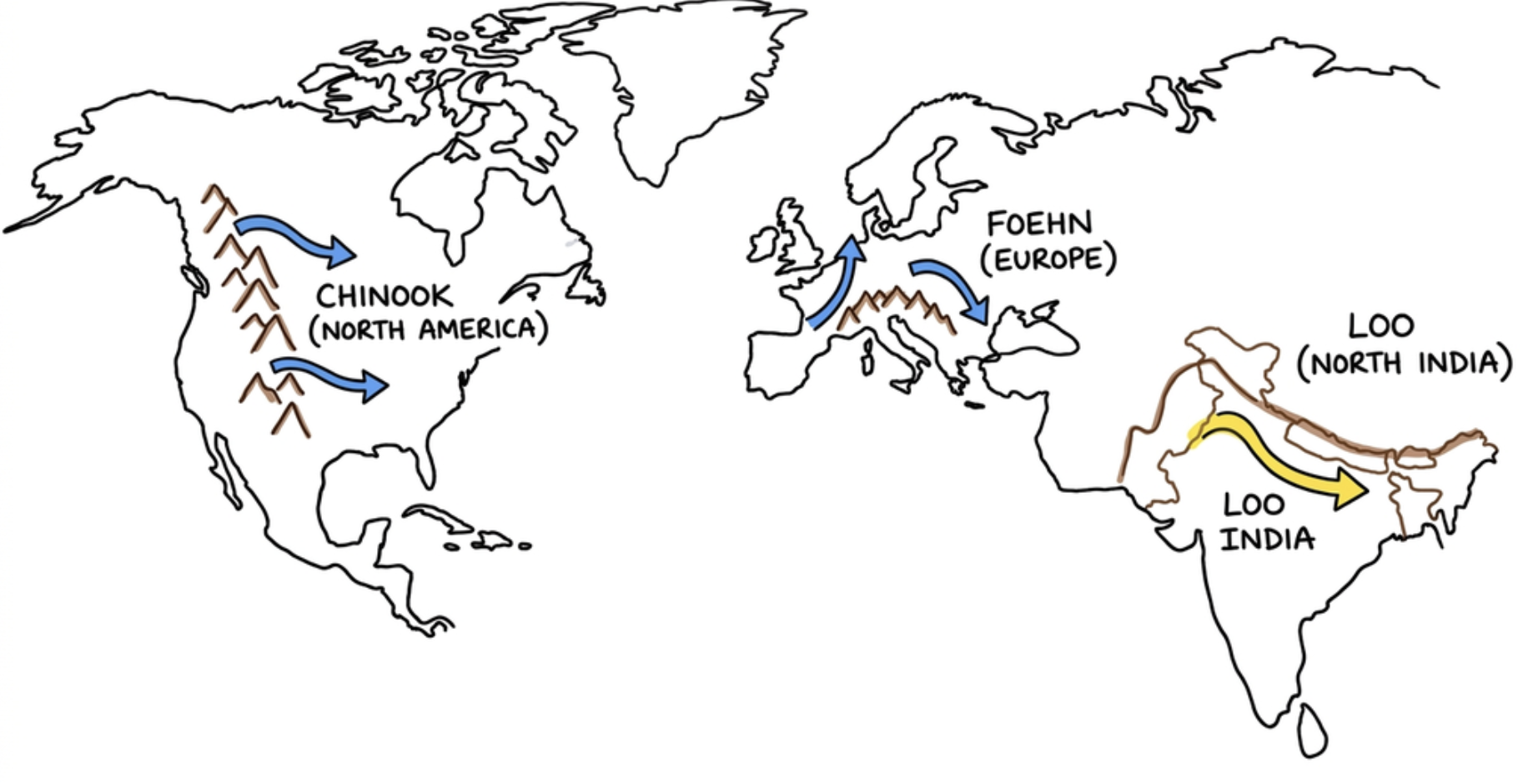
Global Distribution of Major Local Winds: Chinook, Foehn and Loo
Regions of Prevalence
-
Loo Geography: Originates in the Indo-Gangetic Plains, covering North India and Pakistan.
- Eg: Affects states like Rajasthan, Haryana, and Uttar Pradesh.
-
Chinook Geography: Occurs on the eastern leeward slopes of the Rocky Mountains in North America.
- Eg: Primarily impacts the Canadian Prairies and the US Great Plains.
-
Foehn Geography: Prevalent on the northern leeward side of the Alps Mountains in Europe.
- Eg: Dominant in the valleys of Switzerland, Austria, and Germany.
-
Topographical Drivers: Foehn and Chinook are mountain-descending winds, whereas Loo is a surface-advection wind.
-
Altitudinal Range: Chinook/Foehn operate at high altitudes before descending; Loo is a low-level tropospheric flow.
Nature and Physical Characteristics
-
Thermal Profile: All three are warm, but Loo is extremely hot (45°C-50°C) compared to the relatively warm Chinook/Foehn.
-
Adiabatic Heating: Chinook and Foehn heat via compression (Dry Adiabatic Lapse Rate) during descent.
-
Moisture Content: All are desiccating winds; Loo carries intense dust, while Foehn/Chinook are moisture-depleted after windward precipitation.
-
Seasonality: Loo is a summer phenomenon (May-June); Chinook and Foehn are prominent in winter and early spring.
-
Velocity and Gustiness: Loo is characterized by high-velocity heat tremors and dust storms, while Foehn is a steady, dry gale.
Climatic and Socio-Economic Impacts
-
Snow-Eater Effect: Chinook rapidly melts winter snow, clearing land for winter grazing in the Prairies.
-
Agricultural Ripening: Foehn provides the warmth necessary for grape ripening and viticulture in the Alpine valleys.
-
Heatwave Hazards: Loo causes severe heatstrokes and mortality, necessitating NDMA Heat Action Plans.
-
Vegetation Impact: Loo causes transpiration stress and crop wilting, whereas Foehn can trigger accidental forest fires.
-
Psychological Effects: Foehn is associated with "Foehn Illness" (headaches/anxiety) due to rapid atmospheric pressure changes.
These winds exemplify the dynamic interplay between orography and thermodynamics. Effective management of their impacts is essential for achieving SDG 13 (Climate Action) and ensuring agricultural resilience against extreme weather events.
Answer Length
Model answers may exceed the word limit for better clarity and depth. Use them as a guide, but always frame your final answer within the exam’s prescribed limit.
Evaluate this PYQ now
Write your answer & evaluate in just 60 seconds




500+ students evaluated
Model Answers by Subject


Crack UPSC with your
Personal AI Mentor
An AI-powered ecosystem to learn, practice, and evaluate with discipline



