A business house is working on a project that could displace a forest community from their habitat. As the administrative officer of that district, what ethical challenges are you likely to face?
A business house is working on a project that could displace a forest community from their habitat. As the administrative officer of that district, what ethical challenges are you likely to face?
Ethical governance involves reconciling the Utilitarian goal of economic development with Deontological duties toward marginalized communities, ensuring that the Dignity of Life is never sacrificed for commercial profit.
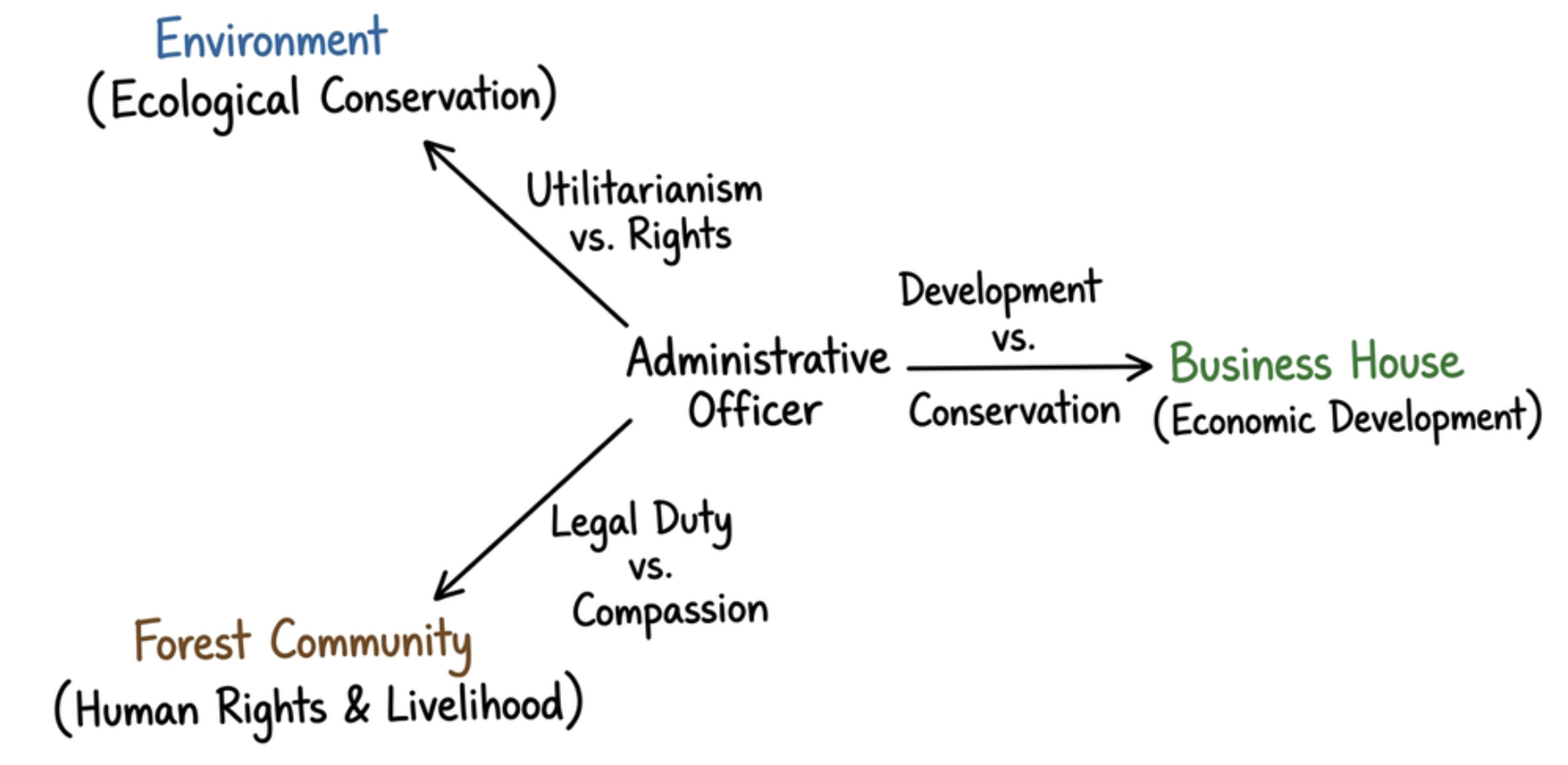
Ethical Conflicts in Balancing Development, Rights and Environmental Conservation
Ethical Challenges Faced as an Administrative Officer
-
Development vs. Conservation Dilemma: Balancing the economic benefits of the business project against the ecological integrity of the forest, especially following the Forest Conservation Amendment Act 2023 which eases certain diversions.
-
Procedural vs. Substantive Justice: Ensuring the Gram Sabha consent is not merely a "paper formality" but a meaningful exercise of autonomy under the PESA Act 1996 and Forest Rights Act (FRA) 2006.
-
Rights of the Marginalized vs. Corporate Interests: The pressure to facilitate "Ease of Doing Business" may conflict with the Constitutional Morality of protecting Article 21 rights for forest dwellers.
-
Cultural Identity vs. Modernization: Displacing a community risks the loss of Traditional Ecological Knowledge and sacred ties to land, as highlighted in the Digbal Tandi vs. State of Chhattisgarh (2026) ruling.
-
Distributive Justice in Compensation: Addressing the "conservation-agrarian squeeze" where inadequate compensation, as noted in recent 2026 land acquisition reports, leads to long term impoverishment.
-
Gender Justice: Implementing the Ram Charan vs. Sukhram (2025) principle to ensure tribal women receive equal ancestral property rights during the resettlement process, despite patriarchal customary laws.
-
Administrative Integrity: Resisting potential "nexus" pressures between commercial houses and political stakeholders, as warned by the Supreme Court in the 2025 Pune forest land conversion case.
Framework for Ethical Resolution
-
Informed Consent: Adhere to the National Policy on Rehabilitation and Resettlement (updated 2026), ensuring social impact assessments are transparent and participatory for all stakeholders.
-
Trusteeship Model: Applying Gandhian Trusteeship to ensure the business house contributes to the long term socio-economic upliftment of the displaced, rather than just providing one time cash settlements.
-
Empathetic Neutrality: Maintaining professional distance from corporate lobbyists while practicing Compassion toward the vulnerable forest community to ensure their voice is heard in the District Mineral Foundation planning.
Upholding the Ethos of Public Service requires an officer to act as a Fair Arbiter, ensuring that the pursuit of Viksit Bharat remains inclusive and aligned with the Seven Sins philosophy of Mahatma Gandhi, specifically avoiding "Commerce without Morality."
Answer Length
Model answers may exceed the word limit for better clarity and depth. Use them as a guide, but always frame your final answer within the exam’s prescribed limit.
Evaluate this PYQ now
Write your answer & evaluate in just 60 seconds




500+ students evaluated
Model Answers from
- 2026Ethics: Theory10 MarksView Answer
Some moral philosophers argue that spending some of your resources, without significantly affecting your financial stability, to help other people who badly suffer is our moral duty and not merely a matter of charity. Justify this claim by explaining the distinction between duty and charity.
- 2026Ethics: Theory10 MarksView Answer
On the request of his Personal Assistant (PA), the District Magistrate (DM) stops the transfer of a schoolteacher who takes private tuition for his daughter diagnosed with learning disability. In this context, discuss the aspects of empathy versus compliance with rules.
- 2026Ethics: Theory10 MarksView Answer
In international relations, ethical considerations are often subjugated to the strategic interests of nation-states. Discuss this from an ethical perspective.
- 2026Ethics: Theory10 MarksView Answer
Usually schools, working in remote areas, do not fully comply with government regulations. However, if the rules are enforced strictly, it would lead to most schools closing down. How should an administrator strike a balance between enforcement of rules and educational rights of children?
- 2026Ethics: Theory10 MarksView Answer
Efficiency is doing things right, while effectiveness is doing the right thing. How do you strike a balance between the two to enhance productivity?
- 2026Ethics: Theory10 MarksView Answer
Citing the serious adverse effects of long-term medication, a doctor convinces the family of a female patient for surgery. This led the patient to reluctantly consent for the surgery, though her original choice was to opt for medication. Explain the concepts of paternalism and beneficence by analysing the doctor's action.
Model Answers by Subject


Crack UPSC with your
Personal AI Mentor
An AI-powered ecosystem to learn, practice, and evaluate with discipline



