To achieve holistic development goal, a civil servant acts as an enabler and active facilitator of growth rather than a regulator. What specific measures will you suggest to achieve this goal?
To achieve holistic development goal, a civil servant acts as an enabler and active facilitator of growth rather than a regulator. What specific measures will you suggest to achieve this goal?
Holistic development requires civil servants to transition from regulatory gatekeepers to developmental catalysts, embodying Kautilya's concept of administrator as "lok-sevak" and Gandhi's trusteeship principle.
Transforming Administrative Mindset
-
Servant Leadership Approach: Adopting Robert Greenleaf's servant leadership model where administrators prioritize community needs over hierarchical power (e.g., IAS officer Armstrong Pame's community-driven road construction in Manipur).
-
Participatory Governance: Implementing Habermas's communicative action theory through regular Jan Sunwai and Gram Sabha consultations for inclusive decision-making.
-
Solution-Oriented Thinking: Moving from "why it cannot be done" to "how it can be achieved" mindset, exemplified by E. Sreedharan's innovative project management approaches.
-
Empathy and Emotional Intelligence: Developing Daniel Goleman's emotional intelligence framework to understand citizen perspectives and ground realities.
-
Continuous Learning Culture: Embracing the culture of regular skill upgradation and cross-sector exposure programs.
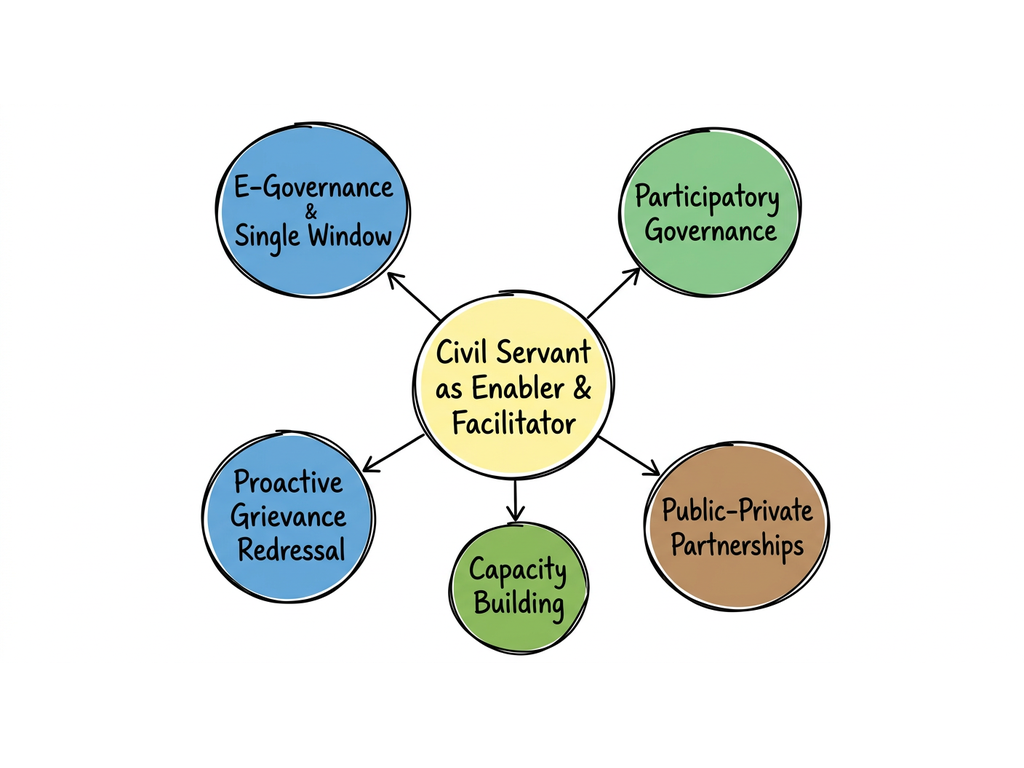
Civil servant role in governance landscape
Institutional Reforms and Capacity Building
-
Performance Measurement Systems: Implementing outcome-based evaluation rather than process-oriented assessments using SMART indicators for development goals.
-
Technology Integration: Leveraging Digital India initiatives like e-governance platforms and AI-driven citizen services for efficient service delivery.
-
Inter-departmental Coordination: Establishing convergence mechanisms similar to Mission Antyodaya for holistic rural development through collaborative approaches.
-
Decentralization of Powers: Strengthening 73rd and 74th Constitutional Amendments through genuine power devolution to local governance institutions.
-
Innovation Labs: Creating administrative innovation hubs like Atal Innovation Mission for experimenting with citizen-centric solutions.
-
Mentorship Programs: Developing senior-junior officer mentoring systems for knowledge transfer and ethical leadership development.
Transforming civil servants into development enablers requires systemic reforms combining Gandhian values with modern governance tools, ensuring sustainable and inclusive growth for all citizens.
Answer Length
Model answers may exceed the word limit for better clarity and depth. Use them as a guide, but always frame your final answer within the exam’s prescribed limit.
Evaluate this PYQ now
Write your answer & evaluate in just 60 seconds




500+ students evaluated
Model Answers from
- 2025Ethics: Theory10 MarksView Answer
India is an emerging economic power of the world as it has recently secured the status of fourth largest economy of the world as per IMF projection. However, it has been observed that in some sectors, allocated funds remain either under-utilised or misutilised. What specific measures would you recommend for ensuring accountability in this regard to stop leakages and gaining the status of third largest economy of the world in near future?
- 2025Ethics: Theory10 MarksView Answer
It is said that for an ethical work culture, there must be code of ethics in place in every organisation. To ensure value-based and compliance-based work culture, what suitable measures would you adopt in your work place?
- 2025Ethics: Theory10 MarksView Answer
"One who is devoted to one's duty attains highest perfection in life." Analyse this statement with reference to sense of responsibility and personal fulfilment as a civil servant.
- 2025Ethics: Theory10 MarksView Answer
What are the major teachings of Mahavir? Explain their relevance in the contemporary world.
- 2025Ethics: Theory10 MarksView Answer
"For any kind of social re-engineering by successfully implementing welfare schemes, a civil servant must use reason and critical thinking in an ethical framework." Justify this statement with suitable examples.
- 2025Ethics: Theory10 MarksView Answer
Given below is the quotation of a great thinker. What does this quotations convey to you in the present context?
"The strength of a society is not in its laws, but in the morality of its people." – Swami Vivekananda
Model Answers by Subject


Crack UPSC with your
Personal AI Mentor
An AI-powered ecosystem to learn, practice, and evaluate with discipline