What does this quotation convey to you in present context
“Learn everything that is good from others, but bring it in, and in your own way absorb it, do not become others.” — Swami Vivekananda
What does this quotation convey to you in present context
“Learn everything that is good from others, but bring it in, and in your own way absorb it, do not become others.” — Swami Vivekananda
This quote emphasizes the value of openness to learning while maintaining cultural and personal identity. In today’s interconnected and globalized world, it holds profound ethical, professional, and societal significance.
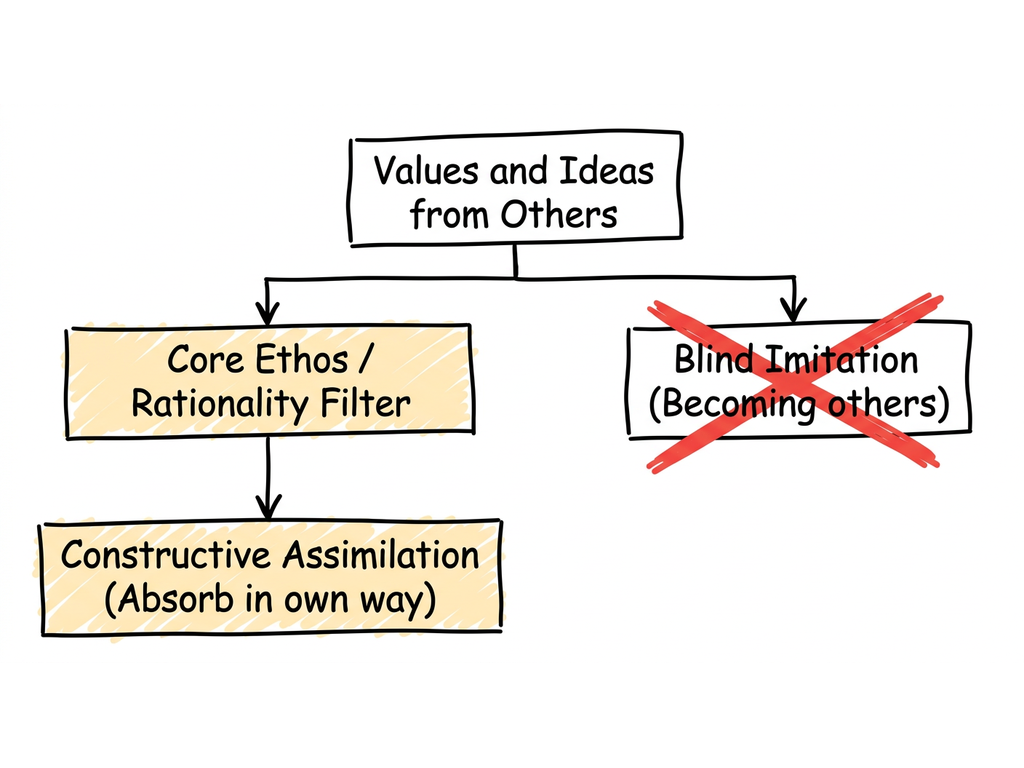
Processing Values through Rationality
Key Ideas Conveyed
-
Discerning Imitation vs. Authentic Absorption: We must learn good practices but adapt them in line with our own values and context. Blind imitation leads to loss of identity, while intelligent adaptation fosters growth without alienation.
Example: India adopting parliamentary democracy from Britain but enriching it with local democratic traditions like panchayati raj.
-
Preservation of Core Identity: The principle emphasizes that core values and uniqueness must not be compromised in the name of modernization or globalization. It promotes self-respect, cultural pride, and inner integrity.
-
Contextual Learning: It advocates that ethics, governance, and policy models must be tailored to local realities.
Example: public administration reforms in India must respect diversity, federalism, and socio-economic disparities, even if inspired by Western efficiency models.
-
Professional Ethics: We are constantly exposed to various role models and ideologies in professional set up. While learning is essential, decisions and behaviors must reflect individual conscience, constitutional values, and local needs.
-
Spiritual and Cultural Independence: The quote also warns against the colonial mindset of blindly considering foreign ideals superior. It calls for intellectual self-reliance and ethical nationalism — embracing global best practices without erasing indigenous wisdom.
Swami Vivekananda urges us to be open-minded yet rooted, adaptive yet authentic. In today’s world of rapid change, the wisdom lies in integrating the best from everywhere, but with discernment, originality, and integrity. This principle forms the ethical foundation of a confident, balanced, and inclusive society.
Answer Length
Model answers may exceed the word limit for better clarity and depth. Use them as a guide, but always frame your final answer within the exam’s prescribed limit.
Evaluate this PYQ now
Write your answer & evaluate in just 60 seconds




500+ students evaluated
Model Answers from
- 2024Ethics: Theory10 MarksView Answer
Mission Karmayogi is aiming for maintaining a very high standard of conduct and behaviour to ensure efficiency for serving citizens and in turn developing oneself. How will this scheme empower the civil servants in enhancing productive efficiency and delivering the services at the grassroots level ?
- 2024Ethics: Theory10 MarksView Answer
“In Indian culture and value system, an equal opportunity has been provided irrespective of gender identity. The number of women in public service has been steadily increasing over the years.”
Examine the gender-specific challenges faced by female public servants and suggest suitable measures to increase their efficiency in discharging their duties and maintaining high standards of probity. - 2024Ethics: Theory10 MarksView Answer
The soul of the new law, Bharatiya Nyaya Sanhita (BNS) is Justice, Equality and Impartiality based on Indian culture and ethos. Discuss this in the light of major shift from a doctrine of punishment to justice in the present judicial system.
- 2024Ethics: Theory10 MarksView Answer
‘The ‘Code of Conduct’ and ‘Code of Ethics’ are the sources of guidance in public administration. There is code of conduct already in operation, whereas code of ethics is not yet put in place. Suggest a suitable model for code of ethics to maintain integrity, probity and transparency in governance.
- 2024Ethics: Theory10 MarksView Answer
“Mindless addiction to Form, ignoring the Substance of the matter, results in rendering of injustice. A perceptive civil servant is one who ignores such literalness and carries out true intent.”
Examine the above statement with suitable illustrations. - 2024Ethics: Theory10 MarksView Answer
“The concept of Just and Unjust is contextual. What was just a year back, may turn out to be unjust in today’s context. Changing context should be constantly under scrutiny to prevent miscarriage of justice.”
Examine the above statement with suitable examples.
Model Answers by Subject


Crack UPSC with your
Personal AI Mentor
An AI-powered ecosystem to learn, practice, and evaluate with discipline