What does this quotation mean to you
“If a country is to be corruption free and become a nation of beautiful minds, I strongly feel there are three key societal members who can make a difference. They are the father, the mother and the teacher.” – Abdul Kalam.
What does this quotation mean to you
“If a country is to be corruption free and become a nation of beautiful minds, I strongly feel there are three key societal members who can make a difference. They are the father, the mother and the teacher.” – Abdul Kalam.
Dr. Kalam’s words highlight a truth often missed in anti‑corruption debates: laws and enforcement can punish graft, but only value‑centric upbringing can prevent it. The quotation emphasises that the first line of defence against corruption is ethical socialisation inside families and classrooms. Fathers, mothers, and teachers are therefore the “ethical architects” who mould young minds long before they enter public life.
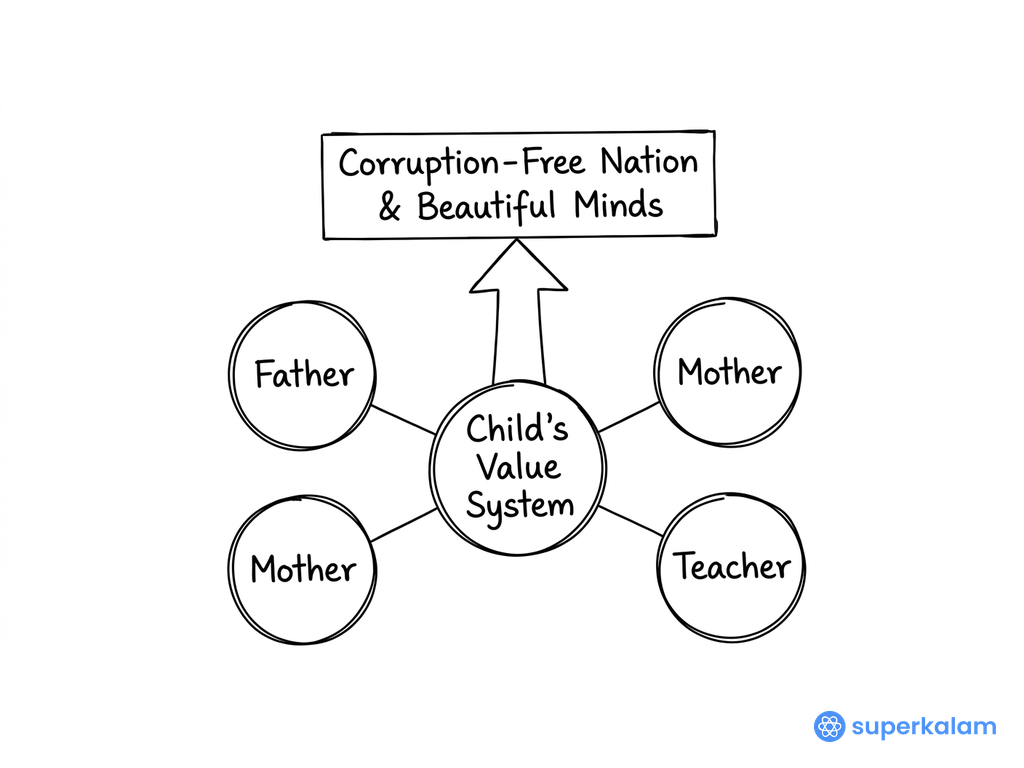
Child's Value System Triad Framework Diagram
Key Ideas and Interpretations
-
Character Building Starts at Home and School: Ethical values are not learned overnight—they are absorbed in early childhood through observation and imitation of parents and teachers.
Example: Dr. A.P.J. Abdul Kalam often credited his own values of simplicity and honesty to his father Jainulabdeen, a boat owner and imam, and his school teacher who ignited his curiosity and moral reasoning.
-
Parents as Moral Anchors: A child’s first sense of right and wrong comes from parents. If parents are honest, disciplined, and compassionate, these values become ingrained in the child.
Example: In 2016, a Mumbai traffic constable’s 10-year-old son reported his own father for accepting a bribe. The boy had been taught in school and at home that corruption is wrong—demonstrating the power of early ethical socialization.
-
Teachers as Ethical Role Models: Beyond textbooks, teachers shape students’ moral compass by the way they conduct themselves. Their influence often lasts a lifetime.
Example: In Kerala, a school teacher introduced a “value education hour” where students read about Gandhi, Vivekananda, and debated ethical dilemmas—leading to improved classroom behavior and social awareness.
-
Preventive Ethics over Punitive Action: Institutions can punish corruption, but only value-driven citizens can prevent it. Ethics taught at home and school builds internal moral resistance to wrongdoing.
Example: Many civil servants like Armstrong Pame (IAS) attribute their commitment to public service to values instilled by their parents and teachers.
-
Long-Term Nation Building: A corruption-free society is not a quick outcome of laws but a generational investment in nurturing responsible, empathetic, and courageous individuals.
Example: Scandinavian countries like Finland and Norway rank high on integrity indexes due to strong family and educational emphasis on ethics—not just stringent laws.
-
Triad of Influence: Family–School–Society: Fathers, mothers, and teachers are foundational to cultivating a national conscience. When these three agents work in harmony, societal transformation becomes sustainable.
Example: The Teach India initiative involves volunteers acting as moral and academic mentors in slums—impacting both learning and value systems in underprivileged children.
Dr. Kalam’s quotation is a clarion call to shift anti‑corruption focus from boardrooms and courtrooms to living rooms and classrooms. Laws deter wrongdoing, but fathers, mothers and teachers prevent it by crafting beautiful minds that naturally choose integrity over advantage. True nation‑building, therefore, begins with ethical parenting and value‑based education—laying the foundation for a corruption‑free, compassionate India.
Answer Length
Model answers may exceed the word limit for better clarity and depth. Use them as a guide, but always frame your final answer within the exam’s prescribed limit.
Evaluate this PYQ now
Write your answer & evaluate in just 60 seconds




500+ students evaluated
Model Answers from
- 2022Ethics: Theory10 MarksView Answer
In contemporary world, corporate sector’s contribution in generating wealth and employment is increasing. In doing so, they are bringing in unprecedented onslaught on the climate, environmental sustainability and living conditions of human beings. In this background, do you Responsibility (CSR) is efficient and sufficient enough to fulfill the social roles and responsibilities needed in the corporate work mandated? Critically examine.
- 2022Ethics: Theory10 MarksView Answer
Whistle blower, who reports corruption and illegal activities, wrongdoing and misconduct to the concerned authorities, runs the risk of being exposed to grave danger, physical harm and victimization by the vested interests, accused persons and his team. What policy measures would you suggest to strengthen protection mechanism to safeguard the whistle blower?
- 2022Ethics: Theory10 MarksView Answer
Write short notes on the following in 30 words each :
(i) Constitutional morality
(ii) Conflict of interest
(iii) Probity in public life
(iv) Challenges of digitalization
(v) Devotion to duty - 2022Ethics: Theory10 MarksView Answer
The Russia and Ukraine war has been going on for the last seven months. Different countries have taken independent stands and actions keeping in view their own national interests. We are all aware that war has its own impact on the different aspects of society, including human tragedy. What are those ethical issues that are crucial to be considered while launching the war and its continuation so far? Illustrate with justification the ethical issues involved in the given state of affair.
- 2022Ethics: Theory10 MarksView Answer
Online methodology is being used for day-to-day meetings, institutional approvals in the administration and for teaching and learning in education sector to the extent telemedicine in the health sector is getting popular with the approvals of the competent authority. No doubt it has advantages and disadvantages for both the beneficiaries and system at large. Describe and discuss the ethical issues involved in the use of online method particularly to
vulnerable section of society. - 2022Ethics: Theory10 MarksView Answer
What do you understand by term ‘good governance’? How far recent initiatives in terms of e-Governance steps taken by the State have helped the beneficiaries? Discuss with suitable examples.
Model Answers by Subject


Crack UPSC with your
Personal AI Mentor
An AI-powered ecosystem to learn, practice, and evaluate with discipline



