The Russia and Ukraine war has been going on for the last seven months. Different countries have taken independent stands and actions keeping in view their own national interests. We are all aware that war has its own impact on the different aspects of society, including human tragedy. What are those ethical issues that are crucial to be considered while launching the war and its continuation so far? Illustrate with justification the ethical issues involved in the given state of affair.
The Russia and Ukraine war has been going on for the last seven months. Different countries have taken independent stands and actions keeping in view their own national interests. We are all aware that war has its own impact on the different aspects of society, including human tragedy. What are those ethical issues that are crucial to be considered while launching the war and its continuation so far? Illustrate with justification the ethical issues involved in the given state of affair.
War is often seen as a failure of diplomacy, where political objectives override humanitarian concerns. The Russia-Ukraine war, now ongoing for over seven months, presents not only a geopolitical crisis but also raises profound ethical questions related to justice, sovereignty, human rights, and global responsibility. Ethical scrutiny is vital to assess not just the causes of war, but also its means and its consequences.
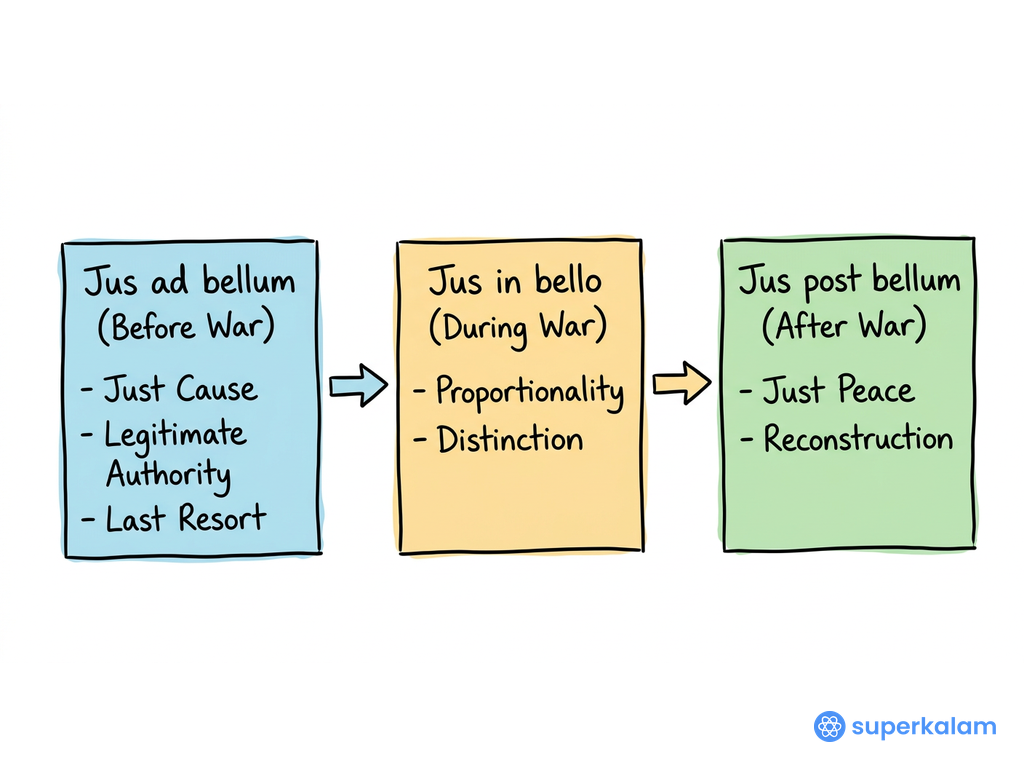
Just War Theory Three Part Framework
Ethical Issues in Launching the War
-
Violation of Sovereignty and Territorial Integrity: Russia's military invasion of Ukraine undermines the principle of respect for national sovereignty enshrined in international law. It's Ethical Breach Ignoring the UN Charter and just war principles (jus ad bellum).
-
Pre-emptive Violence and Aggression: Any war initiated without exhausting peaceful negotiations is ethically questionable.
Example: Claims of preemptive self-defence or NATO threat are contested and don’t justify full-scale invasion.
-
Disproportionate Use of Force: Ethical warfare requires proportionality; civilian infrastructure like hospitals, schools, and homes should not be targeted.
Example: Bombing of Mariupol theatre (sheltering civilians) raised global ethical outrage.
-
Manipulation of Information and Propaganda: Spreading misinformation to justify war erodes informed consent and rational discourse.
Example: Russian state media presenting the invasion as a “special military operation” and suppressing dissent.
-
Lack of Legitimate Authority or Mandate: Decisions to go to war should ideally involve parliamentary or multilateral backing. Autocratic decision-making without wider representation violates democratic ethics.
Ethical Issues in the Continuation of War
-
Humanitarian Crisis and Civilian Suffering: The war has led to the death of thousands and displacement of millions.
Example: Over 6 million Ukrainians have become refugees—raising ethical concerns about the conduct of war.
-
Weaponisation of Essential Services: Targeting of energy grids, water supply, and nuclear facilities endangers civilians.
Example: Shelling near Zaporizhzhia Nuclear Plant endangers regional and global health.
-
Children and Vulnerable Groups Affected: War inflicts lasting trauma on children, widens educational gaps, and exacerbates gender-based violence.
Example: UNICEF reports major mental health risks for war-affected children in Ukraine.
-
Use of Economic Sanctions and Their Ethical Limits: Though non-violent, sanctions hurt common citizens more than political elites.
Example: Sanctions on Russian banks have led to medicine and food shortages in some regions.
-
Arms Trade and Proxy Warfare Ethics: Weaponizing the conflict through indirect military aid can prolong suffering for geopolitical gains.
Example: Supply of arms to Ukraine by NATO countries while avoiding direct conflict raises questions about moral responsibility.
-
Selective Global Responses and Moral Hypocrisy: Varying responses to different global conflicts show moral inconsistency.
Example: Comparisons between attention given to Ukraine vs. conflicts in Syria, Yemen, or Africa expose ethical double standards.
War always leads to destruction — physical, emotional, moral. While nations prioritize strategic interests, ethical responsibility demands the primacy of human dignity, peace, and proportional justice. The Russia-Ukraine war is not just a clash of states, but a mirror to the world’s moral conscience, calling for introspection, accountability, and commitment to non-violence and diplomacy.
Answer Length
Model answers may exceed the word limit for better clarity and depth. Use them as a guide, but always frame your final answer within the exam’s prescribed limit.
Evaluate this PYQ now
Write your answer & evaluate in just 60 seconds




500+ students evaluated
Model Answers from
- 2022Ethics: Theory10 MarksView Answer
In contemporary world, corporate sector’s contribution in generating wealth and employment is increasing. In doing so, they are bringing in unprecedented onslaught on the climate, environmental sustainability and living conditions of human beings. In this background, do you Responsibility (CSR) is efficient and sufficient enough to fulfill the social roles and responsibilities needed in the corporate work mandated? Critically examine.
- 2022Ethics: Theory10 MarksView Answer
Whistle blower, who reports corruption and illegal activities, wrongdoing and misconduct to the concerned authorities, runs the risk of being exposed to grave danger, physical harm and victimization by the vested interests, accused persons and his team. What policy measures would you suggest to strengthen protection mechanism to safeguard the whistle blower?
- 2022Ethics: Theory10 MarksView Answer
Write short notes on the following in 30 words each :
(i) Constitutional morality
(ii) Conflict of interest
(iii) Probity in public life
(iv) Challenges of digitalization
(v) Devotion to duty - 2022Ethics: Theory10 MarksView Answer
Online methodology is being used for day-to-day meetings, institutional approvals in the administration and for teaching and learning in education sector to the extent telemedicine in the health sector is getting popular with the approvals of the competent authority. No doubt it has advantages and disadvantages for both the beneficiaries and system at large. Describe and discuss the ethical issues involved in the use of online method particularly to
vulnerable section of society. - 2022Ethics: Theory10 MarksView Answer
What do you understand by term ‘good governance’? How far recent initiatives in terms of e-Governance steps taken by the State have helped the beneficiaries? Discuss with suitable examples.
- 2022Ethics: Theory10 MarksView Answer
What does this quotation mean to you
“Judge your success by what you had to give up in order to get it.” Dalai Lama.
Model Answers by Subject


Crack UPSC with your
Personal AI Mentor
An AI-powered ecosystem to learn, practice, and evaluate with discipline



