Too little cash, too much politics, leaves UNESCO
fighting for life.’ Discuss the statement in light of the
US withdrawal and its accusation of the cultural
body as being ‘anti-Israel bias’.
Too little cash, too much politics, leaves UNESCO
fighting for life.’ Discuss the statement in light of the
US withdrawal and its accusation of the cultural
body as being ‘anti-Israel bias’.
UNESCO faces existential challenges due to severe funding shortfalls and escalating political polarization, exemplified by the US withdrawal over alleged anti-Israel bias accusations.
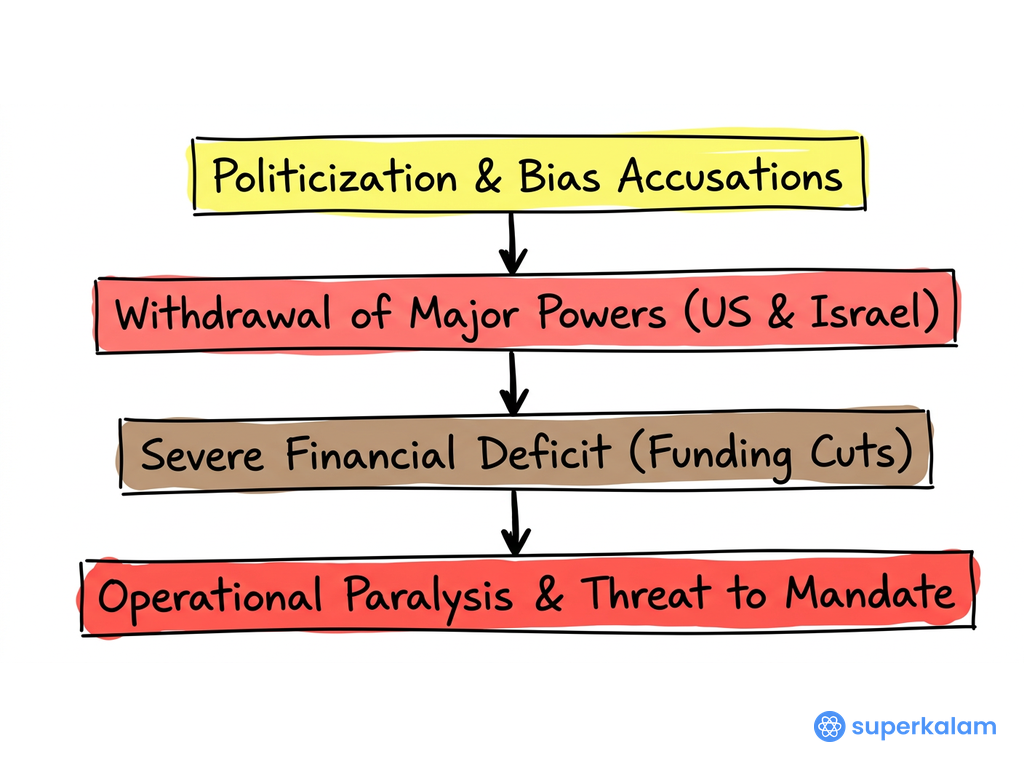
UNESCO Institutional Crisis Politicization and Bias
Financial Crisis at UNESCO
- Budget Deficit: UNESCO's 2024-25 budget of $1.8 billion remains inadequate for its global mandate covering 195 member states' educational, cultural, and scientific programs
- US Funding Gap: America's withdrawal eliminated approximately 22% of UNESCO's regular budget, creating operational paralysis in key programs
- Delayed Contributions: Many member states consistently delay their assessed contributions, forcing UNESCO to operate with cash flow problems
- Program Cuts: Critical initiatives like education in conflict zones and cultural heritage preservation face severe budget reductions
- Staff Reductions: Financial constraints have led to hiring freezes and staff cuts across UNESCO's headquarters and field offices
Political Polarization Issues
- Anti-Israel Bias Allegations: US cited UNESCO's 2016 resolution denying Jewish connection to Temple Mount as evidence of systematic bias against Israel
- Palestine Membership Crisis: UNESCO's acceptance of Palestine as full member in 2011 triggered immediate US funding suspension under domestic legislation
- Weaponization of Culture: Member states increasingly use UNESCO platforms to advance narrow political agendas rather than collective cultural objectives
- Voting Blocs: Regional and religious voting patterns have transformed technical cultural decisions into geopolitical battlegrounds
- Credibility Erosion: Repeated controversies have damaged UNESCO's reputation as an impartial guardian of global cultural heritage
Operational Consequences
| Challenge | Impact | Example |
|---|---|---|
| Funding Shortfall | Program Suspension | Emergency heritage protection reduced by 40% |
| Political Interference | Delayed Decisions | World Heritage Site listings blocked for political reasons |
| Staff Exodus | Expertise Loss | Senior cultural specialists leaving for better-funded organizations |
Reform and Revival Strategies
- Financial Diversification: Expanding partnerships with private foundations like Gates Foundation and tech companies for education programs
- Depoliticization Efforts: Implementing stricter procedural safeguards to separate cultural work from political disputes
- Enhanced Transparency: Regular financial audits and public reporting to rebuild donor confidence
- Constitutional Reforms: Revising voting procedures to prevent manipulation by political blocs
- Strategic Refocusing: Concentrating resources on core competencies like heritage preservation and education quality improvement
UNESCO's survival depends on member states' collective commitment to depoliticize cultural cooperation while ensuring sustainable financing through innovative funding mechanisms and institutional reforms.
Answer Length
Model answers may exceed the word limit for better clarity and depth. Use them as a guide, but always frame your final answer within the exam’s prescribed limit.
Evaluate this PYQ now
Write your answer & evaluate in just 60 seconds




500+ students evaluated
Model Answers from
- 2019International Relations15 MarksView Answer
What introduces friction into the ties between
India and the United States, Washington
is still unable to find for India a position in its
global strategy, which would satisfy India’s
National self-esteem and ambitions” Explain
with suitable examples. - 2019International Relations15 MarksView Answer
The long-sustained image of India as a leader
of the oppressed and marginalised Nations has
disappeared on account of its newfound role in
the emerging global order. Elaborate. - 2019International Relations10 MarksView Answer
The time has come for India and Japan to build a
strong contemporary relationship, one involving
global and strategic partnership that will have great
significance for Asia and the world as a whole.’
Comment.
Model Answers by Subject


Crack UPSC with your
Personal AI Mentor
An AI-powered ecosystem to learn, practice, and evaluate with discipline



