The time has come for India and Japan to build a
strong contemporary relationship, one involving
global and strategic partnership that will have great
significance for Asia and the world as a whole.’
Comment.
The time has come for India and Japan to build a
strong contemporary relationship, one involving
global and strategic partnership that will have great
significance for Asia and the world as a whole.’
Comment.
India and Japan's partnership has evolved into a Special Strategic and Global Partnership, reflecting shared democratic values and strategic interests in maintaining Indo-Pacific stability.
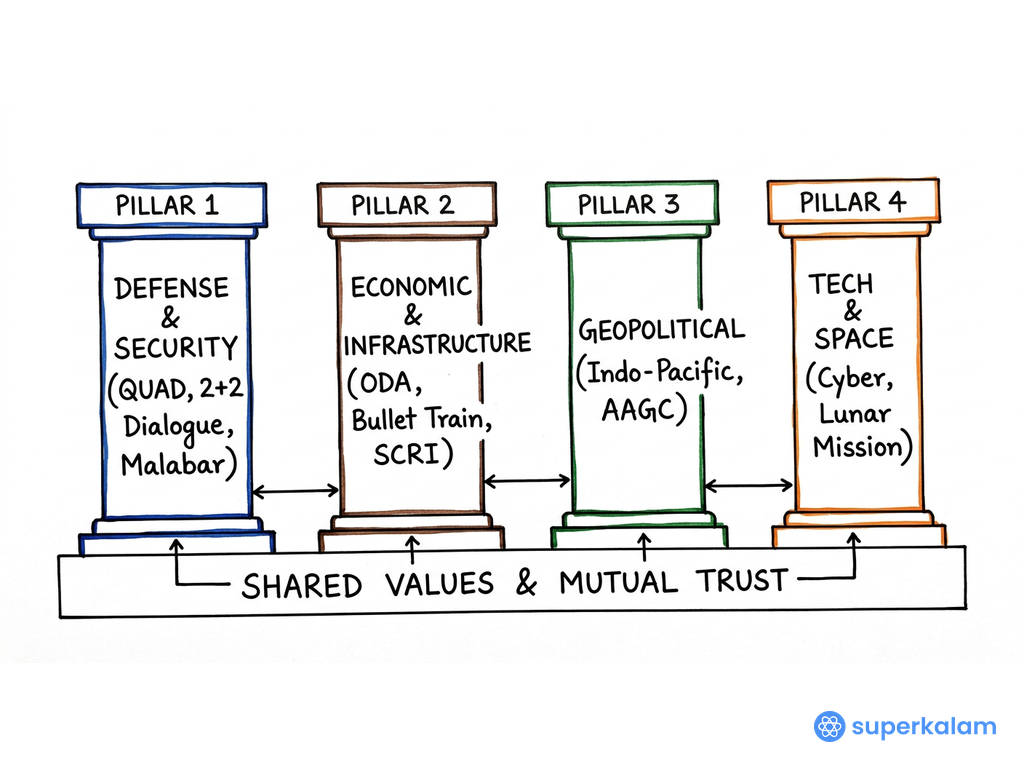
India Japan Strategic Global Partnership Framework
Strategic and Security Cooperation
- Defense Partnership: 2+2 Ministerial Dialogue mechanism strengthens defense capabilities and maritime security cooperation
- Military Exercises: Joint participation in Malabar Naval Exercise with US and Australia enhances interoperability
- Technology Sharing: Collaboration in defense technology, including potential joint development of fighter aircraft engines
- Cyber Security: Joint initiatives in cybersecurity and space technology address modern security challenges
- Intelligence Cooperation: Enhanced information sharing mechanisms counter regional security threats
Economic and Infrastructure Partnership
- Trade Growth: Bilateral trade reached $18.3 billion in 2022-23, with potential to reach $50 billion by 2025
- Investment Flow: Japan remains among top 5 FDI sources with cumulative investment of $36 billion (2000-2023)
- Infrastructure Projects: Mumbai-Ahmedabad High-Speed Rail project showcases technological cooperation
- Supply Chain Resilience: Partnership for Critical and Emerging Technologies (iCET) framework strengthens economic security
- Manufacturing Hub: Japanese companies' participation in Make in India initiative boosts manufacturing capabilities
Regional and Global Impact
| Dimension | India-Japan Contribution |
|---|---|
| Indo-Pacific Strategy | Joint vision for free, open, and inclusive Indo-Pacific |
| Multilateral Cooperation | Quad partnership with US and Australia |
| Connectivity Projects | Asia-Africa Growth Corridor as alternative to BRI |
| Climate Action | Joint initiatives in renewable energy and clean technology |
Challenges and Opportunities
- Geopolitical Dynamics: Managing China's assertiveness while maintaining economic engagement
- Nuclear Cooperation: Civil nuclear agreement potential despite Japan's nuclear concerns
- Cultural Exchange: Expanding people-to-people connections through education and tourism
- Technology Transfer: Balancing technology sharing with national security considerations
- Third Country Partnerships: Joint infrastructure development in Southeast Asia and Africa
The India-Japan partnership represents a defining relationship of the 21st century, crucial for Asian stability and global prosperity. Their collaboration in emerging technologies, sustainable development, and regional security architecture will significantly influence the rules-based international order and democratic resilience in Asia.
Answer Length
Model answers may exceed the word limit for better clarity and depth. Use them as a guide, but always frame your final answer within the exam’s prescribed limit.
Evaluate this PYQ now
Write your answer & evaluate in just 60 seconds




500+ students evaluated
Model Answers from
- 2019International Relations15 MarksView Answer
What introduces friction into the ties between
India and the United States, Washington
is still unable to find for India a position in its
global strategy, which would satisfy India’s
National self-esteem and ambitions” Explain
with suitable examples. - 2019International Relations15 MarksView Answer
The long-sustained image of India as a leader
of the oppressed and marginalised Nations has
disappeared on account of its newfound role in
the emerging global order. Elaborate. - 2019International Relations10 MarksView Answer
Too little cash, too much politics, leaves UNESCO
fighting for life.’ Discuss the statement in light of the
US withdrawal and its accusation of the cultural
body as being ‘anti-Israel bias’.
Model Answers by Subject


Crack UPSC with your
Personal AI Mentor
An AI-powered ecosystem to learn, practice, and evaluate with discipline



