The long-sustained image of India as a leader
of the oppressed and marginalised Nations has
disappeared on account of its newfound role in
the emerging global order. Elaborate.
The long-sustained image of India as a leader
of the oppressed and marginalised Nations has
disappeared on account of its newfound role in
the emerging global order. Elaborate.
India's transformation from a champion of the developing world to a major global power reflects its evolving strategic priorities and growing economic capabilities in the 21st century.
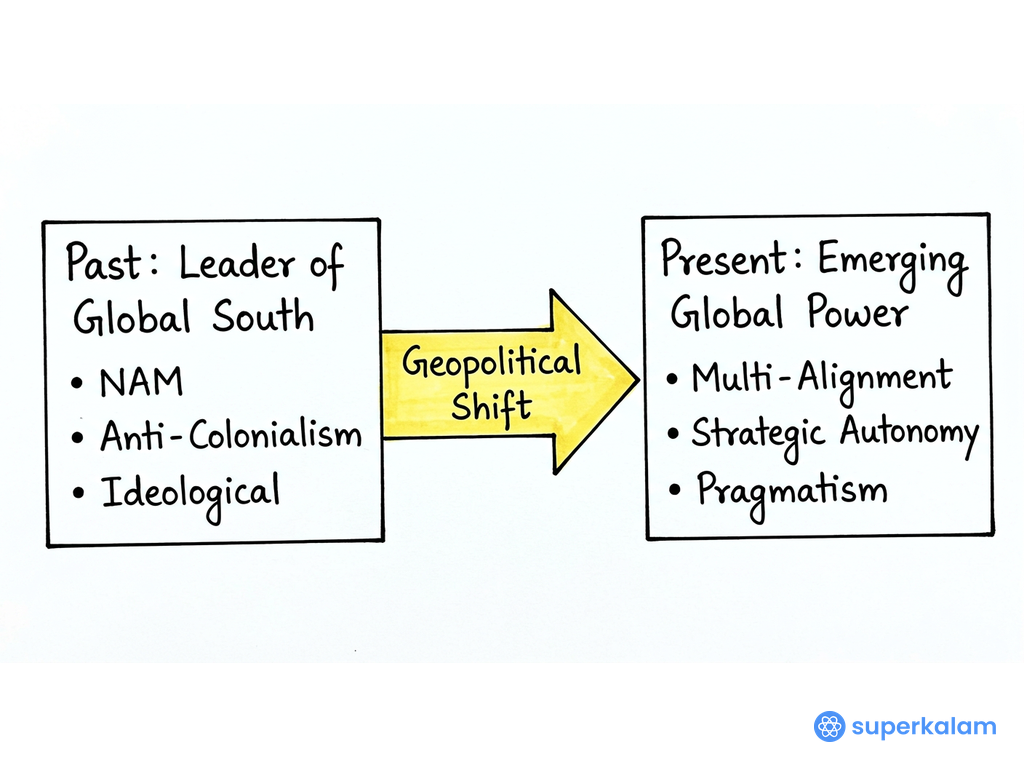
Past Leader Transition Comparative Flowchart
Shift from Traditional Non-Aligned Leadership
- Historical Role: India led the Non-Aligned Movement (NAM) with 120 members, advocating for decolonization and opposing superpower dominance during the Cold War
- Economic Transformation: Rise from $390 billion economy in 2000 to $3.7 trillion in 2023, fundamentally altering its global positioning
- Strategic Autonomy Evolution: From principled non-alignment to multi-alignment strategy, engaging simultaneously with competing power blocs
- Changing Priorities: Focus shifted from ideological solidarity to economic partnerships and strategic interests
- New Partnerships: Active participation in QUAD (2021 revival), I2U2 (2022), and Indo-Pacific Strategy, signaling departure from traditional neutrality
Factors Behind Image Transformation
- Economic Diplomacy Emphasis: Trade with Africa grew from $7 billion (2005) to $98 billion (2023), but increasingly driven by commercial rather than solidarity motives
- Western Strategic Alignment: Defense trade with US increased from $500 million (2008) to $20 billion (2023), creating perception of Western tilt
- Technology Partnerships: Participation in Chip-4 Alliance and Critical Minerals Partnership with developed nations
- Climate Leadership Shift: From demanding climate justice to promoting "Panchamrit" commitments at COP26, balancing development needs with global responsibilities
- UN Reform Advocacy: Pushing for UNSC permanent membership alongside traditional G77 solidarity
(SK Table: India's Changing Global Engagement)
| Traditional Approach (1947-1990s) | Contemporary Approach (2000s-Present) |
|---|---|
| Anti-colonial leadership | Economic partnership focus |
| NAM founding member | Multi-alignment strategy |
| South-South cooperation | North-South-East engagement |
| Ideological solidarity | Pragmatic interest-based relations |
| Moral leadership emphasis | Strategic autonomy prioritization |
Balancing Old and New Roles
- Voice of Global South Summit (2023): India organized this initiative with 125 developing nations, maintaining leadership credentials
- BRICS Expansion: Supported inclusion of 6 new members in 2023 while participating in Western-led initiatives
- Development Cooperation: $75 billion in development assistance since 2000, continuing South-South cooperation tradition
- International Solar Alliance: Led creation with 110+ member countries, demonstrating climate leadership for developing world
- Digital Diplomacy: India Stack technology shared with 50+ countries, combining development assistance with technological leadership
India's evolving global image reflects natural progression from revolutionary idealism to responsible power pragmatism. While traditional solidarity rhetoric has diminished, India maintains developing world engagement through enhanced capabilities and new institutional mechanisms, suggesting evolution rather than abandonment of its historical role.
Answer Length
Model answers may exceed the word limit for better clarity and depth. Use them as a guide, but always frame your final answer within the exam’s prescribed limit.
Evaluate this PYQ now
Write your answer & evaluate in just 60 seconds




500+ students evaluated
Model Answers from
- 2019International Relations15 MarksView Answer
What introduces friction into the ties between
India and the United States, Washington
is still unable to find for India a position in its
global strategy, which would satisfy India’s
National self-esteem and ambitions” Explain
with suitable examples. - 2019International Relations10 MarksView Answer
Too little cash, too much politics, leaves UNESCO
fighting for life.’ Discuss the statement in light of the
US withdrawal and its accusation of the cultural
body as being ‘anti-Israel bias’. - 2019International Relations10 MarksView Answer
The time has come for India and Japan to build a
strong contemporary relationship, one involving
global and strategic partnership that will have great
significance for Asia and the world as a whole.’
Comment.
Model Answers by Subject


Crack UPSC with your
Personal AI Mentor
An AI-powered ecosystem to learn, practice, and evaluate with discipline



