Anger is a harmful negative emotion. It is injurious to both personal life and work life. (a) Discuss how it leads to negative emotions and undesirable behaviors. (b) How can hit be managed and controlled?
Anger is a harmful negative emotion. It is injurious to both personal life and work life. (a) Discuss how it leads to negative emotions and undesirable behaviors. (b) How can hit be managed and controlled?
Anger, as Aristotle noted, represents a departure from the golden mean of emotional balance. Buddha's teachings emphasize anger as one of the three poisons that cloud judgment and impede righteous conduct.
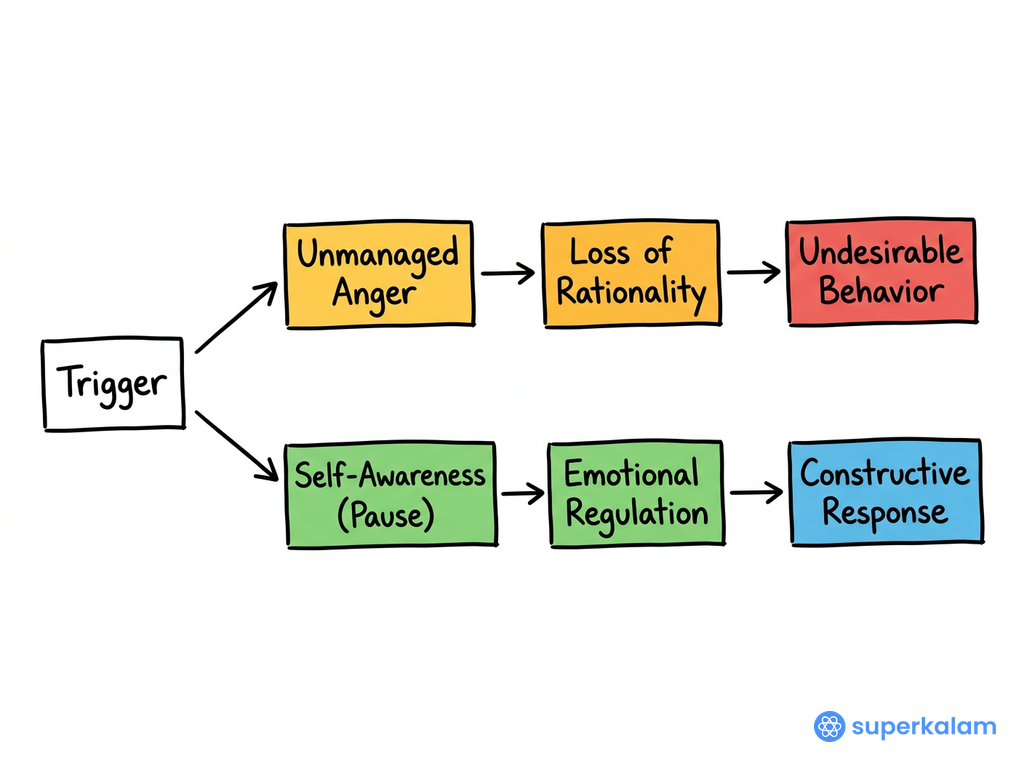
Trigger comparison flowchart beginning with trigger
Anger Leading to Negative Emotions and Undesirable Behaviors
• Cognitive Impairment: Anger triggers amygdala hijack, reducing rational thinking capacity and leading to impulsive decisions (e.g., road rage incidents resulting in violence and legal consequences).
• Interpersonal Relationship Damage: Uncontrolled anger destroys trust and communication, creating hostile environments (e.g., workplace conflicts affecting team productivity and organizational culture).
• Physical Health Deterioration: Chronic anger increases cortisol levels, leading to hypertension, cardiovascular diseases, and weakened immune systems, as documented by WHO studies.
• Professional Misconduct: Anger-driven decisions violate service conduct rules, compromising public service delivery (e.g., cases of police brutality damaging police-community relations).
• Escalation of Conflicts: Anger perpetuates cycles of retaliation and violence, undermining social harmony and conflict resolution mechanisms in communities.
• Ethical Compromise: Anger clouds moral judgment, leading to violations of dharmic principles and professional ethics codes in civil services.
Management and Control of Anger
• Mindfulness Practices: Vipassana meditation and pranayama techniques help develop emotional awareness and self-regulation, as practiced by leaders like A.P.J. Abdul Kalam.
• Cognitive Restructuring: Rational Emotive Behavior Therapy (REBT) helps reframe negative thought patterns and develop emotional intelligence for better decision-making.
• Institutional Support Systems: Employee Assistance Programs (EAPs) in government organizations provide counseling and stress management resources for civil servants.
• Physical Exercise: Regular yoga and sports activities release endorphins, reducing stress hormones and promoting emotional stability among public servants.
• Communication Skills Training: Active listening and assertiveness training help express concerns constructively without aggressive outbursts, improving stakeholder engagement.
• Value-Based Leadership: Embracing Gandhian principles of ahimsa and satyagraha helps channel anger into constructive social change and transformational leadership.
Effective anger management requires integrating ancient wisdom with modern psychological techniques, enabling civil servants to maintain emotional equilibrium while serving the public with compassion and integrity.
Answer Length
Model answers may exceed the word limit for better clarity and depth. Use them as a guide, but always frame your final answer within the exam’s prescribed limit.
Evaluate this PYQ now
Write your answer & evaluate in just 60 seconds




500+ students evaluated
Model Answers from
- 2016Ethics: Theory10 MarksView Answer
“Max Webar said that it is not wise to apply to public administration the sort of moral and ethical norms we apply to matters of personal conscience. It is important to realize that the state bureaucracy might possess its own independent bureaucratic morality.” Critically analyse this statement.
- 2016Ethics: Theory10 MarksView Answer
Our attitudes towards life, work, other people and society are generally shaped unconsciously by the family and the social surroundings in which we grow up. Some of these unconsciously acquired attitudes and values are often undesirable in the citizens of a modern democratic and egalitarian society. (a) Discuss such undesirable values prevalent in Today’s educated Indians (b) How can such undesirable attitudes be changed and socioethical values considered necessary in public services be cultivated in the aspiring and serving civil servants?
- 2016Ethics: Theory10 MarksView Answer
Law and ethics are considered to be the two tools for controlling human conduct so as to make it conducive to civilized social existence. (a) Discuss how they achieve this objective. (b) Giving examples, show how the two differ in their approaches.
- 2016Ethics: Theory10 MarksView Answer
How could social influence and persuasion contribute to the success of Swachh Bharat Abhiyan? .
- 2016Ethics: Theory10 MarksView Answer
“Corruption causes misuse of government treasury, administrative inefficiency and obstruction in the path of national development.” Discuss Kautilya’s views.
- 2016Ethics: Theory10 MarksView Answer
Discuss the Public Services Code as recommended by the 2nd Administrative Reforms Commission.
Model Answers by Subject


Crack UPSC with your
Personal AI Mentor
An AI-powered ecosystem to learn, practice, and evaluate with discipline