What does ethics seek to promote in human life? Why is it all the more important in Public Administration?
What does ethics seek to promote in human life? Why is it all the more important in Public Administration?
Ethics, as defined by Aristotle, seeks to promote eudaimonia (human flourishing) through virtuous conduct and moral reasoning. It establishes frameworks for distinguishing right from wrong, fostering dignity, justice, and well-being in human interactions.
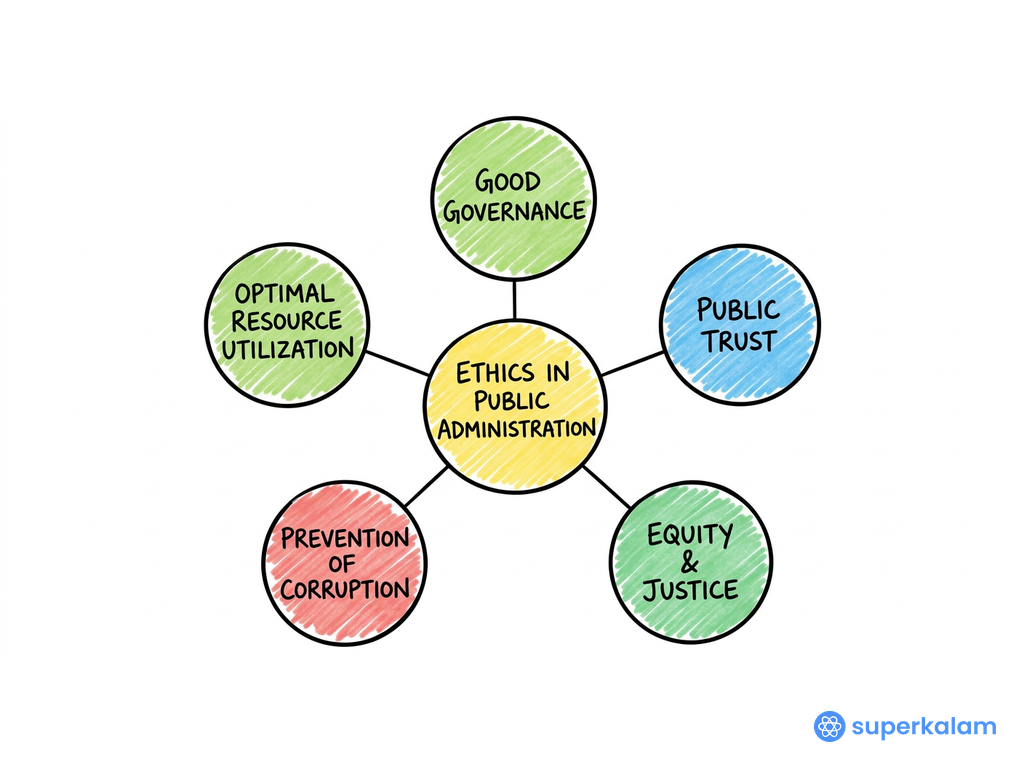
Ethics in Public Administration Radial Diagram
What Ethics Seeks to Promote in Human Life
• Moral Character Development: Ethics cultivates virtues like honesty, compassion, and integrity, enabling individuals to make principled decisions aligned with Kant's categorical imperative.
• Social Harmony and Justice: Promotes Rawls' principles of justice ensuring fair distribution of resources and opportunities, exemplified by Gandhi's satyagraha movement for social equality.
• Human Dignity and Rights: Upholds inherent worth of individuals through Kantian respect for persons, protecting fundamental freedoms and preventing exploitation.
• Rational Decision-Making: Encourages Mill's utilitarian calculus and Aristotelian practical wisdom for choices that maximize collective welfare while respecting individual autonomy.
• Accountability and Responsibility: Establishes moral obligations toward society, environment, and future generations, as emphasized by Hans Jonas' ethics of responsibility.
• Conflict Resolution: Provides frameworks for resolving moral dilemmas through prima facie duties and ethical reasoning, promoting peaceful coexistence.
Importance of Ethics in Public Administration
• Public Trust and Legitimacy: Ethical governance ensures citizen confidence in institutions, as demonstrated by E. Sreedharan's transparent project management in Delhi Metro construction.
• Equitable Service Delivery: Prevents discrimination and ensures constitutional values of equality, exemplified by Aruna Roy's advocacy for Right to Information Act.
• Resource Optimization: Ethical allocation prevents corruption and wastage, maximizing public welfare through schemes like PM-KISAN and Ayushman Bharat.
• Democratic Accountability: Upholds Weber's bureaucratic ideals of impartiality and merit-based governance, strengthening democratic institutions and rule of law.
• Long-term Sustainability: Promotes intergenerational equity in policy-making, balancing immediate needs with future consequences in environmental and developmental decisions.
• Crisis Management: Ethical leadership during emergencies ensures transparent communication and equitable relief distribution, as seen in COVID-19 pandemic response.
Ethics in public administration transforms governance from mere rule-following to value-based service, ensuring that administrative power serves humanity's highest aspirations while maintaining constitutional morality and democratic principles.
Answer Length
Model answers may exceed the word limit for better clarity and depth. Use them as a guide, but always frame your final answer within the exam’s prescribed limit.
Evaluate this PYQ now
Write your answer & evaluate in just 60 seconds




500+ students evaluated
Model Answers from
- 2014Ethics: Theory10 MarksView Answer
We are witnessing increasing instances of sexual violence against women in the country. Despite existing legal provisions against it, the number of such incidences is on the rise. Suggest some innovative measures to tackle this menace.
- 2014Ethics: Theory10 MarksView Answer
What does ‘accountability’ mean in the context of public service ? What measures can be adopted to ensure individual and collective accountability of public servants?
- 2014Ethics: Theory10 MarksView Answer
What factors affect the formation of a person’s attitude towards social problems? In our society, contrasting attitudes are prevalent about many social problems. What contrasting attitudes do you notice about the caste system in our society? How do you explain the existence of these contrasting attitudes?
- 2014Ethics: Theory10 MarksView Answer
It is often said that poverty leads to corruption. However there is no dearth of instances where affluent and powerful people indulge in corruption in a big way. What are the basic causes of corruption among people? Support your answer with examples.
- 2014Ethics: Theory10 MarksView Answer
The current society is plagued with widespread trust-deficit. What are the consequences of this situation for personal well-being and for societal well-being? What can you do at the personal level to make yourself trustworthy?
- 2014Ethics: Theory10 MarksView Answer
There is a heavy ethical responsibility on the public servants because they occupy positions of power, handle huge amounts of public funds, and their decisions have wide ranging impact on society and environment. What steps have you taken to improve your ethical competence to handle such responsibility?
Model Answers by Subject


Crack UPSC with your
Personal AI Mentor
An AI-powered ecosystem to learn, practice, and evaluate with discipline



