“Integrity without knowledge is weak and useless, but knowledge without integrity is dangerous and dreadful.” What do you understand by this statement? Explain your stand with illustrations from modern day context.
“Integrity without knowledge is weak and useless, but knowledge without integrity is dangerous and dreadful.” What do you understand by this statement? Explain your stand with illustrations from modern day context.
This statement by Samuel Johnson emphasizes the symbiotic relationship between integrity and knowledge, highlighting that both are essential for ethical leadership and effective governance in civil services.
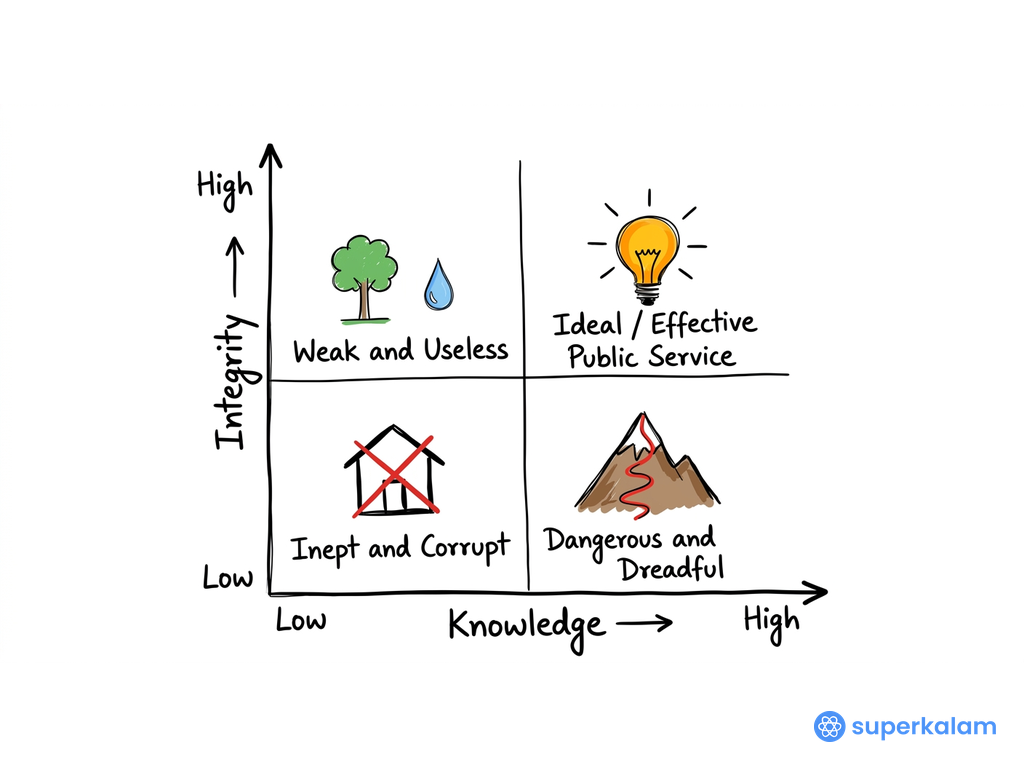
2x2 Matrix Diagram of Knowledge Axes
Understanding the Statement
• Integrity without Knowledge: Refers to well-intentioned individuals lacking competence to make informed decisions, potentially causing harm despite good intentions.
• Knowledge without Integrity: Represents the dangerous combination of expertise with moral corruption, enabling sophisticated manipulation and systemic damage.
• Symbiotic Relationship: Aristotle's concept of phronesis (practical wisdom) demonstrates that ethical virtue must combine with intellectual capability for effective governance.
• Civil Service Context: Modern administrators require both technical competence and moral character to serve public interest effectively.
• Kantian Perspective: Categorical imperative demands that actions be both morally sound and practically viable for universal application.
• Gandhian Philosophy: Satyagraha exemplifies the integration of moral conviction with strategic knowledge for social transformation.
Modern Day Illustrations
• Corporate Scandals: Enron executives possessed sophisticated financial knowledge but lacked integrity, leading to massive fraud affecting thousands of stakeholders.
• Whistleblowing Cases: Edward Snowden demonstrated integrity in exposing surveillance programs, though debates continue about the knowledge-based approach to disclosure.
• Administrative Excellence: E. Sreedharan's leadership in Delhi Metro project combined technical expertise with unwavering integrity, delivering world-class infrastructure.
• Healthcare Crisis: During COVID-19 pandemic, administrators with integrity but insufficient epidemiological knowledge sometimes implemented ineffective policies despite good intentions.
• Digital Governance: Aadhaar implementation required balancing technological knowledge with ethical considerations regarding privacy and inclusion.
• Environmental Governance: Sunderlal Bahuguna's Chipko movement combined ecological knowledge with moral commitment for sustainable development.
Effective civil servants must cultivate both intellectual competence through continuous learning and moral character through dharmic principles, ensuring that public service delivery remains both efficient and ethically grounded for societal welfare.
Answer Length
Model answers may exceed the word limit for better clarity and depth. Use them as a guide, but always frame your final answer within the exam’s prescribed limit.
Evaluate this PYQ now
Write your answer & evaluate in just 60 seconds




500+ students evaluated
Model Answers from
- 2014Ethics: Theory10 MarksView Answer
We are witnessing increasing instances of sexual violence against women in the country. Despite existing legal provisions against it, the number of such incidences is on the rise. Suggest some innovative measures to tackle this menace.
- 2014Ethics: Theory10 MarksView Answer
What does ‘accountability’ mean in the context of public service ? What measures can be adopted to ensure individual and collective accountability of public servants?
- 2014Ethics: Theory10 MarksView Answer
What factors affect the formation of a person’s attitude towards social problems? In our society, contrasting attitudes are prevalent about many social problems. What contrasting attitudes do you notice about the caste system in our society? How do you explain the existence of these contrasting attitudes?
- 2014Ethics: Theory10 MarksView Answer
It is often said that poverty leads to corruption. However there is no dearth of instances where affluent and powerful people indulge in corruption in a big way. What are the basic causes of corruption among people? Support your answer with examples.
- 2014Ethics: Theory10 MarksView Answer
The current society is plagued with widespread trust-deficit. What are the consequences of this situation for personal well-being and for societal well-being? What can you do at the personal level to make yourself trustworthy?
- 2014Ethics: Theory10 MarksView Answer
There is a heavy ethical responsibility on the public servants because they occupy positions of power, handle huge amounts of public funds, and their decisions have wide ranging impact on society and environment. What steps have you taken to improve your ethical competence to handle such responsibility?
Model Answers by Subject


Crack UPSC with your
Personal AI Mentor
An AI-powered ecosystem to learn, practice, and evaluate with discipline



