What do you understand by the following terms in the context of public service?
1. Integrity
2. Perseverance
3. Spirit of service
4. Commitment
5. Courage of conviction
What do you understand by the following terms in the context of public service?
1. Integrity
2. Perseverance
3. Spirit of service
4. Commitment
5. Courage of conviction
Integrity, perseverance, spirit of service, commitment, and courage of conviction form the ethical foundation of public administration, embodying Aristotelian virtues essential for effective governance.
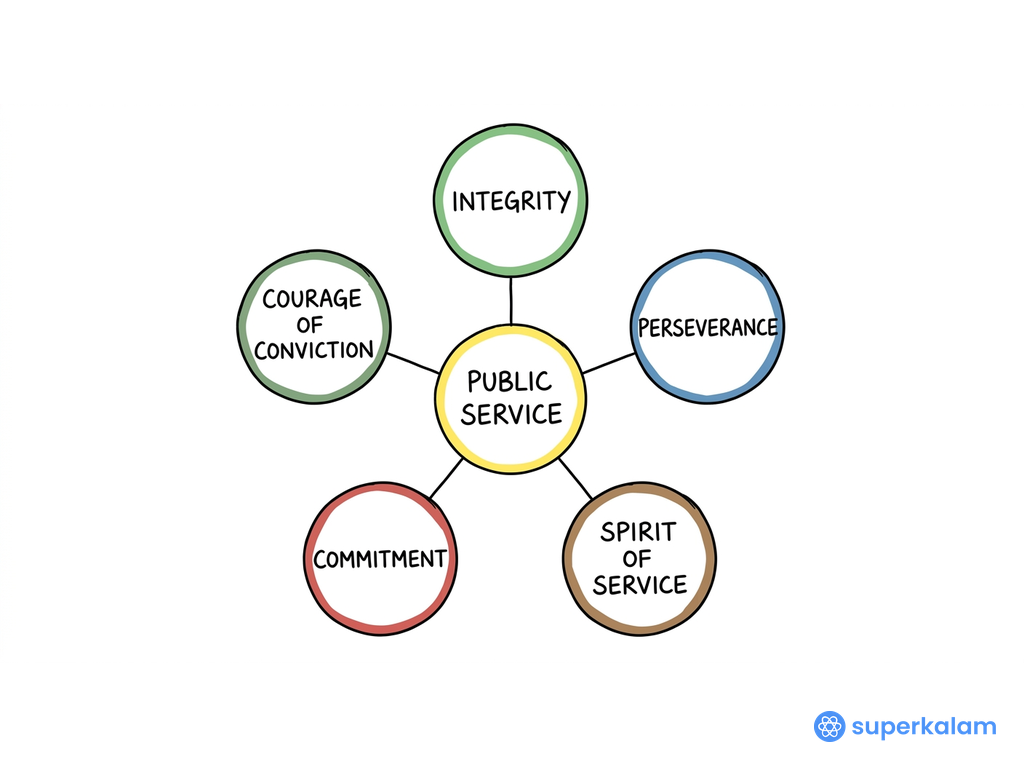
Public Service radial hub and spoke diagram
Integrity in Public Service
• Moral Consistency: Alignment between personal values and professional conduct, exemplified by T.N. Seshan's electoral reforms despite political pressure.
• Financial Probity: Transparent handling of public resources, as demonstrated through RTI Act 2005 promoting accountability in government transactions.
• Honest Decision-Making: Prioritizing public interest over personal gains, reflecting Kantian categorical imperative in administrative choices.
• Ethical Leadership: Setting moral standards for subordinates, following Chanakya's Arthashastra principles of righteous governance.
• Zero Tolerance for Corruption: Implementing Lokpal and Lokayuktas Act 2013 to maintain institutional credibility.
• Professional Ethics: Adhering to All India Services Conduct Rules ensuring impartial service delivery.
Perseverance in Public Service
• Long-term Vision: Sustained efforts toward policy implementation, like E. Sreedharan's dedication to infrastructure projects spanning decades.
• Resilience Against Obstacles: Overcoming bureaucratic hurdles, exemplified in Polio Eradication Campaign's persistent vaccination drives.
• Consistent Performance: Maintaining service quality despite resource constraints, reflecting Bhagavad Gita's concept of nishkama karma.
• Policy Continuity: Ensuring program sustainability across political transitions, as seen in MGNREGA's consistent implementation.
• Crisis Management: Sustained response during emergencies, demonstrated during COVID-19 pandemic healthcare management.
• Capacity Building: Continuous skill development through Mission Karmayogi for enhanced service delivery.
Spirit of Service
• Public Welfare Orientation: Prioritizing citizen needs over bureaucratic convenience, embodying Gandhian sarvodaya philosophy.
• Empathetic Governance: Understanding citizen grievances through Grievance Redressal Mechanisms and Jan Aushadhi schemes.
• Inclusive Administration: Ensuring equitable service delivery, particularly for marginalized communities through Digital India initiatives.
• Community Engagement: Active participation in local development, following Panchayati Raj decentralization principles.
• Humanitarian Approach: Compassionate response to public needs, exemplified by Aruna Roy's advocacy for transparency.
• Social Responsibility: Contributing beyond official duties, reflecting Vivekananda's service ideals.
Commitment in Public Service
• Dedication to Duty: Unwavering focus on responsibilities, demonstrated through Ashok Khemka's anti-corruption stance despite transfers.
• Goal Achievement: Persistent pursuit of developmental objectives, seen in Swachh Bharat Mission's sanitation targets.
• Professional Excellence: Continuous improvement in service standards through Performance Management Systems.
• Institutional Loyalty: Upholding organizational values while maintaining ethical independence.
• Time Management: Efficient resource utilization for maximum public benefit, following scientific management principles.
• Result Orientation: Focus on measurable outcomes in policy implementation and citizen satisfaction.
Courage of Conviction
• Moral Courage: Standing firm on ethical principles despite pressure, exemplified by Satyendra Dubey's whistleblowing in infrastructure projects.
• Decision-Making Under Pressure: Taking difficult but necessary decisions, reflecting Rawlsian justice principles.
• Speaking Truth to Power: Honest communication with superiors about ground realities and policy limitations.
• Protecting Whistleblowers: Supporting Whistleblowers Protection Act 2014 for institutional transparency.
• Reform Advocacy: Championing necessary changes despite resistance, following Ambedkar's constitutional vision.
• Risk-Taking for Public Good: Making bold decisions for long-term benefits, demonstrated in demonetization policy implementation.
These virtues collectively ensure responsive governance and citizen-centric administration, forming the cornerstone of effective public service delivery in democratic societies.
Answer Length
Model answers may exceed the word limit for better clarity and depth. Use them as a guide, but always frame your final answer within the exam’s prescribed limit.
Evaluate this PYQ now
Write your answer & evaluate in just 60 seconds




500+ students evaluated
Model Answers from
- 2013Ethics: Theory10 MarksView Answer
It is often said that ‘politics’ and ‘ethics’ do not go together. What is your opinion in this regard? Justify your answer with illustrations.
- 2013Ethics: Theory10 MarksView Answer
The good of an individual is contained in the good of all.” What do you understand by this statement? How can this principle be implemented in public life?
- 2013Ethics: Theory10 MarksView Answer
What does this quotation mean to you in present context
"I count him braver who overcomes his desires than him who overcomes his enemies.”—Aristotle. - 2013Ethics: Theory10 MarksView Answer
What does this quotation mean to you in present context
"Nearly all men can withstand adversity, but if you want to test a man’s character, give him power.”—Abraham Lincoln. - 2013Ethics: Theory10 MarksView Answer
What does this quotation mean to you in present context
There is enough on this earth for everyone’s need but for no one’s greed.- Mahatma Gandhi - 2013Ethics: Theory10 MarksView Answer
What is meant by ‘crisis of conscience’? Narrate one incident in your life when you were faced with such a crisis and how you resolved the same.
Model Answers by Subject


Crack UPSC with your
Personal AI Mentor
An AI-powered ecosystem to learn, practice, and evaluate with discipline



