Indicate two more attributes that you consider important for public service. Justify your answer.
Indicate two more attributes that you consider important for public service. Justify your answer.
Empathy and Adaptability represent crucial attributes for effective public service, complementing traditional virtues like integrity and accountability in contemporary governance challenges.
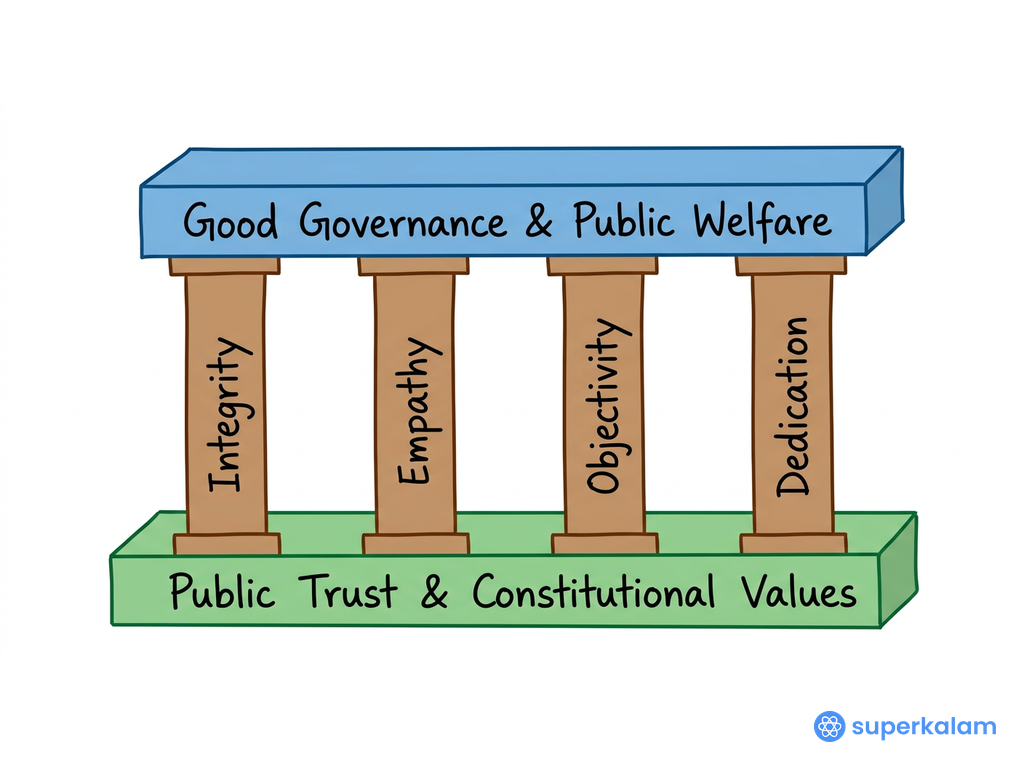
Building structural diagram foundation pillars roof
Empathy as a Core Public Service Attribute
• Understanding Citizen Perspectives: Empathy enables civil servants to comprehend diverse socio-economic backgrounds and genuine needs of citizens, moving beyond bureaucratic procedures to human-centered governance.
• Inclusive Policy Formulation: Kantian ethics emphasizes treating people as ends, not means - empathetic administrators design policies considering marginalized communities like tribal populations in PESA areas or urban homeless.
• Effective Grievance Redressal: Empathetic approach transforms Public Grievance Redressal Mechanisms from mechanical processes to meaningful citizen engagement, as demonstrated by District Collectors during COVID-19 relief distribution.
• Building Trust and Legitimacy: Mahatma Gandhi's Satyagraha emphasized understanding opponents' perspectives - similarly, empathetic civil servants build public trust through compassionate service delivery.
• Case Study - Aruna Roy: Her empathetic understanding of rural Rajasthan's information needs led to the transformative Right to Information Act, demonstrating how empathy drives systemic reforms.
Adaptability as Essential Administrative Quality
• Dynamic Governance Requirements: Heraclitus's principle of constant change applies to public administration - civil servants must adapt to evolving technological disruptions, climate challenges, and demographic transitions.
• Innovation in Service Delivery: Adaptable administrators embrace Digital India initiatives, transforming traditional processes through e-governance platforms like DigiLocker and Aadhaar-based service delivery.
• Crisis Management Capabilities: COVID-19 pandemic demonstrated adaptability's importance - successful administrators quickly pivoted to telemedicine, online education, and contactless service delivery mechanisms.
• Learning Organization Principles: Peter Senge's learning organization concept requires continuous adaptation - civil servants must update skills through Mission Karmayogi and embrace evidence-based policymaking.
• Cultural Sensitivity: Adaptable administrators modify approaches based on local contexts, respecting Article 371 provisions and implementing culturally appropriate development programs in diverse regions.
Empathy and adaptability together create responsive, human-centered governance that addresses 21st-century challenges while maintaining ethical foundations essential for democratic public service.
Answer Length
Model answers may exceed the word limit for better clarity and depth. Use them as a guide, but always frame your final answer within the exam’s prescribed limit.
Evaluate this PYQ now
Write your answer & evaluate in just 60 seconds




500+ students evaluated
Model Answers from
- 2013Ethics: Theory10 MarksView Answer
It is often said that ‘politics’ and ‘ethics’ do not go together. What is your opinion in this regard? Justify your answer with illustrations.
- 2013Ethics: Theory10 MarksView Answer
The good of an individual is contained in the good of all.” What do you understand by this statement? How can this principle be implemented in public life?
- 2013Ethics: Theory10 MarksView Answer
What does this quotation mean to you in present context
"I count him braver who overcomes his desires than him who overcomes his enemies.”—Aristotle. - 2013Ethics: Theory10 MarksView Answer
What does this quotation mean to you in present context
"Nearly all men can withstand adversity, but if you want to test a man’s character, give him power.”—Abraham Lincoln. - 2013Ethics: Theory10 MarksView Answer
What does this quotation mean to you in present context
There is enough on this earth for everyone’s need but for no one’s greed.- Mahatma Gandhi - 2013Ethics: Theory10 MarksView Answer
What is meant by ‘crisis of conscience’? Narrate one incident in your life when you were faced with such a crisis and how you resolved the same.
Model Answers by Subject


Crack UPSC with your
Personal AI Mentor
An AI-powered ecosystem to learn, practice, and evaluate with discipline



